

194
Use of Radioisotopic Methodology in Aquatic Microbial Ecology
4.4.2.3 Estimating Chemosynthetic and the Overall Bacterial Production in
the Redox Zones Within the Water Column
The chemosynthetic production of particulate organic matter by bacteria is a
widespread phenomenon in aquatic environments in areas of either deep and
shallow hydrothcrms, which exhale the reduced inorganic compounds, and also
in any ordinary water basin, where the same reduced substances like Hz, CH4,
HzS, So, and Fe 2 + are produced during the anaerobic decomposition of organic
matter in the microaerophylic or anaerobic zones (or in the microzones). This
process proceeds also within the bodies of symbiotic animals which harbor
chemosynthetic bacteria. The microbial biomass produced via chemoautotrophic CO2 uptake is an important food source for fauna, which inhabits
dark water layers and the bottom sediments far from the sites of photosynthesis. The aggregations of benthic fauna around the deep oceanic vents is a
spectacular demonstration of the involvement of chemosynthesis in aquatic
animal life. The chemosynthetic production processes are localized mainly
within the redox layers of the water bodies, situated at boundaries between
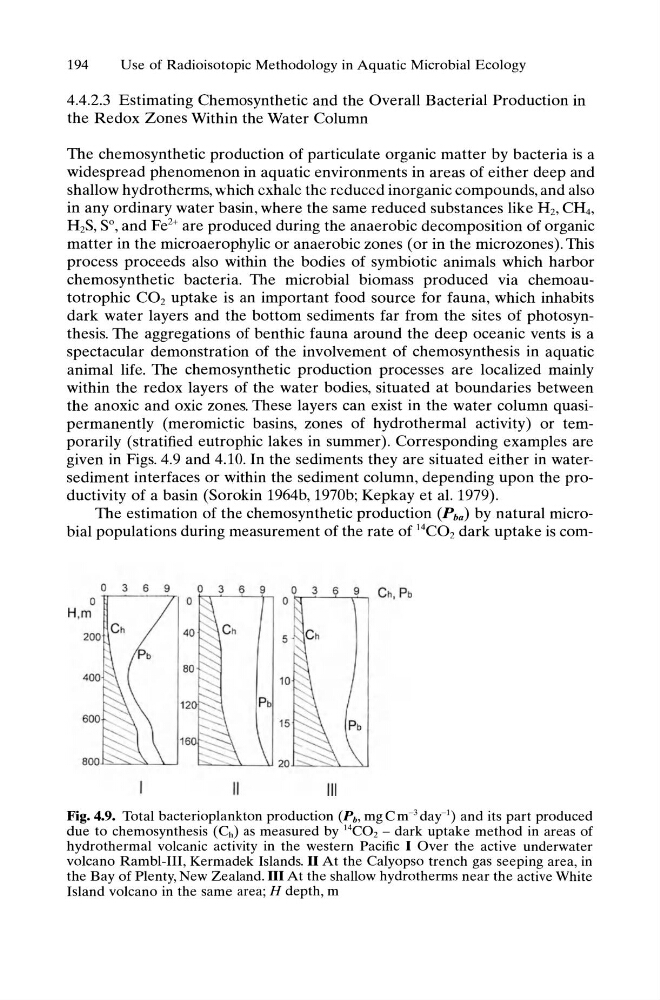
the anoxic and oxic zones. These layers can exist in the water column quasipermanently (meromictic basins, zones of hydrothermal activity) or temporarily (stratified eutrophic lakes in summer). Corresponding examples are
given in Figs. 4.9 and 4.10. In the sediments they are situated either in watersediment interfaces or within the sediment column, depending upon the productivity of a basin (Sorokin 1964b, 1970b; Kepkay et a1. 1979).
The estimation of the chemosynthetic production (Pba) by natural microbial populations during measurement of the rate of 14C02 dark uptake is como
H,m
o 3
"
3 6
9
C h, Pb
III
Fig. 4.9. Total bacterioplankton production (Pb, mg C m- 3 day-I) and its part produced
due to chemosynthesis (Ch) as measured by 14C02 - dark uptake method in areas of
hydrothermal volcanic activity in the western Pacific lOver the active underwater
volcano Rambl-III, Kermadek Islands. II At the Calyopso trench gas seeping area, in
the Bay of Plenty, New Zealand. III At the shallow hydrotherms near the active White
Island volcano in the same area; H depth, m
Use of Radioisotopic Methodology in Aquatic Microbial Ecology
4.4.2.3 Estimating Chemosynthetic and the Overall Bacterial Production in
the Redox Zones Within the Water Column
The chemosynthetic production of particulate organic matter by bacteria is a
widespread phenomenon in aquatic environments in areas of either deep and
shallow hydrothcrms, which exhale the reduced inorganic compounds, and also
in any ordinary water basin, where the same reduced substances like Hz, CH4,
HzS, So, and Fe 2 + are produced during the anaerobic decomposition of organic
matter in the microaerophylic or anaerobic zones (or in the microzones). This
process proceeds also within the bodies of symbiotic animals which harbor
chemosynthetic bacteria. The microbial biomass produced via chemoautotrophic CO2 uptake is an important food source for fauna, which inhabits
dark water layers and the bottom sediments far from the sites of photosynthesis. The aggregations of benthic fauna around the deep oceanic vents is a
spectacular demonstration of the involvement of chemosynthesis in aquatic
animal life. The chemosynthetic production processes are localized mainly
within the redox layers of the water bodies, situated at boundaries between
the anoxic and oxic zones. These layers can exist in the water column quasipermanently (meromictic basins, zones of hydrothermal activity) or temporarily (stratified eutrophic lakes in summer). Corresponding examples are
given in Figs. 4.9 and 4.10. In the sediments they are situated either in watersediment interfaces or within the sediment column, depending upon the productivity of a basin (Sorokin 1964b, 1970b; Kepkay et a1. 1979).
The estimation of the chemosynthetic production (Pba) by natural microbial populations during measurement of the rate of 14C02 dark uptake is como
H,m
o 3
"
3 6
9
C h, Pb
III
Fig. 4.9. Total bacterioplankton production (Pb, mg C m- 3 day-I) and its part produced
due to chemosynthesis (Ch) as measured by 14C02 - dark uptake method in areas of
hydrothermal volcanic activity in the western Pacific lOver the active underwater
volcano Rambl-III, Kermadek Islands. II At the Calyopso trench gas seeping area, in
the Bay of Plenty, New Zealand. III At the shallow hydrotherms near the active White
Island volcano in the same area; H depth, m