

Determination of Microbial Production
193
perature close to that in situ like the water samples during Ae estimation.
The time of incubation should be selected within the ranges given above for
water samples. The incubation is halted by adding formalin to 2 % of its final
concentration. The fixed samples are transferred into 50-ml flasks with an
additional 15 ml of 0.01 N KOH solution, so that the whole volume of silt suspension in them becomes 30ml. These flasks are then shaken for 1-2h or
treated in the ultrasonic disintegrator to separate bacteria from particles.
When this is finished, each sample is mixed again and let stand for 1-2 min for
sedimentation of larger mineral particles. Two subsamples of 2 ml each are
then taken and transferred into a filtration funnel with 0.2-mm pore size
membrane filter to which 1 ml of 0.1 N HCI has been added. The filters are
rinsed in the funnel twice with 1 ml of the same HCl. The wet filters are placed
into scintillation vials to count radioactivity. First, 0.2 ml 0.2 N HCI is added
into the vials and they are dried at 50°C. This operation is necessary to eliminate the remaining 14C-carbonate. Then the filters are dissolved in 1 ml of
ethylene glycol and radioassayed with 10 ml of toluene cocktail. The radioactivity values thus measured on the filters from the intact sample (R;) and
from the sample incubated with the Na-azide added (Ra) are corrected for
control by subtracting the radioactivity found in the filter from the killed
sample. The values of dark CO2 uptake by sediment bacteria are calculated
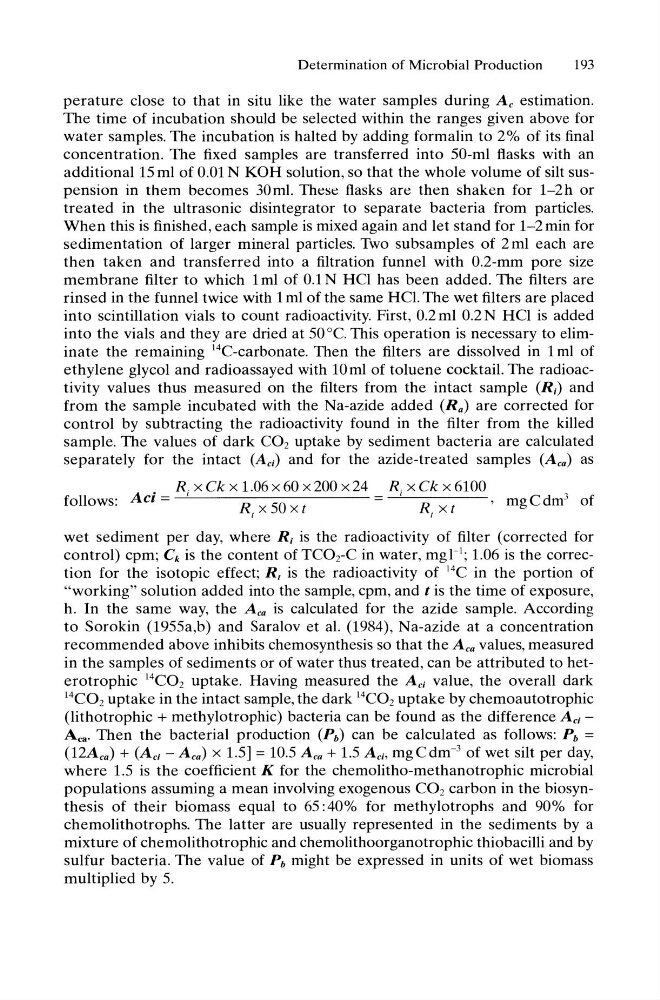
separately for the intact (Ae;) and for the azide-treated samples (Aea) as
R x Ck x 1.06 x 60 x 200 x 24
follows: Aci = ----'-,----------R, x 50 x t
R xCk x6100
,
, mgCdm 3 of
R, xt
wet sediment per day, where R; is the radioactivity of filter (corrected for
control) cpm; Ck is the content of TCOz-C in water, mgl- 1 ; 1.06 is the correction for the isotopic effect; R, is the radioactivity of 14C in the portion of
"working" solution added into the sample, cpm, and t is the time of exposure,
h. In the same way, the Aea is calculated for the azide sample. According
to Sorokin (1955a,b) and Saralov et al. (1984), Na-azide at a concentration
recommended above inhibits chemosynthesis so that the Aea values, measured
in the samples of sediments or of water thus treated, can be attributed to heterotrophic 14C02 uptake. Having measured the Ad value, the overall dark
14C02 uptake in the intact sample, the dark 14C02 uptake by chemoautotrophic
(lithotrophic + methylotrophic) bacteria can be found as the difference Aci -
Aca. Then the bacterial production (Ph) can be calculated as follows: Ph =
(12Aea) + (Aci - Aea) x 1.5] = 10.5 Aea + 1.5 A ci, mg C dm- 3 of wet silt per day,
where 1.5 is the coefficient K for the chemolitho-methanotrophic microbial
populations assuming a mean involving exogenous CO2 carbon in the biosynthesis of their biomass equal to 65: 40% for methylotrophs and 90% for
chemolithotrophs. The latter are usually represented in the sediments by a
mixture of chemolithotrophic and chemolithoorganotrophic thiobacilli and by
sulfur bacteria. The value of Ph might be expressed in units of wet biomass
multiplied by 5.
193
perature close to that in situ like the water samples during Ae estimation.
The time of incubation should be selected within the ranges given above for
water samples. The incubation is halted by adding formalin to 2 % of its final
concentration. The fixed samples are transferred into 50-ml flasks with an
additional 15 ml of 0.01 N KOH solution, so that the whole volume of silt suspension in them becomes 30ml. These flasks are then shaken for 1-2h or
treated in the ultrasonic disintegrator to separate bacteria from particles.
When this is finished, each sample is mixed again and let stand for 1-2 min for
sedimentation of larger mineral particles. Two subsamples of 2 ml each are
then taken and transferred into a filtration funnel with 0.2-mm pore size
membrane filter to which 1 ml of 0.1 N HCI has been added. The filters are
rinsed in the funnel twice with 1 ml of the same HCl. The wet filters are placed
into scintillation vials to count radioactivity. First, 0.2 ml 0.2 N HCI is added
into the vials and they are dried at 50°C. This operation is necessary to eliminate the remaining 14C-carbonate. Then the filters are dissolved in 1 ml of
ethylene glycol and radioassayed with 10 ml of toluene cocktail. The radioactivity values thus measured on the filters from the intact sample (R;) and
from the sample incubated with the Na-azide added (Ra) are corrected for
control by subtracting the radioactivity found in the filter from the killed
sample. The values of dark CO2 uptake by sediment bacteria are calculated
separately for the intact (Ae;) and for the azide-treated samples (Aea) as
R x Ck x 1.06 x 60 x 200 x 24
follows: Aci = ----'-,----------R, x 50 x t
R xCk x6100
,
, mgCdm 3 of
R, xt
wet sediment per day, where R; is the radioactivity of filter (corrected for
control) cpm; Ck is the content of TCOz-C in water, mgl- 1 ; 1.06 is the correction for the isotopic effect; R, is the radioactivity of 14C in the portion of
"working" solution added into the sample, cpm, and t is the time of exposure,
h. In the same way, the Aea is calculated for the azide sample. According
to Sorokin (1955a,b) and Saralov et al. (1984), Na-azide at a concentration
recommended above inhibits chemosynthesis so that the Aea values, measured
in the samples of sediments or of water thus treated, can be attributed to heterotrophic 14C02 uptake. Having measured the Ad value, the overall dark
14C02 uptake in the intact sample, the dark 14C02 uptake by chemoautotrophic
(lithotrophic + methylotrophic) bacteria can be found as the difference Aci -
Aca. Then the bacterial production (Ph) can be calculated as follows: Ph =
(12Aea) + (Aci - Aea) x 1.5] = 10.5 Aea + 1.5 A ci, mg C dm- 3 of wet silt per day,
where 1.5 is the coefficient K for the chemolitho-methanotrophic microbial
populations assuming a mean involving exogenous CO2 carbon in the biosynthesis of their biomass equal to 65: 40% for methylotrophs and 90% for
chemolithotrophs. The latter are usually represented in the sediments by a
mixture of chemolithotrophic and chemolithoorganotrophic thiobacilli and by
sulfur bacteria. The value of Ph might be expressed in units of wet biomass
multiplied by 5.