

Determination of Microbial Production
195
o 2 4 6 8 o 10 20 30
o 8 16 24 0 4 8 12 Ch
o
3
4
5
50
15
~~ ______ ~~~ ______ ~L-_ _____ ~~ ______ ~
II
III
IV
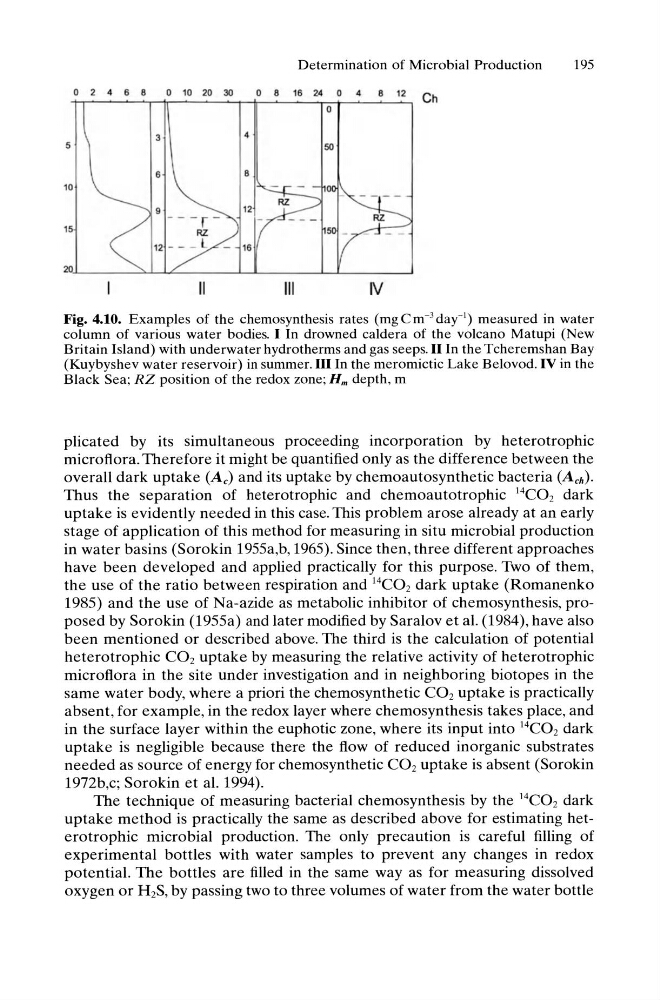
Fig. 4.10. Examples of the chemosynthesis rates (mgCm- 3 day-') measured in water
column of various water bodies. I In drowned caldera of the volcano Matupi (New
Britain Island) with underwater hydrotherms and gas seeps. II In the Tcheremshan Bay
(Kuybyshev water reservoir) in summer. III In the meromictic Lake Belovod. IV in the
Black Sea; RZ position of the redox zone; Hm depth, m
plica ted by its simultaneous proceeding incorporation by heterotrophic
microflora. Therefore it might be quantified only as the difference between the
overall dark uptake (Ac) and its uptake by chemoautosynthetic bacteria (Ach) '
Thus the separation of heterotrophic and chemoautotrophic 14C02 dark
uptake is evidently needed in this case. This problem arose already at an early
stage of application of this method for measuring in situ microbial production
in water basins (Sorokin 1955a,b, 1965). Since then, three different approaches
have been developed and applied practically for this purpose. Two of them,
the use of the ratio between respiration and 14C02 dark uptake (Romanenko
1985) and the use of Na-azide as metabolic inhibitor of chemosynthesis, proposed by Sorokin (1955a) and later modified by Saralov et al. (1984), have also
been mentioned or described above. The third is the calculation of potential
heterotrophic CO2 uptake by measuring the relative activity of heterotrophic
microflora in the site under investigation and in neighboring biotopes in the
same water body, where a priori the chemosynthetic CO2 uptake is practically
absent, for example, in the redox layer where chemosynthesis takes place, and
in the surface layer within the euphotic zone, where its input into 14C02 dark
uptake is negligible because there the flow of reduced inorganic substrates
needed as source of energy for chemosynthetic CO2 uptake is absent (Sorokin
1972b,c; Sorokin et al. 1994).
The technique of measuring bacterial chemosynthesis by the 14C02 dark
uptake method is practically the same as described above for estimating heterotrophic microbial production. The only precaution is careful filling of
experimental bottles with water samples to prevent any changes in redox
potential. The bottles are filled in the same way as for measuring dissolved
oxygen or H 2S, by passing two to three volumes of water from the water bottle
195
o 2 4 6 8 o 10 20 30
o 8 16 24 0 4 8 12 Ch
o
3
4
5
50
15
~~ ______ ~~~ ______ ~L-_ _____ ~~ ______ ~
II
III
IV
Fig. 4.10. Examples of the chemosynthesis rates (mgCm- 3 day-') measured in water
column of various water bodies. I In drowned caldera of the volcano Matupi (New
Britain Island) with underwater hydrotherms and gas seeps. II In the Tcheremshan Bay
(Kuybyshev water reservoir) in summer. III In the meromictic Lake Belovod. IV in the
Black Sea; RZ position of the redox zone; Hm depth, m
plica ted by its simultaneous proceeding incorporation by heterotrophic
microflora. Therefore it might be quantified only as the difference between the
overall dark uptake (Ac) and its uptake by chemoautosynthetic bacteria (Ach) '
Thus the separation of heterotrophic and chemoautotrophic 14C02 dark
uptake is evidently needed in this case. This problem arose already at an early
stage of application of this method for measuring in situ microbial production
in water basins (Sorokin 1955a,b, 1965). Since then, three different approaches
have been developed and applied practically for this purpose. Two of them,
the use of the ratio between respiration and 14C02 dark uptake (Romanenko
1985) and the use of Na-azide as metabolic inhibitor of chemosynthesis, proposed by Sorokin (1955a) and later modified by Saralov et al. (1984), have also
been mentioned or described above. The third is the calculation of potential
heterotrophic CO2 uptake by measuring the relative activity of heterotrophic
microflora in the site under investigation and in neighboring biotopes in the
same water body, where a priori the chemosynthetic CO2 uptake is practically
absent, for example, in the redox layer where chemosynthesis takes place, and
in the surface layer within the euphotic zone, where its input into 14C02 dark
uptake is negligible because there the flow of reduced inorganic substrates
needed as source of energy for chemosynthetic CO2 uptake is absent (Sorokin
1972b,c; Sorokin et al. 1994).
The technique of measuring bacterial chemosynthesis by the 14C02 dark
uptake method is practically the same as described above for estimating heterotrophic microbial production. The only precaution is careful filling of
experimental bottles with water samples to prevent any changes in redox
potential. The bottles are filled in the same way as for measuring dissolved
oxygen or H 2S, by passing two to three volumes of water from the water bottle