

134
Radioisotopic Methods for the Study of Nutrition in Aquatic Animals
125
R b
100
\ "
75
, \"
, ~ ' ,
' . \ \ ",
\
,
,' , "
\ \ "
5
, "., . ~ .... - ... ..... .
\ '
, '-•• - . . :4
\ , - . ---. - , -- .. - .
,
"-'.. . . ..... .
so
' ___ 3 __
--- - - -
25
\2
I _~~::":·~ ":·: · · :·=·~-=·=·=·=·~==~==~====~ __ ~ __ ~ T"h
0+
.••• •
o
0.5
1.5
2
2.5
3
3.5
4
4.5
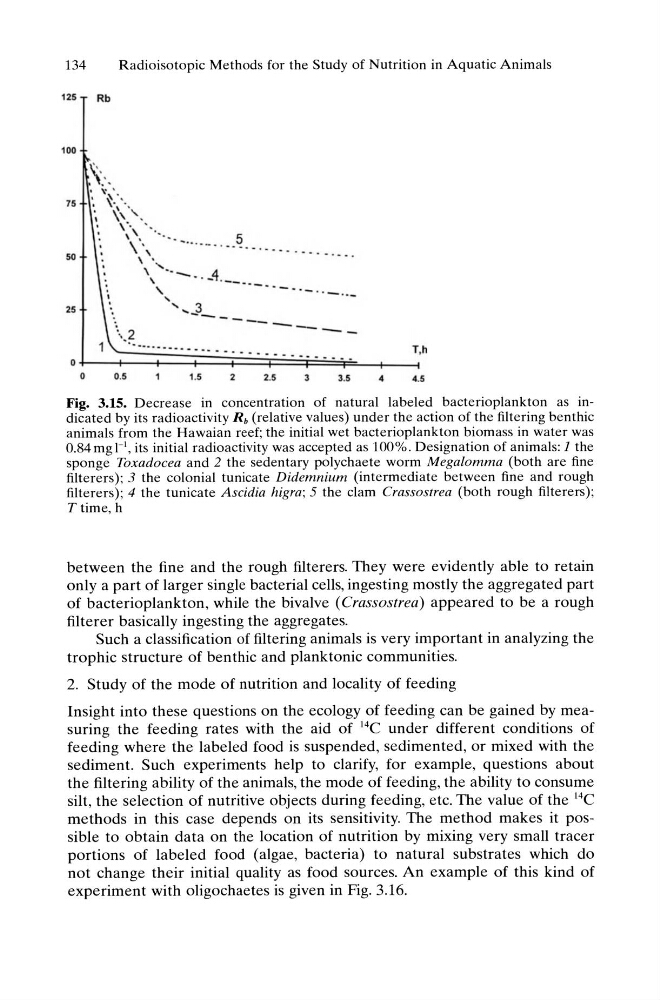
Fig. 3.15. Decrease in concentration of natural labeled bacterioplankton as indicated by its radioactivity Rb (relative values) under the action of the filtering benthic
animals from the Hawaian reef; the initial wet bacterioplankton biomass in water was
0.84mgl-t, its initial radioactivity was accepted as 100% . Designation of animals: 1 the
sponge Toxadocea and 2 the sedentary polychaete worm M egalomma (both are fine
filterers) ; 3 the colonial tunicate Didemnium (intermediate between fine and rough
filterers) ; 4 the tunicate Ascidia higra ; 5 the clam Crassostrea (both rough filterers) ;
Ttime, h
between the fine and the rough filterers. They were evidently able to retain
only a part of larger single bacterial cells, ingesting mostly the aggregated part
of bacterioplankton, while the bivalve (Crassostrea) appeared to be a rough
filterer basically ingesting the aggregates.
Such a classification of filtering animals is very important in analyzing the
trophic structure of benthic and planktonic communities.
2. Study of the mode of nutrition and locality of feeding
Insight into these questions on the ecology of feeding can be gained by measuring the feeding rates with the aid of 14C under different conditions of
feeding where the labeled food is suspended, sedimented, or mixed with the
sediment. Such experiments help to clarify, for example, questions about
the filtering ability of the animals, the mode of feeding, the ability to consume
silt, the selection of nutritive objects during feeding, etc. The value of the 14C
methods in this case depends on its sensitivity. The method makes it possible to obtain data on the location of nutrition by mixing very small tracer
portions of labeled food (algae, bacteria) to natural substrates which do
not change their initial quality as food sources. An example of this kind of
experiment with oligochaetes is given in Fig. 3.16.
Radioisotopic Methods for the Study of Nutrition in Aquatic Animals
125
R b
100
\ "
75
, \"
, ~ ' ,
' . \ \ ",
\
,
,' , "
\ \ "
5
, "., . ~ .... - ... ..... .
\ '
, '-•• - . . :4
\ , - . ---. - , -- .. - .
,
"-'.. . . ..... .
so
' ___ 3 __
--- - - -
25
\2
I _~~::":·~ ":·: · · :·=·~-=·=·=·=·~==~==~====~ __ ~ __ ~ T"h
0+
.••• •
o
0.5
1.5
2
2.5
3
3.5
4
4.5
Fig. 3.15. Decrease in concentration of natural labeled bacterioplankton as indicated by its radioactivity Rb (relative values) under the action of the filtering benthic
animals from the Hawaian reef; the initial wet bacterioplankton biomass in water was
0.84mgl-t, its initial radioactivity was accepted as 100% . Designation of animals: 1 the
sponge Toxadocea and 2 the sedentary polychaete worm M egalomma (both are fine
filterers) ; 3 the colonial tunicate Didemnium (intermediate between fine and rough
filterers) ; 4 the tunicate Ascidia higra ; 5 the clam Crassostrea (both rough filterers) ;
Ttime, h
between the fine and the rough filterers. They were evidently able to retain
only a part of larger single bacterial cells, ingesting mostly the aggregated part
of bacterioplankton, while the bivalve (Crassostrea) appeared to be a rough
filterer basically ingesting the aggregates.
Such a classification of filtering animals is very important in analyzing the
trophic structure of benthic and planktonic communities.
2. Study of the mode of nutrition and locality of feeding
Insight into these questions on the ecology of feeding can be gained by measuring the feeding rates with the aid of 14C under different conditions of
feeding where the labeled food is suspended, sedimented, or mixed with the
sediment. Such experiments help to clarify, for example, questions about
the filtering ability of the animals, the mode of feeding, the ability to consume
silt, the selection of nutritive objects during feeding, etc. The value of the 14C
methods in this case depends on its sensitivity. The method makes it possible to obtain data on the location of nutrition by mixing very small tracer
portions of labeled food (algae, bacteria) to natural substrates which do
not change their initial quality as food sources. An example of this kind of
experiment with oligochaetes is given in Fig. 3.16.