

Use of 14C for Assessment of Nutritional Problems
133
F
---c
o
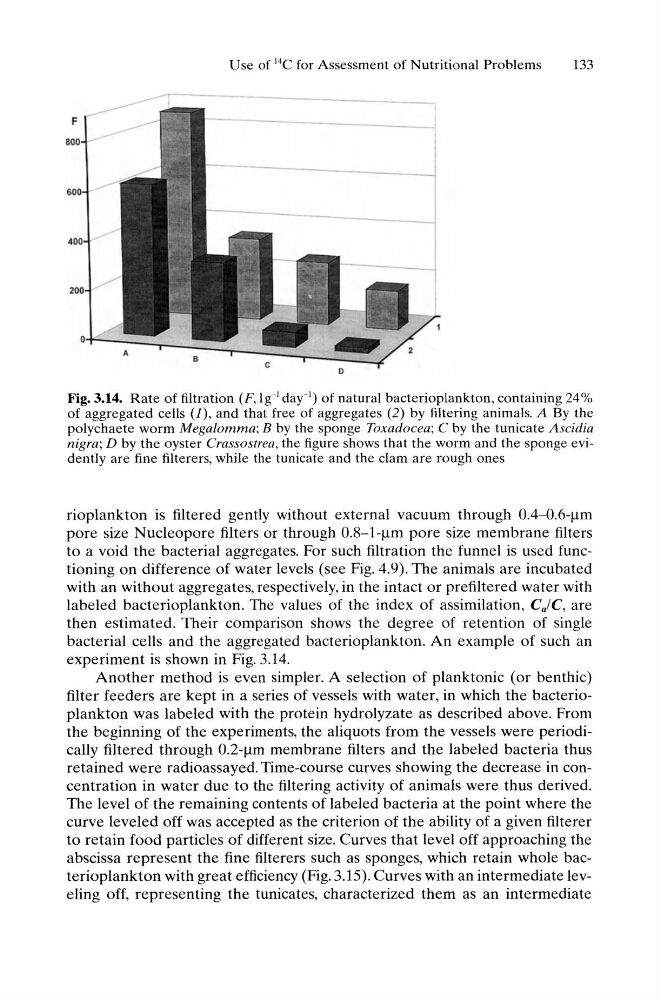
Fig.3.14. Rate of filtration (F, Ig-l day-l) of natural bacterioplankton, containing 24 %
of aggregated cells (1), and that free of aggregates (2) by filtering animals. A By the
polychaete worm Megalomma; B by the sponge Toxadocea; C by the tunicate Ascidia
nigra; D by the oyster Crassostrea, the figure shows that the worm and the sponge evidently are fine filterers, while the tunicate and the clam are rough ones
rioplankton is filtered gently without external vacuum through 0.4-0.6-~m
pore size Nucleopore filters or through O.8-1-~m pore size membrane filters
to a void the bacterial aggregates. For such filtration the funnel is used functioning on difference of water levels (see Fig. 4.9). The animals are incubated
with an without aggregates, respectively, in the intact or prefiltered water with
labeled bacterioplankton. The values of the index of assimilation, CalC, are
then estimated. Their comparison shows the degree of retention of single
bacterial cells and the aggregated bacterioplankton. An example of such an
experiment is shown in Fig. 3.14.
Another method is even simpler. A selection of planktonic (or benthic)
filter feeders are kept in a series of vessels with water, in which the bacterioplankton was labeled with the protein hydrolyzate as described above. From
the beginning of the experiments, the aliquots from the vessels were periodically filtered through O.2-~m membrane filters and the labeled bacteria thus
retained were radioassayed. Time-course curves showing the decrease in concentration in water due to the filtering activity of animals were thus derived.
The level of the remaining contents of labeled bacteria at the point where the
curve leveled off was accepted as the criterion of the ability of a given filterer
to retain food particles of different size. Curves that level off approaching the
abscissa represent the fine filterers such as sponges, which retain whole bacterioplankton with great efficiency (Fig. 3.15). Curves with an intermediate leveling off, representing the tunicates, characterized them as an intermediate
133
F
---c
o
Fig.3.14. Rate of filtration (F, Ig-l day-l) of natural bacterioplankton, containing 24 %
of aggregated cells (1), and that free of aggregates (2) by filtering animals. A By the
polychaete worm Megalomma; B by the sponge Toxadocea; C by the tunicate Ascidia
nigra; D by the oyster Crassostrea, the figure shows that the worm and the sponge evidently are fine filterers, while the tunicate and the clam are rough ones
rioplankton is filtered gently without external vacuum through 0.4-0.6-~m
pore size Nucleopore filters or through O.8-1-~m pore size membrane filters
to a void the bacterial aggregates. For such filtration the funnel is used functioning on difference of water levels (see Fig. 4.9). The animals are incubated
with an without aggregates, respectively, in the intact or prefiltered water with
labeled bacterioplankton. The values of the index of assimilation, CalC, are
then estimated. Their comparison shows the degree of retention of single
bacterial cells and the aggregated bacterioplankton. An example of such an
experiment is shown in Fig. 3.14.
Another method is even simpler. A selection of planktonic (or benthic)
filter feeders are kept in a series of vessels with water, in which the bacterioplankton was labeled with the protein hydrolyzate as described above. From
the beginning of the experiments, the aliquots from the vessels were periodically filtered through O.2-~m membrane filters and the labeled bacteria thus
retained were radioassayed. Time-course curves showing the decrease in concentration in water due to the filtering activity of animals were thus derived.
The level of the remaining contents of labeled bacteria at the point where the
curve leveled off was accepted as the criterion of the ability of a given filterer
to retain food particles of different size. Curves that level off approaching the
abscissa represent the fine filterers such as sponges, which retain whole bacterioplankton with great efficiency (Fig. 3.15). Curves with an intermediate leveling off, representing the tunicates, characterized them as an intermediate