

132
Radioisotopic Methods for the Study of Nutrition in Aquatic Animals
C.A.M
60
............ - .... . .. ,
45
.
l-A ••• C
G
,
I Kopr-900 sp r'
,
M
100
200
300
400
500
600
700
800
900
K
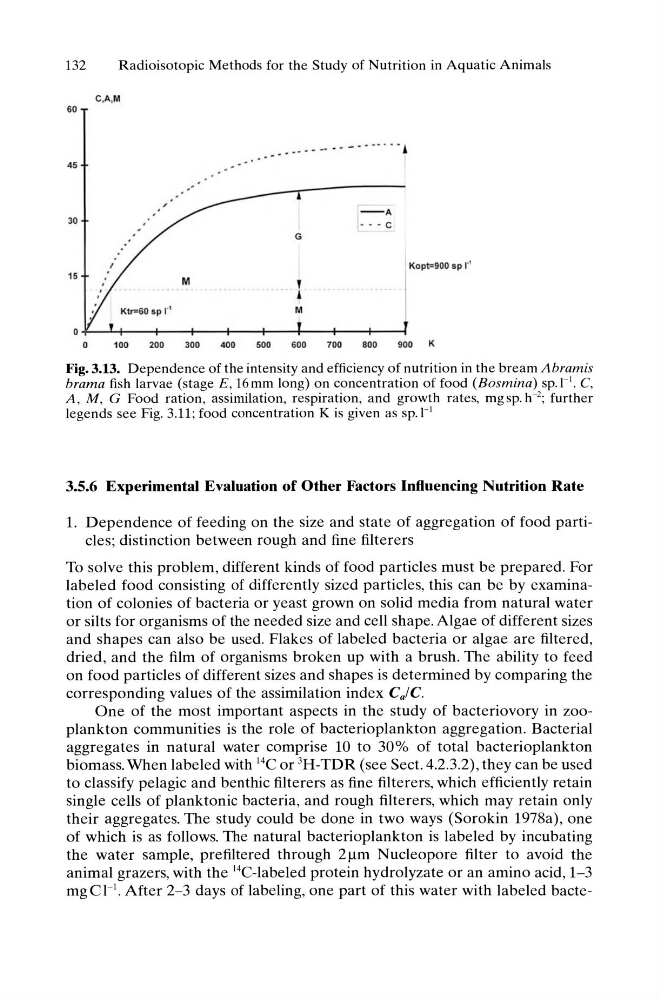
Fig.3.13. Dependence of the intensity and efficiency of nutrition in the bream Abramis
brama fish larvae (stage £, 16mm long) on concentration of food (Bosmina) sp. I- 1 . C,
A, M, G Food ration , assimilation, respiration , and growth rates, mgsp.h- 2 ; furth er
legends see Fig. 3.11 ; food concentration K is given as sp.l-I
3.5.6 Experimental Evaluation of Other Factors Influencing Nutrition Rate
1. Dependence of feeding on the size and state of aggregation of food particles; distinction between rough and fine filterers
To solve this problem, different kinds of food particles must be prepared. For
labeled food consisting of differently sized particles, this can be by examination of colonies of bacteria or yeast grown on solid media from natural water
or silts for organisms of the needed size and cell shape. Algae of different sizes
and shapes can also be used. Flakes of labeled bacteria or algae are filtered ,
dried, and the film of organisms broken up with a brush. The ability to feed
on food particles of different sizes and shapes is determined by comparing the
corresponding values of the assimilation index CalC.
One of the most important aspects in the study of bacteriovory in zooplankton communities is the role of bacterioplankton aggregation. Bacterial
aggregates in natural water comprise 10 to 30% of total bacterioplankton
biomass. When labeled with 14C or 3H-TDR (see Sect. 4.2.3.2) , they can be used
to classify pelagic and benthic filterers as fine filterers, which efficiently retain
single cells of planktonic bacteria, and rough filterers, which may retain only
their aggregates. The study could be done in two ways (Sorokin 1978a), one
of which is as follows. The natural bacterioplankton is labeled by incubating
the water sample, prefiltered through 211m Nucleopore filter to avoid the
animal grazers, with the 14C-Iabeled protein hydrolyzate or an amino acid, 1-3
mg C 1-1 . After 2-3 days of labeling, one part of this water with labeled bacte-
Radioisotopic Methods for the Study of Nutrition in Aquatic Animals
C.A.M
60
............ - .... . .. ,
45
.
l-A ••• C
G
,
I Kopr-900 sp r'
,
M
100
200
300
400
500
600
700
800
900
K
Fig.3.13. Dependence of the intensity and efficiency of nutrition in the bream Abramis
brama fish larvae (stage £, 16mm long) on concentration of food (Bosmina) sp. I- 1 . C,
A, M, G Food ration , assimilation, respiration , and growth rates, mgsp.h- 2 ; furth er
legends see Fig. 3.11 ; food concentration K is given as sp.l-I
3.5.6 Experimental Evaluation of Other Factors Influencing Nutrition Rate
1. Dependence of feeding on the size and state of aggregation of food particles; distinction between rough and fine filterers
To solve this problem, different kinds of food particles must be prepared. For
labeled food consisting of differently sized particles, this can be by examination of colonies of bacteria or yeast grown on solid media from natural water
or silts for organisms of the needed size and cell shape. Algae of different sizes
and shapes can also be used. Flakes of labeled bacteria or algae are filtered ,
dried, and the film of organisms broken up with a brush. The ability to feed
on food particles of different sizes and shapes is determined by comparing the
corresponding values of the assimilation index CalC.
One of the most important aspects in the study of bacteriovory in zooplankton communities is the role of bacterioplankton aggregation. Bacterial
aggregates in natural water comprise 10 to 30% of total bacterioplankton
biomass. When labeled with 14C or 3H-TDR (see Sect. 4.2.3.2) , they can be used
to classify pelagic and benthic filterers as fine filterers, which efficiently retain
single cells of planktonic bacteria, and rough filterers, which may retain only
their aggregates. The study could be done in two ways (Sorokin 1978a), one
of which is as follows. The natural bacterioplankton is labeled by incubating
the water sample, prefiltered through 211m Nucleopore filter to avoid the
animal grazers, with the 14C-Iabeled protein hydrolyzate or an amino acid, 1-3
mg C 1-1 . After 2-3 days of labeling, one part of this water with labeled bacte-