

Use of 14C for Assessment of Nutritional Problems
131
A
2,5
2,0
1,5
1,0
0,5
Kopt=2.4 mgl l
K
0,0 +-....... --+----+---'---f----i-'-----i0,0
1,5
3,0
4 ,5
6,0
7,5
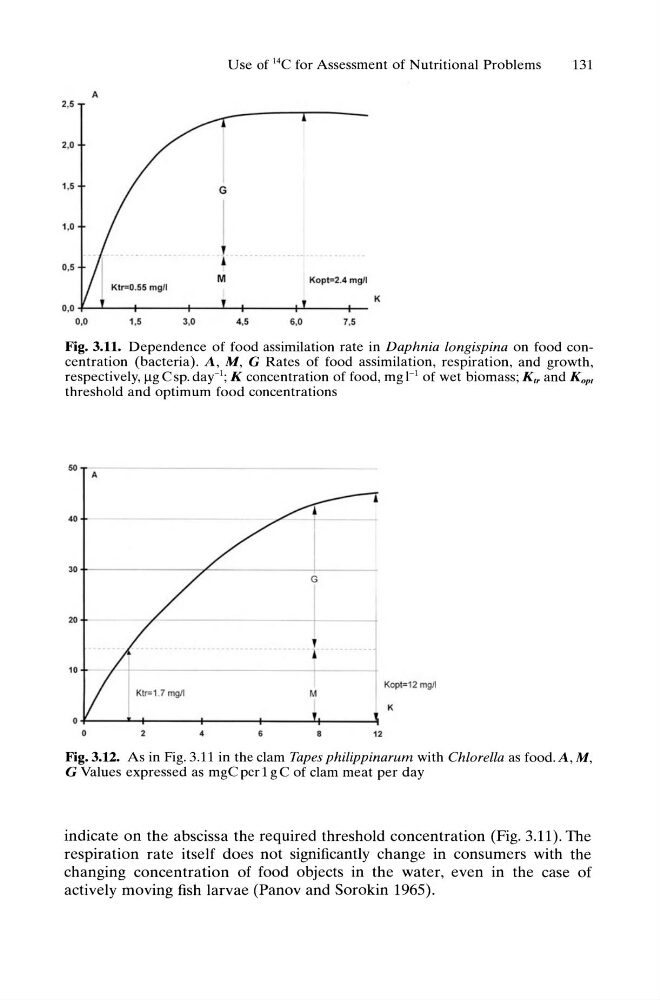
Fig. 3.11. Dependence of food assimilation rate in Daphnia langispina on food concentration (bacteria). A, M, G Rates of food assimilation, respiration, and growth,
respectively, f,Lg C sp. day-I; K concentration of food, mg I-I of wet biomass; K" and K opt
threshold and optimum food concentrations
50
A
40
30+--------~-----------~------20
10
Kopt=12 mg~
K
4
6
12
Fig.3.12. As in Fig. 3.11 in the clam Tapes philippinarum with Chiarella as food. A, M,
G Values expressed as mgC per 1 g C of clam meat per day
indicate on the abscissa the required threshold concentration (Fig. 3.11). The
respiration rate itself does not significantly change in consumers with the
changing concentration of food objects in the water, even in the case of
actively moving fish larvae (Panov and Sorokin 1965).
131
A
2,5
2,0
1,5
1,0
0,5
Kopt=2.4 mgl l
K
0,0 +-....... --+----+---'---f----i-'-----i0,0
1,5
3,0
4 ,5
6,0
7,5
Fig. 3.11. Dependence of food assimilation rate in Daphnia langispina on food concentration (bacteria). A, M, G Rates of food assimilation, respiration, and growth,
respectively, f,Lg C sp. day-I; K concentration of food, mg I-I of wet biomass; K" and K opt
threshold and optimum food concentrations
50
A
40
30+--------~-----------~------20
10
Kopt=12 mg~
K
4
6
12
Fig.3.12. As in Fig. 3.11 in the clam Tapes philippinarum with Chiarella as food. A, M,
G Values expressed as mgC per 1 g C of clam meat per day
indicate on the abscissa the required threshold concentration (Fig. 3.11). The
respiration rate itself does not significantly change in consumers with the
changing concentration of food objects in the water, even in the case of
actively moving fish larvae (Panov and Sorokin 1965).