

Use of 14C for Assessment of Nutritional Problems
135
Ri
c300
11
.200
r -
r -
100
I'
1-<"
-
cIt
.f ':
I ~
I'
I"
r I
':
n r-l
H,cm
a
0
'"
"' -
to"'
'"
'
0
9
~
. . 2- of 0Ji'
.;,
~
"'
.;,
.. ~
.,;
oi
... ..; 0Ji'
,.:,
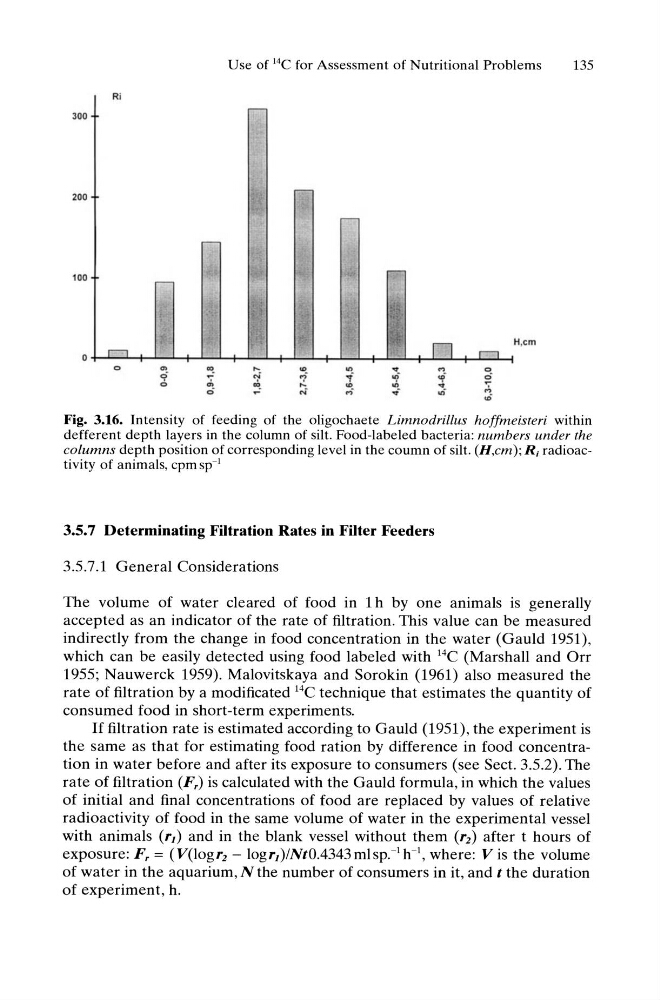
defferent depth layers in the column of silt. Food-labeled bacteria: numbers under the
columns depth position of corresponding level in the coumn of silt. (H,cm); Ri radioactivity of animals, cpm Sp-l
3.5.7 Determinating Filtration Rates in Filter Feeders
3.5.7.1 General Considerations
The volume of water cleared of food in 1 h by one animals is generally
accepted as an indicator of the rate of filtration. This value can be measured
indirectly from the change in food concentration in the water (Gauld 1951),
which can be easily detected using food labeled with 14C (Marshall and Orr
1955; Nauwerck 1959). Malovitskaya and Sorokin (1961) also measured the
rate of filtration by a modificated 14C technique that estimates the quantity of
consumed food in short-term experiments.
If filtration rate is estimated according to Gauld (1951), the experiment is
the same as that for estimating food ration by difference in food concentration in water before and after its exposure to consumers (see Sect. 3.5.2). The
rate of filtration (Fr) is calculated with the Gauld formula, in which the values
of initial and final concentrations of food are replaced by values of relative
radioactivity of food in the same volume of water in the experimental vessel
with animals (rl) and in the blank vessel without them (r2) after t hours of
exposure: Fr = (V(logr2 -logrl)INt0.4343mlsp.-lh-1, where: Vis the volume
of water in the aquarium, N the number of consumers in it, and t the duration
of experiment, h.
135
Ri
c300
11
.200
r -
r -
100
I'
1-<"
-
cIt
.f ':
I ~
I'
I"
r I
':
n r-l
H,cm
a
0
'"
"' -
to"'
'"
'
0
9
~
. . 2- of 0Ji'
.;,
~
"'
.;,
.. ~
.,;
oi
... ..; 0Ji'
,.:,
defferent depth layers in the column of silt. Food-labeled bacteria: numbers under the
columns depth position of corresponding level in the coumn of silt. (H,cm); Ri radioactivity of animals, cpm Sp-l
3.5.7 Determinating Filtration Rates in Filter Feeders
3.5.7.1 General Considerations
The volume of water cleared of food in 1 h by one animals is generally
accepted as an indicator of the rate of filtration. This value can be measured
indirectly from the change in food concentration in the water (Gauld 1951),
which can be easily detected using food labeled with 14C (Marshall and Orr
1955; Nauwerck 1959). Malovitskaya and Sorokin (1961) also measured the
rate of filtration by a modificated 14C technique that estimates the quantity of
consumed food in short-term experiments.
If filtration rate is estimated according to Gauld (1951), the experiment is
the same as that for estimating food ration by difference in food concentration in water before and after its exposure to consumers (see Sect. 3.5.2). The
rate of filtration (Fr) is calculated with the Gauld formula, in which the values
of initial and final concentrations of food are replaced by values of relative
radioactivity of food in the same volume of water in the experimental vessel
with animals (rl) and in the blank vessel without them (r2) after t hours of
exposure: Fr = (V(logr2 -logrl)INt0.4343mlsp.-lh-1, where: Vis the volume
of water in the aquarium, N the number of consumers in it, and t the duration
of experiment, h.