

128
Radioisotopic Methods for the Study of Nutrition in Aquatic Animals
50
40
30
E
.:!
;;;
. .
..c
Q.
II>
o
Qj
o
tJ
II>
::I
E
.,
QI
...,
QI
C
II>
U
II)
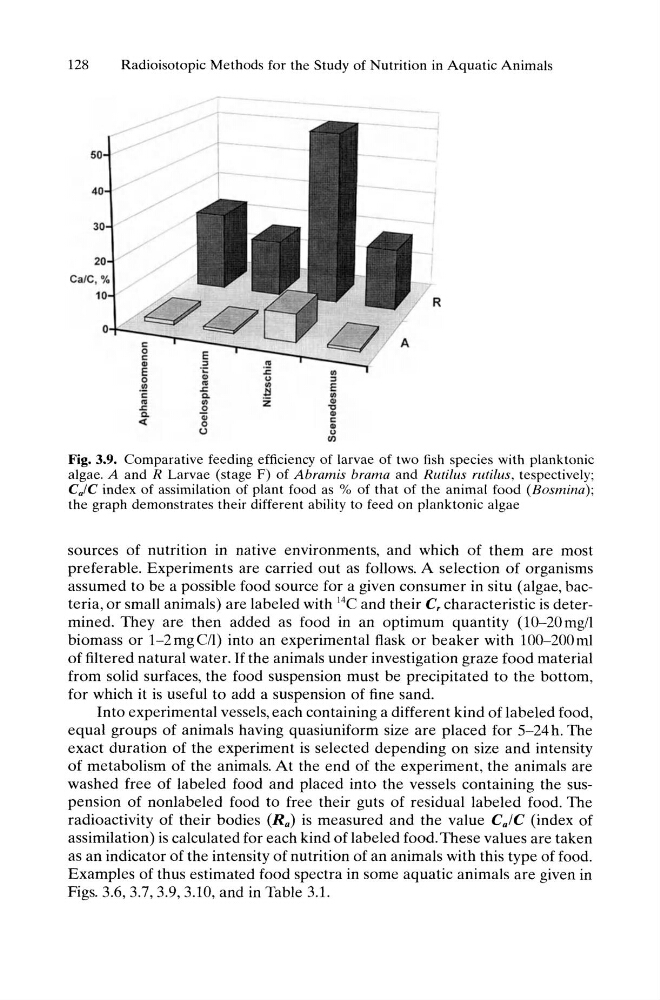
Fig. 3.9. Comparative feeding efficiency of larvae of two fish species with planktonic
algae. A and R Larvae (stage F) of Abramis brama and Rutilus rutilus, tespectively;
CalC index of assimilation of plant food as % of that of the animal food (Bosmina);
the graph demonstrates their different ability to feed on planktonic algae
sources of nutrition in native environments, and which of them are most
preferable. Experiments are carried out as follows. A selection of organisms
assumed to be a possible food source for a given consumer in situ (algae, bacteria, or small animals) are labeled with 14C and their Cr characteristic is determined. They are then added as food in an optimum quantity (10-20 mgll
biomass or 1-2mgC/l) into an experimental flask or beaker with 100-200ml
of filtered natural water. If the animals under investigation graze food material
from solid surfaces, the food suspension must be precipitated to the bottom,
for which it is useful to add a suspension of fine sand.
Into experimental vessels, each containing a different kind of labeled food,
equal groups of animals having quasi uniform size are placed for 5-24 h. The
exact duration of the experiment is selected depending on size and intensity
of metabolism of the animals. At the end of the experiment, the animals are
washed free of labeled food and placed into the vessels containing the suspension of nonlabeled food to free their guts of residual labeled food. The
radioactivity of their bodies (Ra) is measured and the value CalC (index of
assimilation) is calculated for each kind of labeled food. These values are taken
as an indicator of the intensity of nutrition of an animals with this type of food.
Examples of thus estimated food spectra in some aquatic animals are given in
Figs. 3.6,3.7,3.9,3.10, and in Table 3.1.
Radioisotopic Methods for the Study of Nutrition in Aquatic Animals
50
40
30
E
.:!
;;;
. .
..c
Q.
II>
o
Qj
o
tJ
II>
::I
E
.,
QI
...,
QI
C
II>
U
II)
Fig. 3.9. Comparative feeding efficiency of larvae of two fish species with planktonic
algae. A and R Larvae (stage F) of Abramis brama and Rutilus rutilus, tespectively;
CalC index of assimilation of plant food as % of that of the animal food (Bosmina);
the graph demonstrates their different ability to feed on planktonic algae
sources of nutrition in native environments, and which of them are most
preferable. Experiments are carried out as follows. A selection of organisms
assumed to be a possible food source for a given consumer in situ (algae, bacteria, or small animals) are labeled with 14C and their Cr characteristic is determined. They are then added as food in an optimum quantity (10-20 mgll
biomass or 1-2mgC/l) into an experimental flask or beaker with 100-200ml
of filtered natural water. If the animals under investigation graze food material
from solid surfaces, the food suspension must be precipitated to the bottom,
for which it is useful to add a suspension of fine sand.
Into experimental vessels, each containing a different kind of labeled food,
equal groups of animals having quasi uniform size are placed for 5-24 h. The
exact duration of the experiment is selected depending on size and intensity
of metabolism of the animals. At the end of the experiment, the animals are
washed free of labeled food and placed into the vessels containing the suspension of nonlabeled food to free their guts of residual labeled food. The
radioactivity of their bodies (Ra) is measured and the value CalC (index of
assimilation) is calculated for each kind of labeled food. These values are taken
as an indicator of the intensity of nutrition of an animals with this type of food.
Examples of thus estimated food spectra in some aquatic animals are given in
Figs. 3.6,3.7,3.9,3.10, and in Table 3.1.