

Use of 14C for Assessment of Nutritional Problems
129
60
4
5
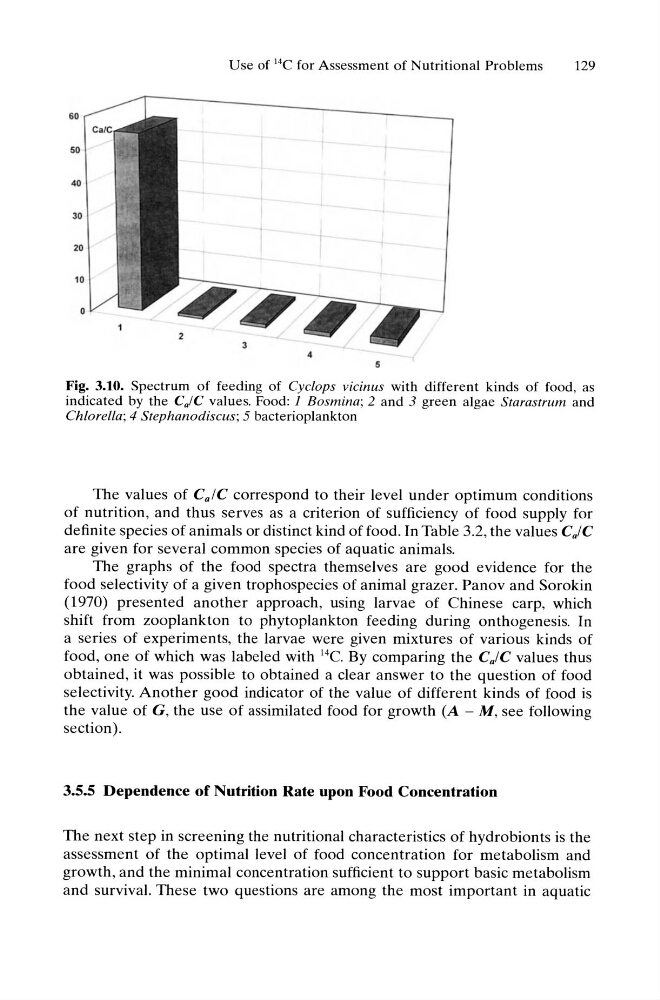
Fig. 3.10. Spectrum of feeding of Cyclops vicinus with different kinds of food, as
indicated by the CalC values. Food: 1 Bosmina; 2 and 3 green algae Starastrum and
Chlorella; 4 Stephanodiscus; 5 bacterioplankton
The values of CalC correspond to their level under optimum conditions
of nutrition, and thus serves as a criterion of sufficiency of food supply for
definite species of animals or distinct kind of food. In Table 3.2, the values CalC
are given for several common species of aquatic animals.
The graphs of the food spectra themselves are good evidence for the
food selectivity of a given trophospecies of animal grazer. Panov and Sorokin
(1970) presented another approach, using larvae of Chinese carp, which
shift from zooplankton to phytoplankton feeding during onthogenesis. In
a series of experiments, the larvae were given mixtures of various kinds of
food, one of which was labeled with 14C. By comparing the CalC values thus
obtained, it was possible to obtained a clear answer to the question of food
selectivity. Another good indicator of the value of different kinds of food is
the value of G, the use of assimilated food for growth (A - M, see following
section).
3.5.5 Dependence of Nutrition Rate upon Food Concentration
The next step in screening the nutritional characteristics of hydrobionts is the
assessment of the optimal level of food concentration for metabolism and
growth, and the minimal concentration sufficient to support basic metabolism
and survival. These two questions are among the most important in aquatic
129
60
4
5
Fig. 3.10. Spectrum of feeding of Cyclops vicinus with different kinds of food, as
indicated by the CalC values. Food: 1 Bosmina; 2 and 3 green algae Starastrum and
Chlorella; 4 Stephanodiscus; 5 bacterioplankton
The values of CalC correspond to their level under optimum conditions
of nutrition, and thus serves as a criterion of sufficiency of food supply for
definite species of animals or distinct kind of food. In Table 3.2, the values CalC
are given for several common species of aquatic animals.
The graphs of the food spectra themselves are good evidence for the
food selectivity of a given trophospecies of animal grazer. Panov and Sorokin
(1970) presented another approach, using larvae of Chinese carp, which
shift from zooplankton to phytoplankton feeding during onthogenesis. In
a series of experiments, the larvae were given mixtures of various kinds of
food, one of which was labeled with 14C. By comparing the CalC values thus
obtained, it was possible to obtained a clear answer to the question of food
selectivity. Another good indicator of the value of different kinds of food is
the value of G, the use of assimilated food for growth (A - M, see following
section).
3.5.5 Dependence of Nutrition Rate upon Food Concentration
The next step in screening the nutritional characteristics of hydrobionts is the
assessment of the optimal level of food concentration for metabolism and
growth, and the minimal concentration sufficient to support basic metabolism
and survival. These two questions are among the most important in aquatic