

Use of 14C for Assessment of Nutritional Problems
127
1
- - - - - - - - - - - - -
--,
1
/ '
-Phenol (mgll)
40
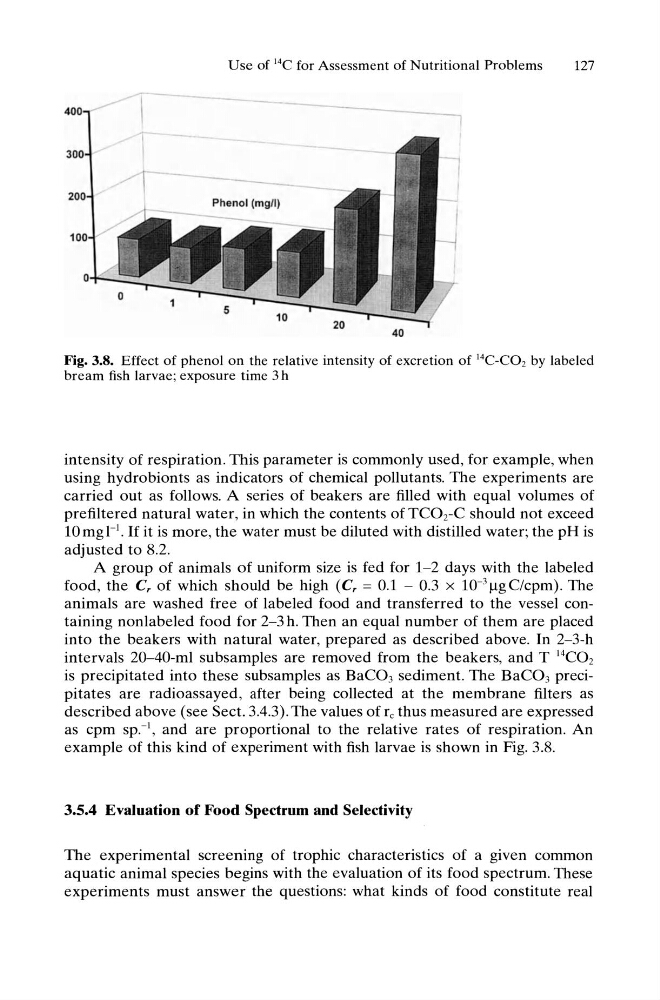
Fig. 3.8. Effect of phenol on the relative intensity of excretion of 14C-C02 by labeled
bream fish larvae; exposure time 3 h
intensity of respiration. This parameter is commonly used, for example, when
using hydrobionts as indicators of chemical pollutants. The experiments are
carried out as follows. A series of beakers are filled with equal volumes of
prefiltered natural water, in which the contents of TCOrC should not exceed
10mgl- 1 . If it is more, the water must be diluted with distilled water; the pH is
adjusted to 8.2.
A group of animals of uniform size is fed for 1-2 days with the labeled
food, the Cr of which should be high (Cr = 0.1 - 0.3 x 1O- 3 f.lgC/cpm). The
animals are washed free of labeled food and transferred to the vessel containing nonlabeled food for 2-3 h. Then an equal number of them are placed
into the beakers with natural water, prepared as described above. In 2-3-h
intervals 20-40-ml subsamples are removed from the beakers, and T 14C02
is precipitated into these subsamples as BaC03 sediment. The BaC03 precipitates are radioassayed, after being collected at the membrane filters as
described above (see Sect. 3.4.3). The values of rc thus measured are expressed
as cpm Sp.-l, and are proportional to the relative rates of respiration. An
example of this kind of experiment with fish larvae is shown in Fig. 3.8.
3.5.4 Evaluation of Food Spectrum and Selectivity
The experimental screening of trophic characteristics of a given common
aquatic animal species begins with the evaluation of its food spectrum. These
experiments must answer the questions: what kinds of food constitute real
127
1
- - - - - - - - - - - - -
--,
1
/ '
-Phenol (mgll)
40
Fig. 3.8. Effect of phenol on the relative intensity of excretion of 14C-C02 by labeled
bream fish larvae; exposure time 3 h
intensity of respiration. This parameter is commonly used, for example, when
using hydrobionts as indicators of chemical pollutants. The experiments are
carried out as follows. A series of beakers are filled with equal volumes of
prefiltered natural water, in which the contents of TCOrC should not exceed
10mgl- 1 . If it is more, the water must be diluted with distilled water; the pH is
adjusted to 8.2.
A group of animals of uniform size is fed for 1-2 days with the labeled
food, the Cr of which should be high (Cr = 0.1 - 0.3 x 1O- 3 f.lgC/cpm). The
animals are washed free of labeled food and transferred to the vessel containing nonlabeled food for 2-3 h. Then an equal number of them are placed
into the beakers with natural water, prepared as described above. In 2-3-h
intervals 20-40-ml subsamples are removed from the beakers, and T 14C02
is precipitated into these subsamples as BaC03 sediment. The BaC03 precipitates are radioassayed, after being collected at the membrane filters as
described above (see Sect. 3.4.3). The values of rc thus measured are expressed
as cpm Sp.-l, and are proportional to the relative rates of respiration. An
example of this kind of experiment with fish larvae is shown in Fig. 3.8.
3.5.4 Evaluation of Food Spectrum and Selectivity
The experimental screening of trophic characteristics of a given common
aquatic animal species begins with the evaluation of its food spectrum. These
experiments must answer the questions: what kinds of food constitute real