

2 Physical Principles and Technical Aspects of Remote Sensing
33
Passive Microwave Sensors. Microwave radiometers measure the emitted radiation. The receiver consists in principle of a high gain antenna, a
switching device, one or several noise sources of known temperature used as
calibration reference, a bandpass filter, amplifiers, and a detector. The signal
received at the antenna is compared with the signals of the reference sources
by switching between the antenna input and the reference loads. According to Eq. 2.4 the microwave radiometric measurements can conveniently be
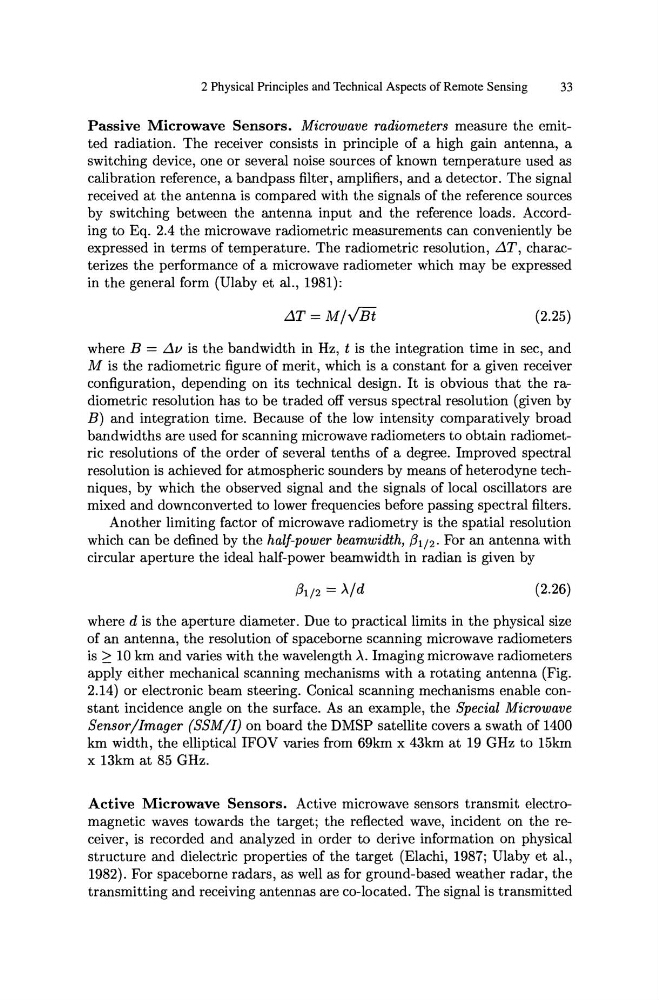
expressed in terms of temperature. The radiometric resolution, t1T, characterizes the performance of a microwave radiometer which may be expressed
in the general form (Ulaby et al., 1981):
(2.25)
where B = t111 is the bandwidth in Hz, t is the integration time in sec, and
M is the radiometric figure of merit, which is a constant for a given receiver
configuration, depending on its technical design. It is obvious that the radiometric resolution has to be traded off versus spectral resolution (given by
B) and integration time. Because of the low intensity comparatively broad
bandwidths are used for scanning microwave radiometers to obtain radiometric resolutions of the order of several tenths of a degree. Improved spectral
resolution is achieved for atmospheric sounders by means of heterodyne techniques, by which the observed signal and the signals of local oscillators are
mixed and down converted to lower frequencies before passing spectral filters.
Another limiting factor of microwave radiometry is the spatial resolution
which can be defined by the half-power beamwidth, /31/2. For an antenna with
circular aperture the ideal half-power beamwidth in radian is given by
/31/2 = Aid
(2.26)
where d is the aperture diameter. Due to practical limits in the physical size
of an antenna, the resolution of spaceborne scanning microwave radiometers
is 2: 10 km and varies with the wavelength A. Imaging microwave radiometers
apply either mechanical scanning mechanisms with a rotating antenna (Fig.
2.14) or electronic beam steering. Conical scanning mechanisms enable constant incidence angle on the surface. As an example, the Special Microwave
Sensor/Imager (SSM/I) on board the DMSP satellite covers a swath of 1400
km width, the elliptical IFOV varies from 69km x 43km at 19 GHz to 15km
x 13km at 85 GHz.
Active Microwave Sensors. Active microwave sensors transmit electromagnetic waves towards the target; the reflected wave, incident on the receiver, is recorded and analyzed in order to derive information on physical
structure and dielectric properties of the target (Elachi, 1987; Ulaby et al.,
1982). For spaceborne radars, as well as for ground-based weather radar, the
transmitting and receiving antennas are co-located. The signal is transmitted
33
Passive Microwave Sensors. Microwave radiometers measure the emitted radiation. The receiver consists in principle of a high gain antenna, a
switching device, one or several noise sources of known temperature used as
calibration reference, a bandpass filter, amplifiers, and a detector. The signal
received at the antenna is compared with the signals of the reference sources
by switching between the antenna input and the reference loads. According to Eq. 2.4 the microwave radiometric measurements can conveniently be
expressed in terms of temperature. The radiometric resolution, t1T, characterizes the performance of a microwave radiometer which may be expressed
in the general form (Ulaby et al., 1981):
(2.25)
where B = t111 is the bandwidth in Hz, t is the integration time in sec, and
M is the radiometric figure of merit, which is a constant for a given receiver
configuration, depending on its technical design. It is obvious that the radiometric resolution has to be traded off versus spectral resolution (given by
B) and integration time. Because of the low intensity comparatively broad
bandwidths are used for scanning microwave radiometers to obtain radiometric resolutions of the order of several tenths of a degree. Improved spectral
resolution is achieved for atmospheric sounders by means of heterodyne techniques, by which the observed signal and the signals of local oscillators are
mixed and down converted to lower frequencies before passing spectral filters.
Another limiting factor of microwave radiometry is the spatial resolution
which can be defined by the half-power beamwidth, /31/2. For an antenna with
circular aperture the ideal half-power beamwidth in radian is given by
/31/2 = Aid
(2.26)
where d is the aperture diameter. Due to practical limits in the physical size
of an antenna, the resolution of spaceborne scanning microwave radiometers
is 2: 10 km and varies with the wavelength A. Imaging microwave radiometers
apply either mechanical scanning mechanisms with a rotating antenna (Fig.
2.14) or electronic beam steering. Conical scanning mechanisms enable constant incidence angle on the surface. As an example, the Special Microwave
Sensor/Imager (SSM/I) on board the DMSP satellite covers a swath of 1400
km width, the elliptical IFOV varies from 69km x 43km at 19 GHz to 15km
x 13km at 85 GHz.
Active Microwave Sensors. Active microwave sensors transmit electromagnetic waves towards the target; the reflected wave, incident on the receiver, is recorded and analyzed in order to derive information on physical
structure and dielectric properties of the target (Elachi, 1987; Ulaby et al.,
1982). For spaceborne radars, as well as for ground-based weather radar, the
transmitting and receiving antennas are co-located. The signal is transmitted