

160
M. Menenti
8.2 Evaporation and radiometric variables
8.2.1 Potential Evaporation
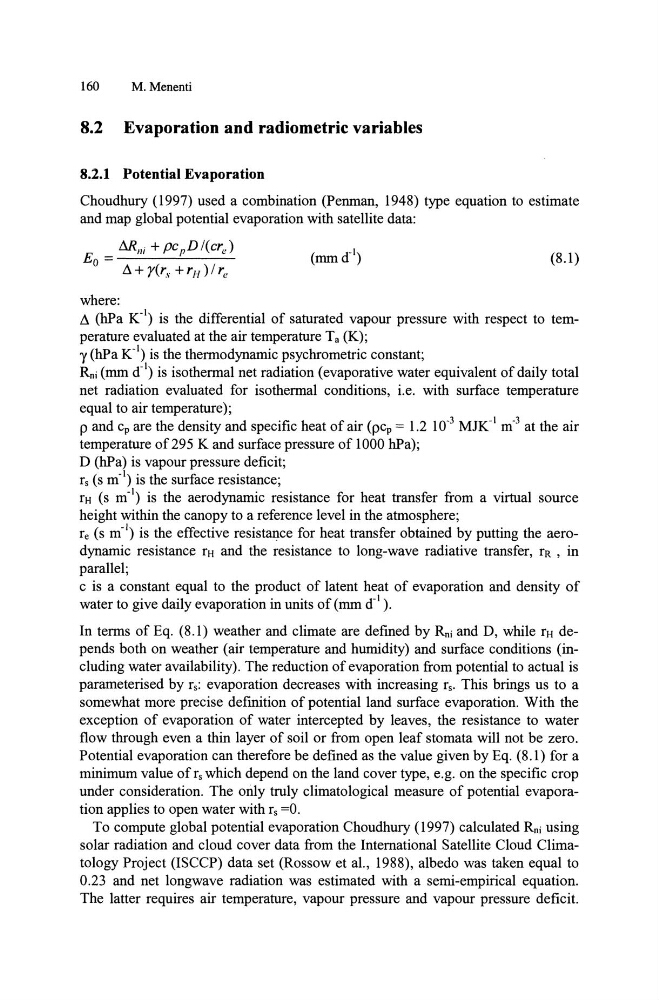
Choudhury (1997) used a combination (Penman, 1948) type equation to estimate
and map global potential evaporation with satellite data:
Mil; + pCpD/(cre)
Eo = -----'---~ + y(r, + rH ) / re
where:
(8.1)
~ (hPa K-') is the differential of saturated vapour pressure with respect to temperature evaluated at the air temperature Ta (K);
y (hPa K-') is the thermodynamic psychrometric constant;
Rni (mm dOl) is isothermal net radiation (evaporative water equivalent of daily total
net radiation evaluated for isothermal conditions, i.e. with surface temperature
equal to air temperature);
p and cp are the density and specific heat of air (pcp = 1.2 10- 3 MJK"' m- 3 at the air
temperature of 295 K and surface pressure of 1000 hPa);
D (hPa) is vapour pressure deficit;
rs (s mol) is the surface resistance;
rH (s mol) is the aerodynamic resistance for heat transfer from a virtual source
height within the canopy to a reference level in the atmosphere;
re (s m-I) is the effective resistance for heat transfer obtained by putting the aerodynamic resistance rH and the resistance to long-wave radiative transfer, rR , in
parallel;
c is a constant equal to the product of latent heat of evaporation and density of
water to give daily evaporation in units of(mm d-').
In terms of Eq. (8.1) weather and climate are defined by Rni and D, while rH depends both on weather (air temperature and humidity) and surface conditions (including water availability). The reduction of evaporation from potential to actual is
parameterised by rs: evaporation decreases with increasing rs. This brings us to a
somewhat more precise definition of potential land surface evaporation. With the
exception of evaporation of water intercepted by leaves, the resistance to water
flow through even a thin layer of soil or from open leaf stomata will not be zero.
Potential evaporation can therefore be defmed as the value given by Eq. (8.1) for a
minimum value of rs which depend on the land cover type, e.g. on the specific crop
under consideration. The only truly climatological measure of potential evaporation applies to open water with rs =0.
To compute global potential evaporation Choudhury (1997) calculated Rni using
solar radiation and cloud cover data from the International Satellite Cloud Climatology Project (ISCCP) data set (Rossow et aI., 1988), albedo was taken equal to
0.23 and net longwave radiation was estimated with a semi-empirical equation.
The latter requires air temperature, vapour pressure and vapour pressure deficit.
M. Menenti
8.2 Evaporation and radiometric variables
8.2.1 Potential Evaporation
Choudhury (1997) used a combination (Penman, 1948) type equation to estimate
and map global potential evaporation with satellite data:
Mil; + pCpD/(cre)
Eo = -----'---~ + y(r, + rH ) / re
where:
(8.1)
~ (hPa K-') is the differential of saturated vapour pressure with respect to temperature evaluated at the air temperature Ta (K);
y (hPa K-') is the thermodynamic psychrometric constant;
Rni (mm dOl) is isothermal net radiation (evaporative water equivalent of daily total
net radiation evaluated for isothermal conditions, i.e. with surface temperature
equal to air temperature);
p and cp are the density and specific heat of air (pcp = 1.2 10- 3 MJK"' m- 3 at the air
temperature of 295 K and surface pressure of 1000 hPa);
D (hPa) is vapour pressure deficit;
rs (s mol) is the surface resistance;
rH (s mol) is the aerodynamic resistance for heat transfer from a virtual source
height within the canopy to a reference level in the atmosphere;
re (s m-I) is the effective resistance for heat transfer obtained by putting the aerodynamic resistance rH and the resistance to long-wave radiative transfer, rR , in
parallel;
c is a constant equal to the product of latent heat of evaporation and density of
water to give daily evaporation in units of(mm d-').
In terms of Eq. (8.1) weather and climate are defined by Rni and D, while rH depends both on weather (air temperature and humidity) and surface conditions (including water availability). The reduction of evaporation from potential to actual is
parameterised by rs: evaporation decreases with increasing rs. This brings us to a
somewhat more precise definition of potential land surface evaporation. With the
exception of evaporation of water intercepted by leaves, the resistance to water
flow through even a thin layer of soil or from open leaf stomata will not be zero.
Potential evaporation can therefore be defmed as the value given by Eq. (8.1) for a
minimum value of rs which depend on the land cover type, e.g. on the specific crop
under consideration. The only truly climatological measure of potential evaporation applies to open water with rs =0.
To compute global potential evaporation Choudhury (1997) calculated Rni using
solar radiation and cloud cover data from the International Satellite Cloud Climatology Project (ISCCP) data set (Rossow et aI., 1988), albedo was taken equal to
0.23 and net longwave radiation was estimated with a semi-empirical equation.
The latter requires air temperature, vapour pressure and vapour pressure deficit.