

Chapter 1: INTRODUCTION
1
1
1
exp sin
x x a
kz
k x ct
ª
º
¬
¼ ,
(1.108)
1
1
1
exp cos
z z a
kz
k x ct
ª
º
¬
¼ ,
(1.109)
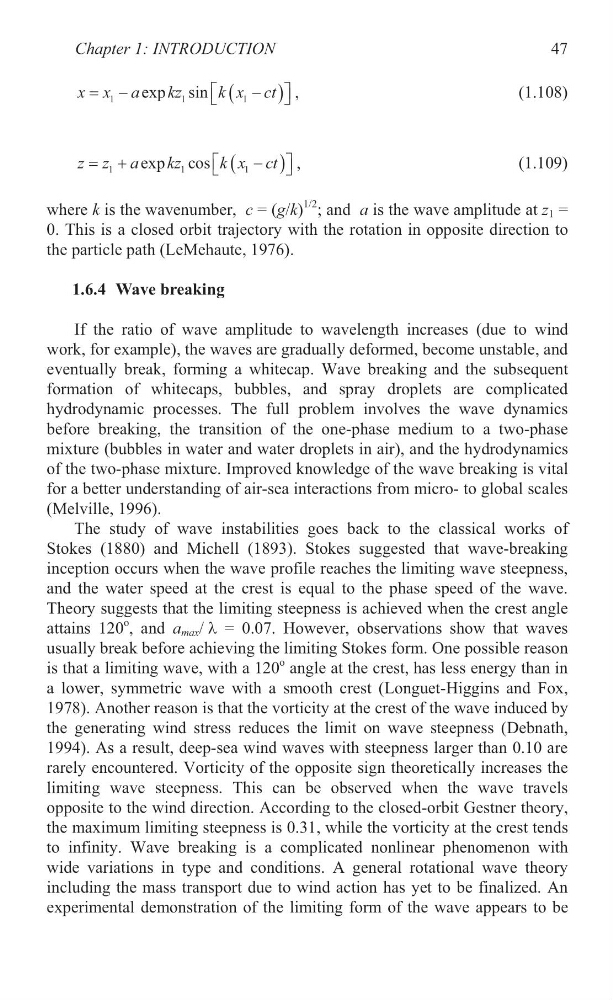
where k is the wavenumber, c = (g/k)
1/2 ; and a is the wave amplitude at z 1 =
0. This is a closed orbit trajectory with the rotation in opposite direction to
the particle path (LeMehaute, 1976).
1.6.4 Wave breaking
If the ratio of wave amplitude to wavelength increases (due to wind
work, for example), the waves are gradually deformed, become unstable, and
eventually break, forming a whitecap. Wave breaking and the subsequent
formation of whitecaps, bubbles, and spray droplets are complicated
hydrodynamic processes. The full problem involves the wave dynamics
before breaking, the transition of the one-phase medium to a two-phase
mixture (bubbles in water and water droplets in air), and the hydrodynamics
of the two-phase mixture. Improved knowledge of the wave breaking is vital
for a better understanding of air-sea interactions from micro- to global scales
(Melville, 1996).
The study of wave instabilities goes back to the classical works of
Stokes (1880) and Michell (1893). Stokes suggested that wave-breaking
inception occurs when the wave profile reaches the limiting wave steepness,
and the water speed at the crest is equal to the phase speed of the wave.
Theory suggests that the limiting steepness is achieved when the crest angle
attains 120
o , and a max /O = 0.07. However, observations show that waves
usually break before achieving the limiting Stokes form. One possible reason
is that a limiting wave, with a 120
o angle at the crest, has less energy than in
a lower, symmetric wave with a smooth crest (Longuet-Higgins and Fox,
1978). Another reason is that the vorticity at the crest of the wave induced by
the generating wind stress reduces the limit on wave steepness (Debnath,
1994). As a result, deep-sea wind waves with steepness larger than 0.10 are
rarely encountered. Vorticity of the opposite sign theoretically increases the
limiting wave steepness. This can be observed when the wave travels
opposite to the wind direction. According to the closed-orbit Gestner theory,
the maximum limiting steepness is 0.31, while the vorticity at the crest tends
to infinity. Wave breaking is a complicated nonlinear phenomenon with
wide variations in type and conditions. A general rotational wave theory
including the mass transport due to wind action has yet to be finalized. An
experimental demonstration of the limiting form of the wave appears to be
47
1
1
1
exp sin
x x a
kz
k x ct
ª
º
¬
¼ ,
(1.108)
1
1
1
exp cos
z z a
kz
k x ct
ª
º
¬
¼ ,
(1.109)
where k is the wavenumber, c = (g/k)
1/2 ; and a is the wave amplitude at z 1 =
0. This is a closed orbit trajectory with the rotation in opposite direction to
the particle path (LeMehaute, 1976).
1.6.4 Wave breaking
If the ratio of wave amplitude to wavelength increases (due to wind
work, for example), the waves are gradually deformed, become unstable, and
eventually break, forming a whitecap. Wave breaking and the subsequent
formation of whitecaps, bubbles, and spray droplets are complicated
hydrodynamic processes. The full problem involves the wave dynamics
before breaking, the transition of the one-phase medium to a two-phase
mixture (bubbles in water and water droplets in air), and the hydrodynamics
of the two-phase mixture. Improved knowledge of the wave breaking is vital
for a better understanding of air-sea interactions from micro- to global scales
(Melville, 1996).
The study of wave instabilities goes back to the classical works of
Stokes (1880) and Michell (1893). Stokes suggested that wave-breaking
inception occurs when the wave profile reaches the limiting wave steepness,
and the water speed at the crest is equal to the phase speed of the wave.
Theory suggests that the limiting steepness is achieved when the crest angle
attains 120
o , and a max /O = 0.07. However, observations show that waves
usually break before achieving the limiting Stokes form. One possible reason
is that a limiting wave, with a 120
o angle at the crest, has less energy than in
a lower, symmetric wave with a smooth crest (Longuet-Higgins and Fox,
1978). Another reason is that the vorticity at the crest of the wave induced by
the generating wind stress reduces the limit on wave steepness (Debnath,
1994). As a result, deep-sea wind waves with steepness larger than 0.10 are
rarely encountered. Vorticity of the opposite sign theoretically increases the
limiting wave steepness. This can be observed when the wave travels
opposite to the wind direction. According to the closed-orbit Gestner theory,
the maximum limiting steepness is 0.31, while the vorticity at the crest tends
to infinity. Wave breaking is a complicated nonlinear phenomenon with
wide variations in type and conditions. A general rotational wave theory
including the mass transport due to wind action has yet to be finalized. An
experimental demonstration of the limiting form of the wave appears to be
47