

THE NEAR-SURFACE LAYER OF THE OCEAN
2
22
44
5
1
. . .
4
gk
a k
a k
Z
§
·
¨
¸
©
¹
.
(1.107)
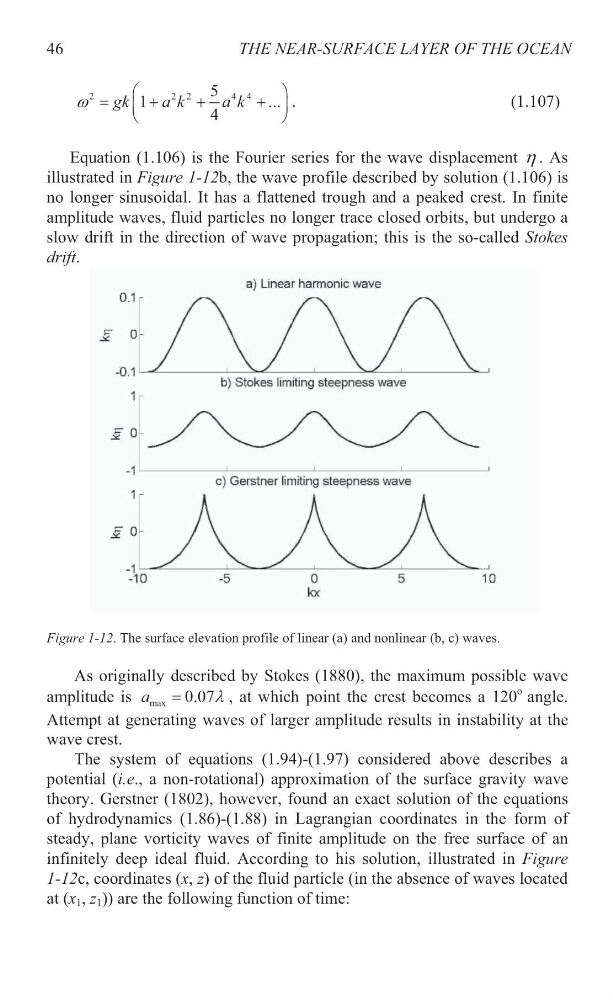
Equation (1.106) is the Fourier series for the wave displacement K . As
illustrated in Figure 1-12b, the wave profile described by solution (1.106) is
no longer sinusoidal. It has a flattened trough and a peaked crest. In finite
amplitude waves, fluid particles no longer trace closed orbits, but undergo a
slow drift in the direction of wave propagation; this is the so-called Stokes
drift.
Figure 1-12. The surface elevation profile of linear (a) and nonlinear (b, c) waves.
As originally described by Stokes (1880), the maximum possible wave
amplitude is max 0.07
a
O , at which point the crest becomes a 120
o angle.
Attempt at generating waves of larger amplitude results in instability at the
wave crest.
The system of equations (1.94)-(1.97) considered above describes a
potential (i.e., a non-rotational) approximation of the surface gravity wave
theory. Gerstner (1802), however, found an exact solution of the equations
of hydrodynamics (1.86)-(1.88) in Lagrangian coordinates in the form of
steady, plane vorticity waves of finite amplitude on the free surface of an
infinitely deep ideal fluid. According to his solution, illustrated in Figure
1-12c, coordinates (x, z) of the fluid particle (in the absence of waves located
at (x 1 , z 1 )) are the following function of time:
46
2
22
44
5
1
. . .
4
gk
a k
a k
Z
§
·
¨
¸
©
¹
.
(1.107)
Equation (1.106) is the Fourier series for the wave displacement K . As
illustrated in Figure 1-12b, the wave profile described by solution (1.106) is
no longer sinusoidal. It has a flattened trough and a peaked crest. In finite
amplitude waves, fluid particles no longer trace closed orbits, but undergo a
slow drift in the direction of wave propagation; this is the so-called Stokes
drift.
Figure 1-12. The surface elevation profile of linear (a) and nonlinear (b, c) waves.
As originally described by Stokes (1880), the maximum possible wave
amplitude is max 0.07
a
O , at which point the crest becomes a 120
o angle.
Attempt at generating waves of larger amplitude results in instability at the
wave crest.
The system of equations (1.94)-(1.97) considered above describes a
potential (i.e., a non-rotational) approximation of the surface gravity wave
theory. Gerstner (1802), however, found an exact solution of the equations
of hydrodynamics (1.86)-(1.88) in Lagrangian coordinates in the form of
steady, plane vorticity waves of finite amplitude on the free surface of an
infinitely deep ideal fluid. According to his solution, illustrated in Figure
1-12c, coordinates (x, z) of the fluid particle (in the absence of waves located
at (x 1 , z 1 )) are the following function of time:
46