

Vorticity
83
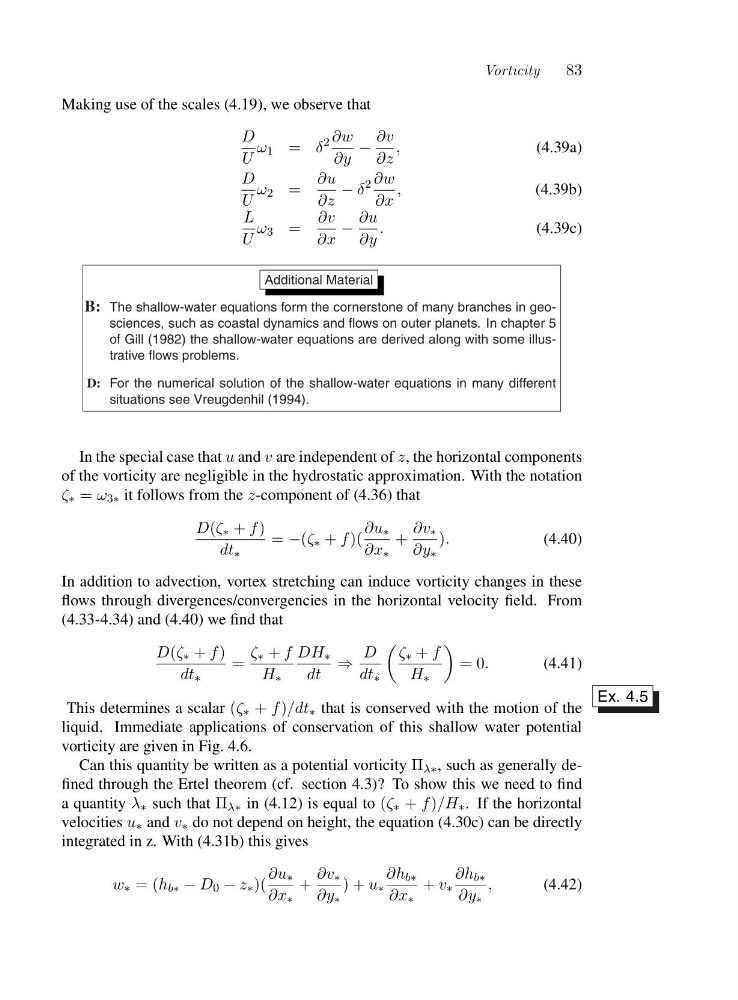
Making use of the scales (4.19), we observe that
D
U
ω 1 = δ
2 ∂w
∂y
−
∂v
∂z
,
(4.39a)
D
U
ω 2 =
∂u
∂z
− δ
2 ∂w
∂x
,
(4.39b)
L
U
ω 3 =
∂v
∂x
−
∂u
∂y
.
(4.39c)
Additional Material
B: The shallow-water equations form the cornerstone of many branches in geosciences, such as coastal dynamics and flows on outer planets. In chapter 5
of Gill (1982) the shallow-water equations are derived along with some illustrative flows problems.
D: For the numerical solution of the shallow-water equations in many different
situations see Vreugdenhil (1994).
In the special case that u and v are independent of z, the horizontal components
of the vorticity are negligible in the hydrostatic approximation. With the notation
ζ ∗ = ω 3∗ it follows from the z-component of (4.36) that
D(ζ ∗ + f )
dt ∗
= −(ζ ∗ + f )(
∂u ∗
∂x ∗
+
∂v ∗
∂y ∗
).
(4.40)
In addition to advection, vortex stretching can induce vorticity changes in these
flows through divergences/convergencies in the horizontal velocity field. From
(4.33-4.34) and (4.40) we find that
D(ζ ∗ + f )
dt ∗
=
ζ ∗ + f
H ∗
DH ∗
dt
⇒
D
dt ∗
ζ ∗ + f
H ∗
=0.
(4.41)
This determines a scalar (ζ ∗ + f )/dt ∗ that is conserved with the motion of the
Ex. 4.5
liquid. Immediate applications of conservation of this shallow water potential
vorticity are given in Fig. 4.6.
Can this quantity be written as a potential vorticity Π λ∗ , such as generally defined through the Ertel theorem (cf. section 4.3)? To show this we need to find
a quantity λ ∗ such that Π λ∗ in (4.12) is equal to (ζ ∗ + f )/H ∗ . If the horizontal
velocities u ∗ and v ∗ do not depend on height, the equation (4.30c) can be directly
integrated in z. With (4.31b) this gives
w ∗ =(h b∗ − D 0 − z ∗ )(
∂u ∗
∂x ∗
+
∂v ∗
∂y ∗
)+u ∗
∂h b∗
∂x ∗
+ v ∗
∂h b∗
∂y ∗
,
(4.42)
83
Making use of the scales (4.19), we observe that
D
U
ω 1 = δ
2 ∂w
∂y
−
∂v
∂z
,
(4.39a)
D
U
ω 2 =
∂u
∂z
− δ
2 ∂w
∂x
,
(4.39b)
L
U
ω 3 =
∂v
∂x
−
∂u
∂y
.
(4.39c)
Additional Material
B: The shallow-water equations form the cornerstone of many branches in geosciences, such as coastal dynamics and flows on outer planets. In chapter 5
of Gill (1982) the shallow-water equations are derived along with some illustrative flows problems.
D: For the numerical solution of the shallow-water equations in many different
situations see Vreugdenhil (1994).
In the special case that u and v are independent of z, the horizontal components
of the vorticity are negligible in the hydrostatic approximation. With the notation
ζ ∗ = ω 3∗ it follows from the z-component of (4.36) that
D(ζ ∗ + f )
dt ∗
= −(ζ ∗ + f )(
∂u ∗
∂x ∗
+
∂v ∗
∂y ∗
).
(4.40)
In addition to advection, vortex stretching can induce vorticity changes in these
flows through divergences/convergencies in the horizontal velocity field. From
(4.33-4.34) and (4.40) we find that
D(ζ ∗ + f )
dt ∗
=
ζ ∗ + f
H ∗
DH ∗
dt
⇒
D
dt ∗
ζ ∗ + f
H ∗
=0.
(4.41)
This determines a scalar (ζ ∗ + f )/dt ∗ that is conserved with the motion of the
Ex. 4.5
liquid. Immediate applications of conservation of this shallow water potential
vorticity are given in Fig. 4.6.
Can this quantity be written as a potential vorticity Π λ∗ , such as generally defined through the Ertel theorem (cf. section 4.3)? To show this we need to find
a quantity λ ∗ such that Π λ∗ in (4.12) is equal to (ζ ∗ + f )/H ∗ . If the horizontal
velocities u ∗ and v ∗ do not depend on height, the equation (4.30c) can be directly
integrated in z. With (4.31b) this gives
w ∗ =(h b∗ − D 0 − z ∗ )(
∂u ∗
∂x ∗
+
∂v ∗
∂y ∗
)+u ∗
∂h b∗
∂x ∗
+ v ∗
∂h b∗
∂y ∗
,
(4.42)