

84
DYNAMICAL OCEANOGRAPHY
ζ 1
H 0
ζ 2
H 0
θ 0
θ 1
(a)
ζ 1
ζ
2
f constant
H
H
1
2
(b)
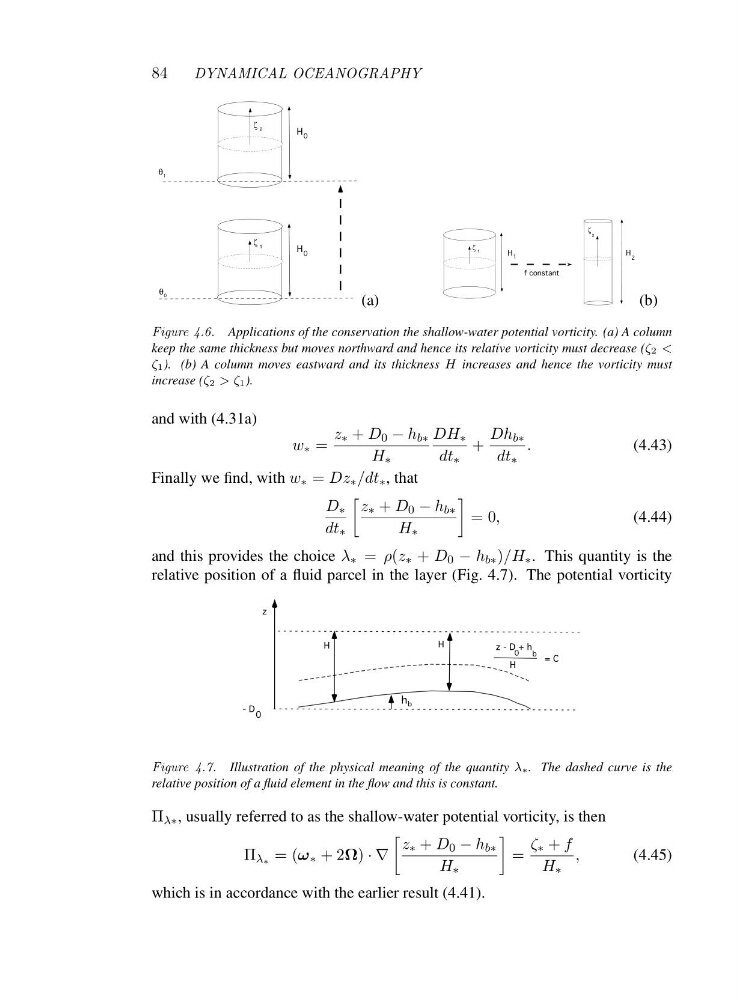
Figure 4.6. Applications of the conservation the shallow-water potential vorticity. (a) A column
keep the same thickness but moves northward and hence its relative vorticity must decrease (ζ2 <
ζ1). (b) A column moves eastward and its thickness H increases and hence the vorticity must
increase (ζ2 >ζ1).
and with (4.31a)
w ∗ =
z ∗ + D 0 − h b∗
H ∗
DH ∗
dt ∗
+
Dh b∗
dt ∗
.
(4.43)
Finally we find, with w ∗ = Dz ∗ /dt ∗ ,that
D ∗
dt ∗
z ∗ + D 0 − h b∗
H ∗
=0,
(4.44)
and this provides the choice λ ∗ = ρ(z ∗ + D 0 − h b∗ )/H ∗ . This quantity is the
relative position of a fluid parcel in the layer (Fig. 4.7). The potential vorticity
H
H
H
z
h b
- D 0
z - D + h
0
b = C
Figure 4.7. Illustration of the physical meaning of the quantity λ∗. The dashed curve is the
relative position of a fluid element in the flow and this is constant.
Π λ∗ , usually referred to as the shallow-water potential vorticity, is then
Π λ∗ =(ω ∗ +2Ω) ·∇
z ∗ + D 0 − h b∗
H ∗
=
ζ ∗ + f
H ∗
,
(4.45)
which is in accordance with the earlier result (4.41).
DYNAMICAL OCEANOGRAPHY
ζ 1
H 0
ζ 2
H 0
θ 0
θ 1
(a)
ζ 1
ζ
2
f constant
H
H
1
2
(b)
Figure 4.6. Applications of the conservation the shallow-water potential vorticity. (a) A column
keep the same thickness but moves northward and hence its relative vorticity must decrease (ζ2 <
ζ1). (b) A column moves eastward and its thickness H increases and hence the vorticity must
increase (ζ2 >ζ1).
and with (4.31a)
w ∗ =
z ∗ + D 0 − h b∗
H ∗
DH ∗
dt ∗
+
Dh b∗
dt ∗
.
(4.43)
Finally we find, with w ∗ = Dz ∗ /dt ∗ ,that
D ∗
dt ∗
z ∗ + D 0 − h b∗
H ∗
=0,
(4.44)
and this provides the choice λ ∗ = ρ(z ∗ + D 0 − h b∗ )/H ∗ . This quantity is the
relative position of a fluid parcel in the layer (Fig. 4.7). The potential vorticity
H
H
H
z
h b
- D 0
z - D + h
0
b = C
Figure 4.7. Illustration of the physical meaning of the quantity λ∗. The dashed curve is the
relative position of a fluid element in the flow and this is constant.
Π λ∗ , usually referred to as the shallow-water potential vorticity, is then
Π λ∗ =(ω ∗ +2Ω) ·∇
z ∗ + D 0 − h b∗
H ∗
=
ζ ∗ + f
H ∗
,
(4.45)
which is in accordance with the earlier result (4.41).