

82
DYNAMICAL OCEANOGRAPHY
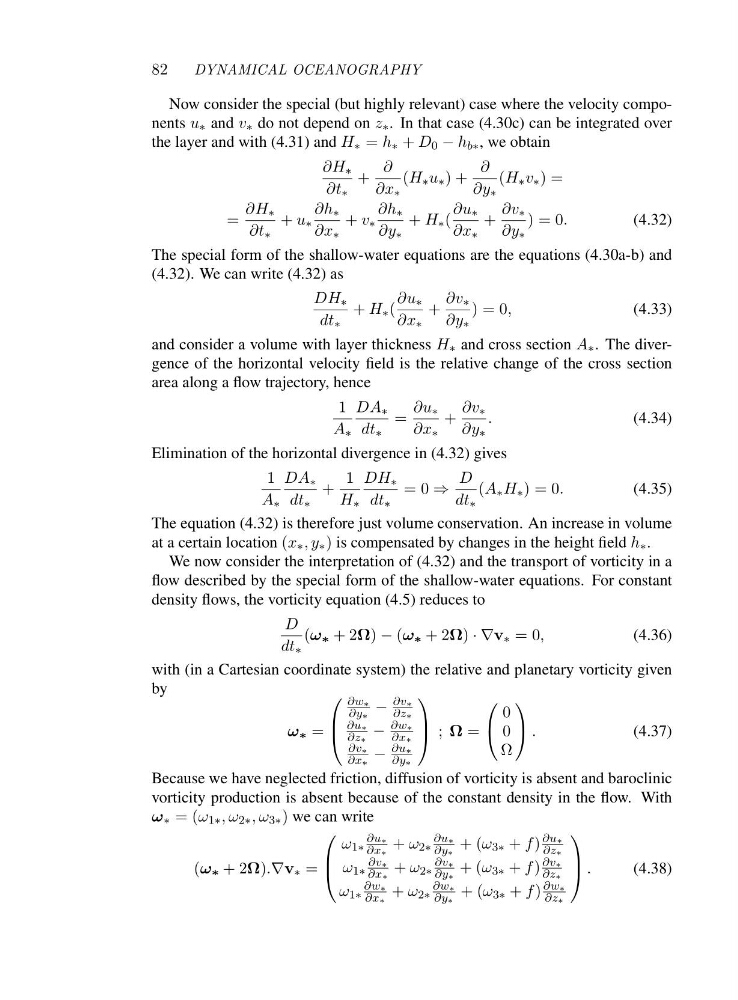
Now consider the special (but highly relevant) case where the velocity components u ∗ and v ∗ do not depend on z ∗ . In that case (4.30c) can be integrated over
the layer and with (4.31) and H ∗ = h ∗ + D 0 − h b∗ , we obtain
∂H ∗
∂t ∗
+
∂
∂x ∗
(H ∗ u ∗ )+
∂
∂y ∗
(H ∗ v ∗ )=
=
∂H ∗
∂t ∗
+ u ∗
∂h ∗
∂x ∗
+ v ∗
∂h ∗
∂y ∗
+ H ∗ (
∂u ∗
∂x ∗
+
∂v ∗
∂y ∗
)=0.
(4.32)
The special form of the shallow-water equations are the equations (4.30a-b) and
(4.32). We can write (4.32) as
DH ∗
dt ∗
+ H ∗ (
∂u ∗
∂x ∗
+
∂v ∗
∂y ∗
)=0,
(4.33)
and consider a volume with layer thickness H ∗ and cross section A ∗ . The divergence of the horizontal velocity field is the relative change of the cross section
area along a flow trajectory, hence
1
A ∗
DA ∗
dt ∗
=
∂u ∗
∂x ∗
+
∂v ∗
∂y ∗
.
(4.34)
Elimination of the horizontal divergence in (4.32) gives
1
A ∗
DA ∗
dt ∗
+
1
H ∗
DH ∗
dt ∗
=0⇒
D
dt ∗
(A ∗ H ∗ )=0.
(4.35)
The equation (4.32) is therefore just volume conservation. An increase in volume
at a certain location (x ∗ ,y ∗ ) is compensated by changes in the height field h ∗ .
We now consider the interpretation of (4.32) and the transport of vorticity in a
flow described by the special form of the shallow-water equations. For constant
density flows, the vorticity equation (4.5) reduces to
D
dt ∗
(ω ∗ +2Ω) − (ω ∗ +2Ω) ·∇v ∗ =0,
(4.36)
with (in a Cartesian coordinate system) the relative and planetary vorticity given
by
ω ∗ =
⎛
⎜
⎝
∂w∗
∂y∗ −
∂v∗
∂z∗
∂u∗
∂z∗ −
∂w∗
∂x∗
∂v∗
∂x∗ −
∂u∗
∂y∗
⎞
⎟
⎠ ; Ω =
⎛
⎝
0
0
Ω
⎞
⎠ .
(4.37)
Because we have neglected friction, diffusion of vorticity is absent and baroclinic
vorticity production is absent because of the constant density in the flow. With
ω ∗ =(ω 1∗ ,ω 2∗ ,ω 3∗ ) we can write
(ω ∗ +2Ω).∇v ∗ =
⎛
⎜
⎝
ω 1∗
∂u∗
∂x∗ + ω 2∗
∂u∗
∂y∗ +(ω 3∗ + f )
∂u∗
∂z∗
ω 1∗
∂v∗
∂x∗ + ω 2∗
∂v∗
∂y∗ +(ω 3∗ + f )
∂v∗
∂z∗
ω 1∗
∂w∗
∂x∗ + ω 2∗
∂w∗
∂y∗ +(ω 3∗ + f )
∂w∗
∂z∗
⎞
⎟
⎠ .
(4.38)
DYNAMICAL OCEANOGRAPHY
Now consider the special (but highly relevant) case where the velocity components u ∗ and v ∗ do not depend on z ∗ . In that case (4.30c) can be integrated over
the layer and with (4.31) and H ∗ = h ∗ + D 0 − h b∗ , we obtain
∂H ∗
∂t ∗
+
∂
∂x ∗
(H ∗ u ∗ )+
∂
∂y ∗
(H ∗ v ∗ )=
=
∂H ∗
∂t ∗
+ u ∗
∂h ∗
∂x ∗
+ v ∗
∂h ∗
∂y ∗
+ H ∗ (
∂u ∗
∂x ∗
+
∂v ∗
∂y ∗
)=0.
(4.32)
The special form of the shallow-water equations are the equations (4.30a-b) and
(4.32). We can write (4.32) as
DH ∗
dt ∗
+ H ∗ (
∂u ∗
∂x ∗
+
∂v ∗
∂y ∗
)=0,
(4.33)
and consider a volume with layer thickness H ∗ and cross section A ∗ . The divergence of the horizontal velocity field is the relative change of the cross section
area along a flow trajectory, hence
1
A ∗
DA ∗
dt ∗
=
∂u ∗
∂x ∗
+
∂v ∗
∂y ∗
.
(4.34)
Elimination of the horizontal divergence in (4.32) gives
1
A ∗
DA ∗
dt ∗
+
1
H ∗
DH ∗
dt ∗
=0⇒
D
dt ∗
(A ∗ H ∗ )=0.
(4.35)
The equation (4.32) is therefore just volume conservation. An increase in volume
at a certain location (x ∗ ,y ∗ ) is compensated by changes in the height field h ∗ .
We now consider the interpretation of (4.32) and the transport of vorticity in a
flow described by the special form of the shallow-water equations. For constant
density flows, the vorticity equation (4.5) reduces to
D
dt ∗
(ω ∗ +2Ω) − (ω ∗ +2Ω) ·∇v ∗ =0,
(4.36)
with (in a Cartesian coordinate system) the relative and planetary vorticity given
by
ω ∗ =
⎛
⎜
⎝
∂w∗
∂y∗ −
∂v∗
∂z∗
∂u∗
∂z∗ −
∂w∗
∂x∗
∂v∗
∂x∗ −
∂u∗
∂y∗
⎞
⎟
⎠ ; Ω =
⎛
⎝
0
0
Ω
⎞
⎠ .
(4.37)
Because we have neglected friction, diffusion of vorticity is absent and baroclinic
vorticity production is absent because of the constant density in the flow. With
ω ∗ =(ω 1∗ ,ω 2∗ ,ω 3∗ ) we can write
(ω ∗ +2Ω).∇v ∗ =
⎛
⎜
⎝
ω 1∗
∂u∗
∂x∗ + ω 2∗
∂u∗
∂y∗ +(ω 3∗ + f )
∂u∗
∂z∗
ω 1∗
∂v∗
∂x∗ + ω 2∗
∂v∗
∂y∗ +(ω 3∗ + f )
∂v∗
∂z∗
ω 1∗
∂w∗
∂x∗ + ω 2∗
∂w∗
∂y∗ +(ω 3∗ + f )
∂w∗
∂z∗
⎞
⎟
⎠ .
(4.38)