

Vorticity
81
4.4.2. Inertial flows
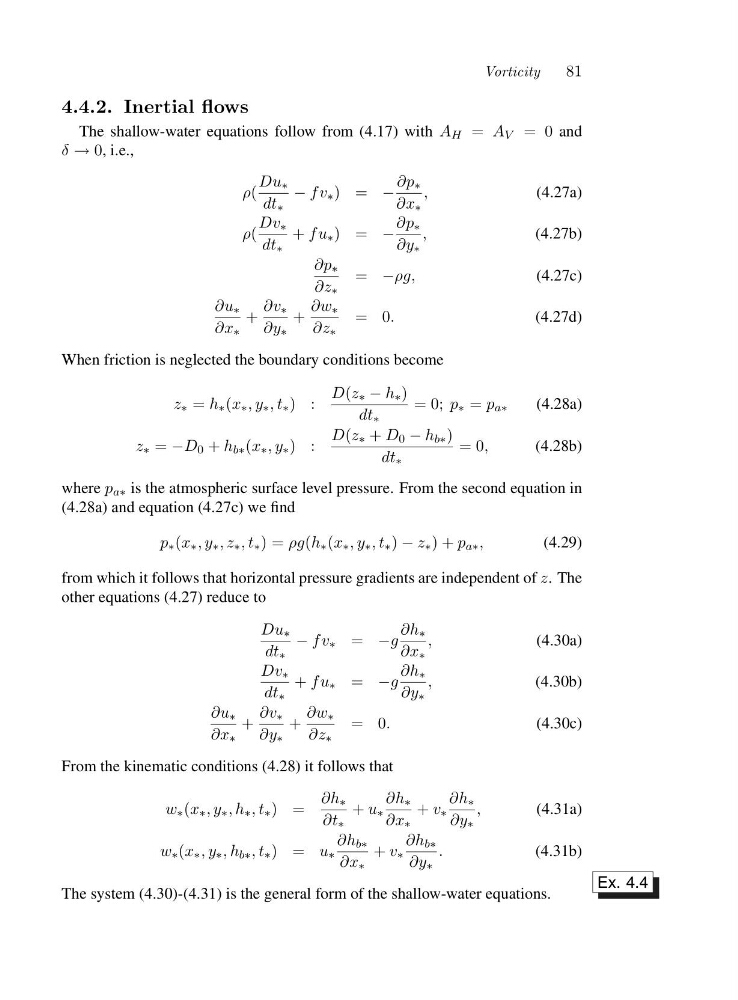
The shallow-water equations follow from (4.17) with A H = A V =0and
δ → 0, i.e.,
ρ(
Du ∗
dt ∗
− fv ∗ )=−
∂p ∗
∂x ∗
,
(4.27a)
ρ(
Dv ∗
dt ∗
+ fu ∗ )=−
∂p ∗
∂y ∗
,
(4.27b)
∂p ∗
∂z ∗
= −ρg,
(4.27c)
∂u ∗
∂x ∗
+
∂v ∗
∂y ∗
+
∂w ∗
∂z ∗
=0 .
(4.27d)
When friction is neglected the boundary conditions become
z ∗ = h ∗ (x ∗ ,y ∗ ,t ∗ ):
D(z ∗ − h ∗ )
dt ∗
=0; p ∗ = p a∗
(4.28a)
z ∗ = −D 0 + h b∗ (x ∗ ,y ∗ ):
D(z ∗ + D 0 − h b∗ )
dt ∗
=0,
(4.28b)
where p a∗ is the atmospheric surface level pressure. From the second equation in
(4.28a) and equation (4.27c) we find
p ∗ (x ∗ ,y ∗ ,z ∗ ,t ∗ )=ρg(h ∗ (x ∗ ,y ∗ ,t ∗ ) − z ∗ )+p a∗ ,
(4.29)
from which it follows that horizontal pressure gradients are independent of z.T h e
other equations (4.27) reduce to
Du ∗
dt ∗
− fv ∗ = −g
∂h ∗
∂x ∗
,
(4.30a)
Dv ∗
dt ∗
+ fu ∗ = −g
∂h ∗
∂y ∗
,
(4.30b)
∂u ∗
∂x ∗
+
∂v ∗
∂y ∗
+
∂w ∗
∂z ∗
=0 .
(4.30c)
From the kinematic conditions (4.28) it follows that
w ∗ (x ∗ ,y ∗ ,h ∗ ,t ∗ )=
∂h ∗
∂t ∗
+ u ∗
∂h ∗
∂x ∗
+ v ∗
∂h ∗
∂y ∗
,
(4.31a)
w ∗ (x ∗ ,y ∗ ,h b∗ ,t ∗ )=u ∗
∂h b∗
∂x ∗
+ v ∗
∂h b∗
∂y ∗
.
(4.31b)
The system (4.30)-(4.31) is the general form of the shallow-water equations.
Ex. 4.4
81
4.4.2. Inertial flows
The shallow-water equations follow from (4.17) with A H = A V =0and
δ → 0, i.e.,
ρ(
Du ∗
dt ∗
− fv ∗ )=−
∂p ∗
∂x ∗
,
(4.27a)
ρ(
Dv ∗
dt ∗
+ fu ∗ )=−
∂p ∗
∂y ∗
,
(4.27b)
∂p ∗
∂z ∗
= −ρg,
(4.27c)
∂u ∗
∂x ∗
+
∂v ∗
∂y ∗
+
∂w ∗
∂z ∗
=0 .
(4.27d)
When friction is neglected the boundary conditions become
z ∗ = h ∗ (x ∗ ,y ∗ ,t ∗ ):
D(z ∗ − h ∗ )
dt ∗
=0; p ∗ = p a∗
(4.28a)
z ∗ = −D 0 + h b∗ (x ∗ ,y ∗ ):
D(z ∗ + D 0 − h b∗ )
dt ∗
=0,
(4.28b)
where p a∗ is the atmospheric surface level pressure. From the second equation in
(4.28a) and equation (4.27c) we find
p ∗ (x ∗ ,y ∗ ,z ∗ ,t ∗ )=ρg(h ∗ (x ∗ ,y ∗ ,t ∗ ) − z ∗ )+p a∗ ,
(4.29)
from which it follows that horizontal pressure gradients are independent of z.T h e
other equations (4.27) reduce to
Du ∗
dt ∗
− fv ∗ = −g
∂h ∗
∂x ∗
,
(4.30a)
Dv ∗
dt ∗
+ fu ∗ = −g
∂h ∗
∂y ∗
,
(4.30b)
∂u ∗
∂x ∗
+
∂v ∗
∂y ∗
+
∂w ∗
∂z ∗
=0 .
(4.30c)
From the kinematic conditions (4.28) it follows that
w ∗ (x ∗ ,y ∗ ,h ∗ ,t ∗ )=
∂h ∗
∂t ∗
+ u ∗
∂h ∗
∂x ∗
+ v ∗
∂h ∗
∂y ∗
,
(4.31a)
w ∗ (x ∗ ,y ∗ ,h b∗ ,t ∗ )=u ∗
∂h b∗
∂x ∗
+ v ∗
∂h b∗
∂y ∗
.
(4.31b)
The system (4.30)-(4.31) is the general form of the shallow-water equations.
Ex. 4.4