

74
DYNAMICAL OCEANOGRAPHY
ω 1
ω 2
compression
convergence
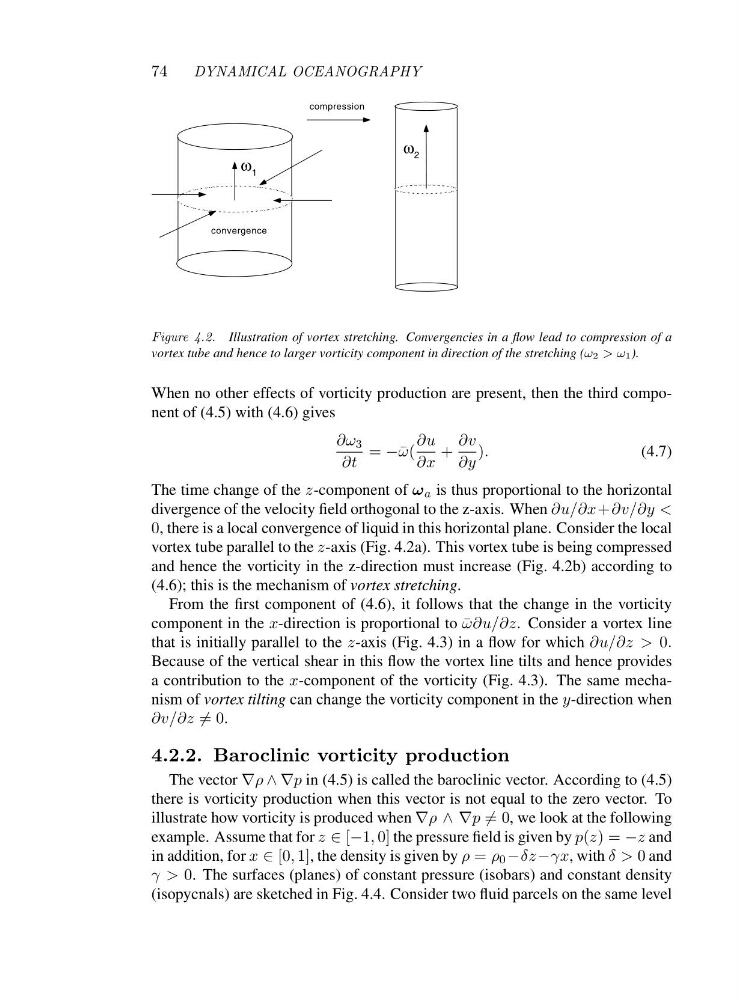
Figure 4.2. Illustration of vortex stretching. Convergencies in a flow lead to compression of a
vortex tube and hence to larger vorticity component in direction of the stretching (ω2 >ω1).
When no other effects of vorticity production are present, then the third component of (4.5) with (4.6) gives
∂ω 3
∂t
= −¯ ω(
∂u
∂x
+
∂v
∂y
).
(4.7)
The time change of the z-component of ω a is thus proportional to the horizontal
divergence of the velocity field orthogonal to the z-axis. When ∂u/∂x+∂v/∂y <
0, there is a local convergence of liquid in this horizontal plane. Consider the local
vortex tube parallel to the z-axis (Fig. 4.2a). This vortex tube is being compressed
and hence the vorticity in the z-direction must increase (Fig. 4.2b) according to
(4.6); this is the mechanism of vortex stretching.
From the first component of (4.6), it follows that the change in the vorticity
component in the x-direction is proportional to ¯
ω∂u/∂z. Consider a vortex line
that is initially parallel to the z-axis (Fig. 4.3) in a flow for which ∂u/∂z > 0.
Because of the vertical shear in this flow the vortex line tilts and hence provides
a contribution to the x-component of the vorticity (Fig. 4.3). The same mechanism of vortex tilting can change the vorticity component in the y-direction when
∂v/∂z =0.
4.2.2. Baroclinic vorticity production
The vector ∇ρ ∧∇p in (4.5) is called the baroclinic vector. According to (4.5)
there is vorticity production when this vector is not equal to the zero vector. To
illustrate how vorticity is produced when ∇ρ ∧∇ p =0, we look at the following
example. Assume that for z ∈ [−1, 0] the pressure field is given by p(z)=−z and
in addition, for x ∈ [0, 1], the density is given by ρ = ρ 0 −δz−γx, with δ>0 and
γ>0. The surfaces (planes) of constant pressure (isobars) and constant density
(isopycnals) are sketched in Fig. 4.4. Consider two fluid parcels on the same level
DYNAMICAL OCEANOGRAPHY
ω 1
ω 2
compression
convergence
Figure 4.2. Illustration of vortex stretching. Convergencies in a flow lead to compression of a
vortex tube and hence to larger vorticity component in direction of the stretching (ω2 >ω1).
When no other effects of vorticity production are present, then the third component of (4.5) with (4.6) gives
∂ω 3
∂t
= −¯ ω(
∂u
∂x
+
∂v
∂y
).
(4.7)
The time change of the z-component of ω a is thus proportional to the horizontal
divergence of the velocity field orthogonal to the z-axis. When ∂u/∂x+∂v/∂y <
0, there is a local convergence of liquid in this horizontal plane. Consider the local
vortex tube parallel to the z-axis (Fig. 4.2a). This vortex tube is being compressed
and hence the vorticity in the z-direction must increase (Fig. 4.2b) according to
(4.6); this is the mechanism of vortex stretching.
From the first component of (4.6), it follows that the change in the vorticity
component in the x-direction is proportional to ¯
ω∂u/∂z. Consider a vortex line
that is initially parallel to the z-axis (Fig. 4.3) in a flow for which ∂u/∂z > 0.
Because of the vertical shear in this flow the vortex line tilts and hence provides
a contribution to the x-component of the vorticity (Fig. 4.3). The same mechanism of vortex tilting can change the vorticity component in the y-direction when
∂v/∂z =0.
4.2.2. Baroclinic vorticity production
The vector ∇ρ ∧∇p in (4.5) is called the baroclinic vector. According to (4.5)
there is vorticity production when this vector is not equal to the zero vector. To
illustrate how vorticity is produced when ∇ρ ∧∇ p =0, we look at the following
example. Assume that for z ∈ [−1, 0] the pressure field is given by p(z)=−z and
in addition, for x ∈ [0, 1], the density is given by ρ = ρ 0 −δz−γx, with δ>0 and
γ>0. The surfaces (planes) of constant pressure (isobars) and constant density
(isopycnals) are sketched in Fig. 4.4. Consider two fluid parcels on the same level