

Vorticity
73
Because the vorticity field is divergence free, Helmholtz’ theorem states that if C 1
and C 2 are two closed curves on a vortex tube (Fig. 4.1) then
Γ 1 =
C1
v · ds =
C2
v · ds =Γ 2 ,
(4.2)
where Γ is the circulation of the velocity field with respect to a closed curve C.
The balance of vorticity follows from the momentum balance (3.29a) by taking
the curl of both sides of the equation. With help of
v ·∇v −
∇v 2
2
+ ω ∧ v =0 ,
(4.3a)
∇∧(
∇p
ρ
)+
∇ρ ∧∇p
ρ 2
=0 ,
(4.3b)
where v 2 = v · v, the vorticity equation is written as
∂ω
∂t
+ ∇∧((2Ω + ω) ∧ v)=ρ
−2 ∇ρ ∧∇p + ∇∧F I .
(4.4)
Using ∇·ω =0and ∇∧(v ∧ ω)=ω ·∇v − ω∇·v − v ·∇ω, it follows that
(4.4) can be written as
∂ω a
∂t
= −v ·∇ω a + ω a ·∇v − ω a ∇·v +
∇ρ ∧∇p
ρ 2
+ ∇∧F I .
(4.5)
This equation shows that the local vorticity can change through advection,
Ex. 4.3
changes in orientation of vortex lines, changes in thickness of vortex tubes, density (or baroclinic) effects and random mixing (diffusion) of vorticity. Of these,
advection needs no further explanation: the other vorticity changing mechanisms
are considered in the next section.
4.2. Vorticity transport
Using elementary examples, we will present the mechanisms of vortex stretching, vortex tilting, baroclinic vorticity production and diffusion of vorticity.
4.2.1. Vortex stretching and tilting
Consider in Fig. 4.2 a situation where in a local Cartesian coordinate system, the vector ω a is initially parallel to the z-axis, i.e., ω a =( ω 1 ,ω 2 ,ω 3 ) T =
¯
ω (0, 0, 1) T , where the superscript T indicates transpose and ¯
ω>0.I ft h ec o m -
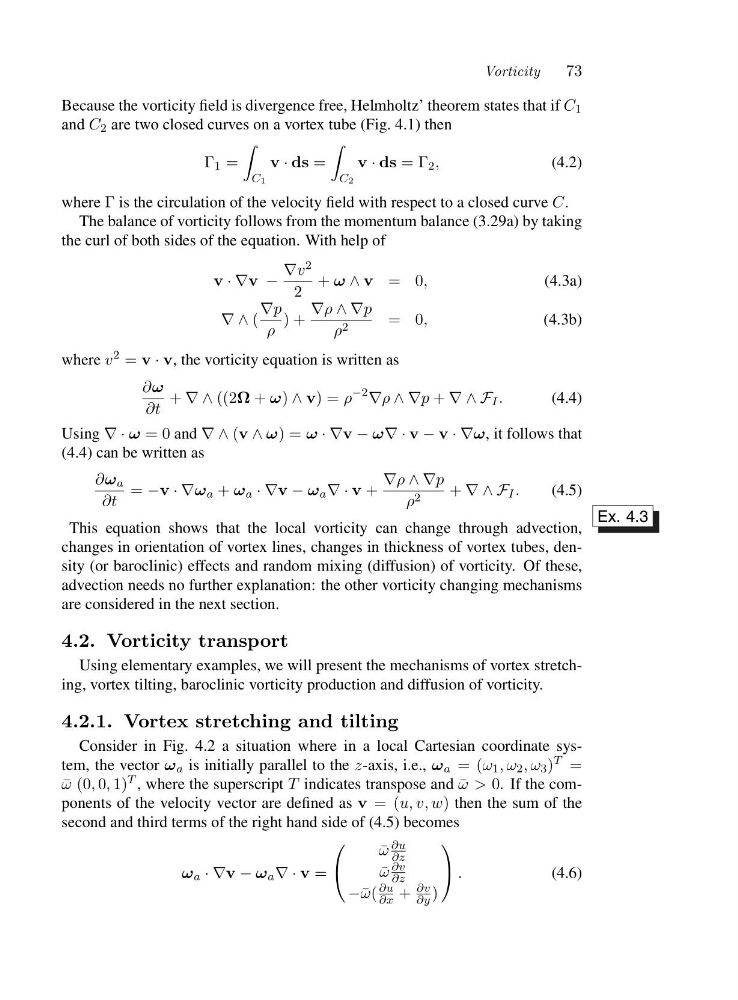
ponents of the velocity vector are defined as v =( u, v, w) then the sum of the
second and third terms of the right hand side of (4.5) becomes
ω a ·∇v − ω a ∇·v =
⎛
⎝
¯
ω
∂u
∂z
¯
ω
∂v
∂z
−¯ ω(
∂u
∂x +
∂v
∂y )
⎞
⎠ .
(4.6)
73
Because the vorticity field is divergence free, Helmholtz’ theorem states that if C 1
and C 2 are two closed curves on a vortex tube (Fig. 4.1) then
Γ 1 =
C1
v · ds =
C2
v · ds =Γ 2 ,
(4.2)
where Γ is the circulation of the velocity field with respect to a closed curve C.
The balance of vorticity follows from the momentum balance (3.29a) by taking
the curl of both sides of the equation. With help of
v ·∇v −
∇v 2
2
+ ω ∧ v =0 ,
(4.3a)
∇∧(
∇p
ρ
)+
∇ρ ∧∇p
ρ 2
=0 ,
(4.3b)
where v 2 = v · v, the vorticity equation is written as
∂ω
∂t
+ ∇∧((2Ω + ω) ∧ v)=ρ
−2 ∇ρ ∧∇p + ∇∧F I .
(4.4)
Using ∇·ω =0and ∇∧(v ∧ ω)=ω ·∇v − ω∇·v − v ·∇ω, it follows that
(4.4) can be written as
∂ω a
∂t
= −v ·∇ω a + ω a ·∇v − ω a ∇·v +
∇ρ ∧∇p
ρ 2
+ ∇∧F I .
(4.5)
This equation shows that the local vorticity can change through advection,
Ex. 4.3
changes in orientation of vortex lines, changes in thickness of vortex tubes, density (or baroclinic) effects and random mixing (diffusion) of vorticity. Of these,
advection needs no further explanation: the other vorticity changing mechanisms
are considered in the next section.
4.2. Vorticity transport
Using elementary examples, we will present the mechanisms of vortex stretching, vortex tilting, baroclinic vorticity production and diffusion of vorticity.
4.2.1. Vortex stretching and tilting
Consider in Fig. 4.2 a situation where in a local Cartesian coordinate system, the vector ω a is initially parallel to the z-axis, i.e., ω a =( ω 1 ,ω 2 ,ω 3 ) T =
¯
ω (0, 0, 1) T , where the superscript T indicates transpose and ¯
ω>0.I ft h ec o m -
ponents of the velocity vector are defined as v =( u, v, w) then the sum of the
second and third terms of the right hand side of (4.5) becomes
ω a ·∇v − ω a ∇·v =
⎛
⎝
¯
ω
∂u
∂z
¯
ω
∂v
∂z
−¯ ω(
∂u
∂x +
∂v
∂y )
⎞
⎠ .
(4.6)