

54
DYNAMICAL OCEANOGRAPHY
(a)
(b)
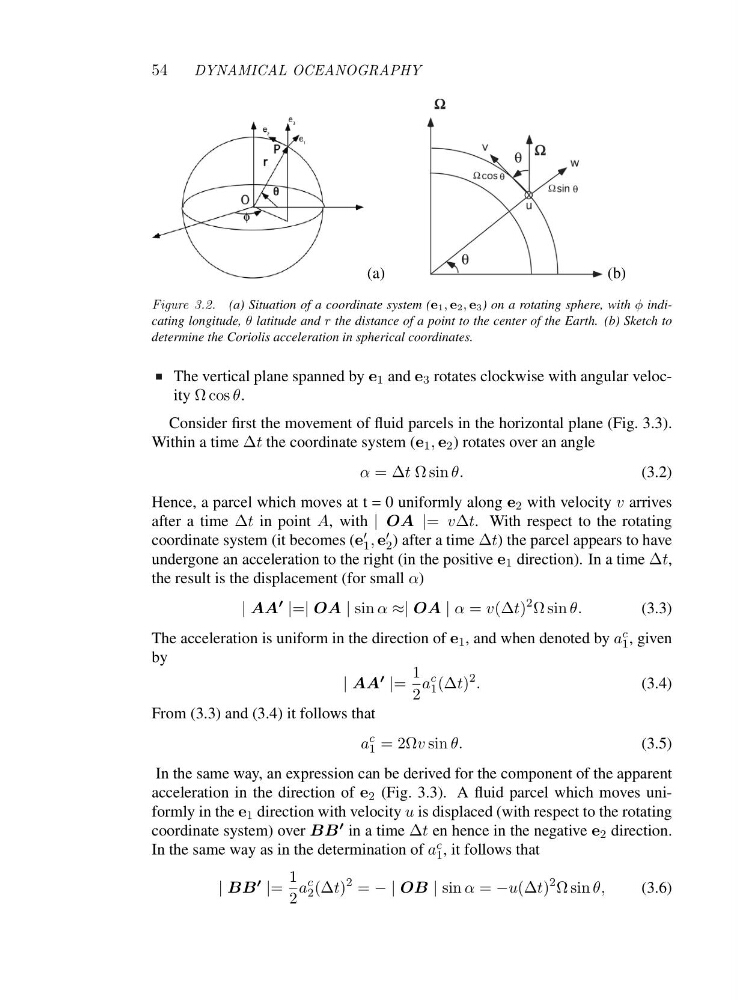
Figure 3.2. (a) Situation of a coordinate system (e1, e2, e3) on a rotating sphere, with φ indicating longitude, θ latitude and r the distance of a point to the center of the Earth. (b) Sketch to
determine the Coriolis acceleration in spherical coordinates.
The vertical plane spanned by e 1 and e 3 rotates clockwise with angular velocity Ωcosθ.
Consider first the movement of fluid parcels in the horizontal plane (Fig. 3.3).
Within a time Δt the coordinate system (e 1 , e 2 ) rotates over an angle
α =Δt Ωsinθ.
(3.2)
Hence, a parcel which moves at t = 0 uniformly along e 2 with velocity v arrives
after a time Δt in point A, with | OA |= vΔt. With respect to the rotating
coordinate system (it becomes (e ′
1 , e ′
2 ) after a time Δt) the parcel appears to have
undergone an acceleration to the right (in the positive e 1 direction). In a time Δt,
the result is the displacement (for small α)
| AA ′ |=| OA | sin α ≈| OA | α = v(Δt)
2 Ωsinθ.
(3.3)
The acceleration is uniform in the direction of e 1 , and when denoted by a c
1 ,given
by
| AA ′ |=
1
2
a
c
1 (Δt)
2 .
(3.4)
From (3.3) and (3.4) it follows that
a
c
1 =2Ωv sin θ.
(3.5)
In the same way, an expression can be derived for the component of the apparent
acceleration in the direction of e 2 (Fig. 3.3). A fluid parcel which moves uniformly in the e 1 direction with velocity u is displaced (with respect to the rotating
coordinate system) over BB ′ in a time Δt en hence in the negative e 2 direction.
In the same way as in the determination of a c
1 , it follows that
| BB ′ |=
1
2
a
c
2 (Δt)
2 = −|OB | sin α = −u(Δt)
2 Ωsinθ,
(3.6)
DYNAMICAL OCEANOGRAPHY
(a)
(b)
Figure 3.2. (a) Situation of a coordinate system (e1, e2, e3) on a rotating sphere, with φ indicating longitude, θ latitude and r the distance of a point to the center of the Earth. (b) Sketch to
determine the Coriolis acceleration in spherical coordinates.
The vertical plane spanned by e 1 and e 3 rotates clockwise with angular velocity Ωcosθ.
Consider first the movement of fluid parcels in the horizontal plane (Fig. 3.3).
Within a time Δt the coordinate system (e 1 , e 2 ) rotates over an angle
α =Δt Ωsinθ.
(3.2)
Hence, a parcel which moves at t = 0 uniformly along e 2 with velocity v arrives
after a time Δt in point A, with | OA |= vΔt. With respect to the rotating
coordinate system (it becomes (e ′
1 , e ′
2 ) after a time Δt) the parcel appears to have
undergone an acceleration to the right (in the positive e 1 direction). In a time Δt,
the result is the displacement (for small α)
| AA ′ |=| OA | sin α ≈| OA | α = v(Δt)
2 Ωsinθ.
(3.3)
The acceleration is uniform in the direction of e 1 , and when denoted by a c
1 ,given
by
| AA ′ |=
1
2
a
c
1 (Δt)
2 .
(3.4)
From (3.3) and (3.4) it follows that
a
c
1 =2Ωv sin θ.
(3.5)
In the same way, an expression can be derived for the component of the apparent
acceleration in the direction of e 2 (Fig. 3.3). A fluid parcel which moves uniformly in the e 1 direction with velocity u is displaced (with respect to the rotating
coordinate system) over BB ′ in a time Δt en hence in the negative e 2 direction.
In the same way as in the determination of a c
1 , it follows that
| BB ′ |=
1
2
a
c
2 (Δt)
2 = −|OB | sin α = −u(Δt)
2 Ωsinθ,
(3.6)