

Mathematical description
53
This indicates the time scale on which the ocean flow with velocity U changes
on the length scale L. Typical values for the basin scale flow above would be
τ a =10 8 s ≈ 3 years.
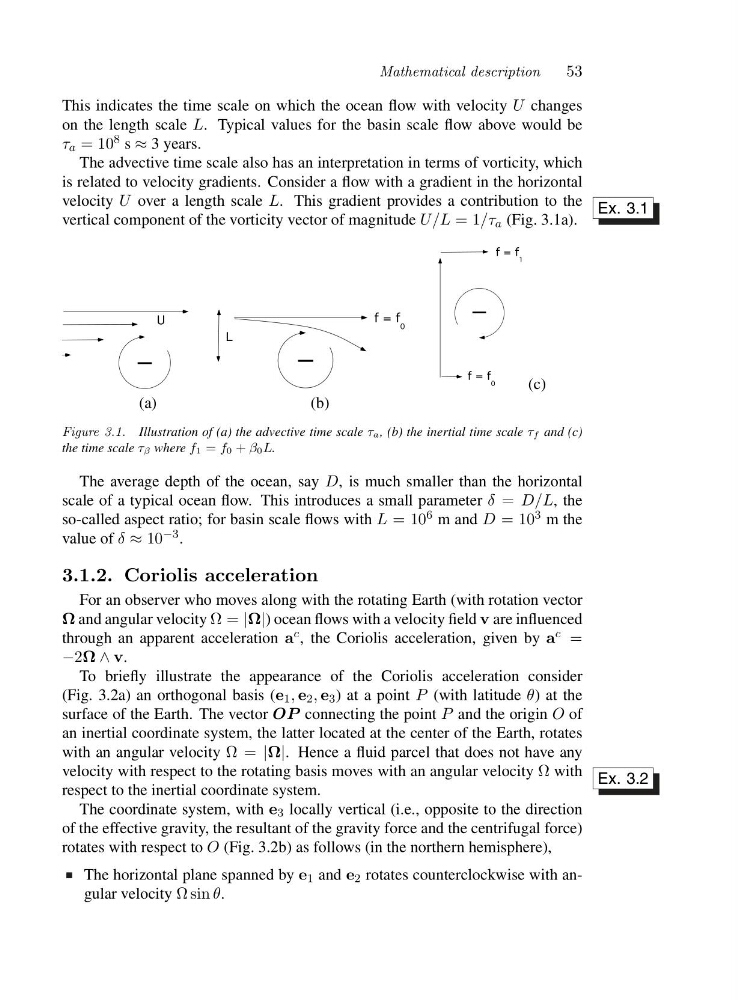
The advective time scale also has an interpretation in terms of vorticity, which
is related to velocity gradients. Consider a flow with a gradient in the horizontal
velocity U over a length scale L. This gradient provides a contribution to the
vertical component of the vorticity vector of magnitude U/L =1/τ a (Fig. 3.1a).
Ex. 3.1
L
U
_
(a)
_
f = f
0
(b)
_
f = f
0
f = f
1
(c)
Figure 3.1. Illustration of (a) the advective time scale τa, (b) the inertial time scale τf and (c)
the time scale τβ where f1 = f0 + β0L.
The average depth of the ocean, say D, is much smaller than the horizontal
scale of a typical ocean flow. This introduces a small parameter δ = D/L,t h e
so-called aspect ratio; for basin scale flows with L =1 0 6 mandD =1 0 3 mthe
value of δ ≈ 10 −3 .
3.1.2. Coriolis acceleration
For an observer who moves along with the rotating Earth (with rotation vector
Ω and angular velocity Ω=|Ω|) ocean flows with a velocity field v are influenced
through an apparent acceleration a c , the Coriolis acceleration, given by a c =
−2Ω ∧ v.
To briefly illustrate the appearance of the Coriolis acceleration consider
(Fig. 3.2a) an orthogonal basis (e 1 , e 2 , e 3 ) at a point P (with latitude θ)a tt h e
surface of the Earth. The vector OP connecting the point P and the origin O of
an inertial coordinate system, the latter located at the center of the Earth, rotates
with an angular velocity Ω=|Ω|. Hence a fluid parcel that does not have any
velocity with respect to the rotating basis moves with an angular velocity Ω with
respect to the inertial coordinate system.
Ex. 3.2
The coordinate system, with e 3 locally vertical (i.e., opposite to the direction
of the effective gravity, the resultant of the gravity force and the centrifugal force)
rotates with respect to O (Fig. 3.2b) as follows (in the northern hemisphere),
The horizontal plane spanned by e 1 and e 2 rotates counterclockwise with angular velocity Ωsinθ.
53
This indicates the time scale on which the ocean flow with velocity U changes
on the length scale L. Typical values for the basin scale flow above would be
τ a =10 8 s ≈ 3 years.
The advective time scale also has an interpretation in terms of vorticity, which
is related to velocity gradients. Consider a flow with a gradient in the horizontal
velocity U over a length scale L. This gradient provides a contribution to the
vertical component of the vorticity vector of magnitude U/L =1/τ a (Fig. 3.1a).
Ex. 3.1
L
U
_
(a)
_
f = f
0
(b)
_
f = f
0
f = f
1
(c)
Figure 3.1. Illustration of (a) the advective time scale τa, (b) the inertial time scale τf and (c)
the time scale τβ where f1 = f0 + β0L.
The average depth of the ocean, say D, is much smaller than the horizontal
scale of a typical ocean flow. This introduces a small parameter δ = D/L,t h e
so-called aspect ratio; for basin scale flows with L =1 0 6 mandD =1 0 3 mthe
value of δ ≈ 10 −3 .
3.1.2. Coriolis acceleration
For an observer who moves along with the rotating Earth (with rotation vector
Ω and angular velocity Ω=|Ω|) ocean flows with a velocity field v are influenced
through an apparent acceleration a c , the Coriolis acceleration, given by a c =
−2Ω ∧ v.
To briefly illustrate the appearance of the Coriolis acceleration consider
(Fig. 3.2a) an orthogonal basis (e 1 , e 2 , e 3 ) at a point P (with latitude θ)a tt h e
surface of the Earth. The vector OP connecting the point P and the origin O of
an inertial coordinate system, the latter located at the center of the Earth, rotates
with an angular velocity Ω=|Ω|. Hence a fluid parcel that does not have any
velocity with respect to the rotating basis moves with an angular velocity Ω with
respect to the inertial coordinate system.
Ex. 3.2
The coordinate system, with e 3 locally vertical (i.e., opposite to the direction
of the effective gravity, the resultant of the gravity force and the centrifugal force)
rotates with respect to O (Fig. 3.2b) as follows (in the northern hemisphere),
The horizontal plane spanned by e 1 and e 2 rotates counterclockwise with angular velocity Ωsinθ.