

38
DYNAMICAL OCEANOGRAPHY
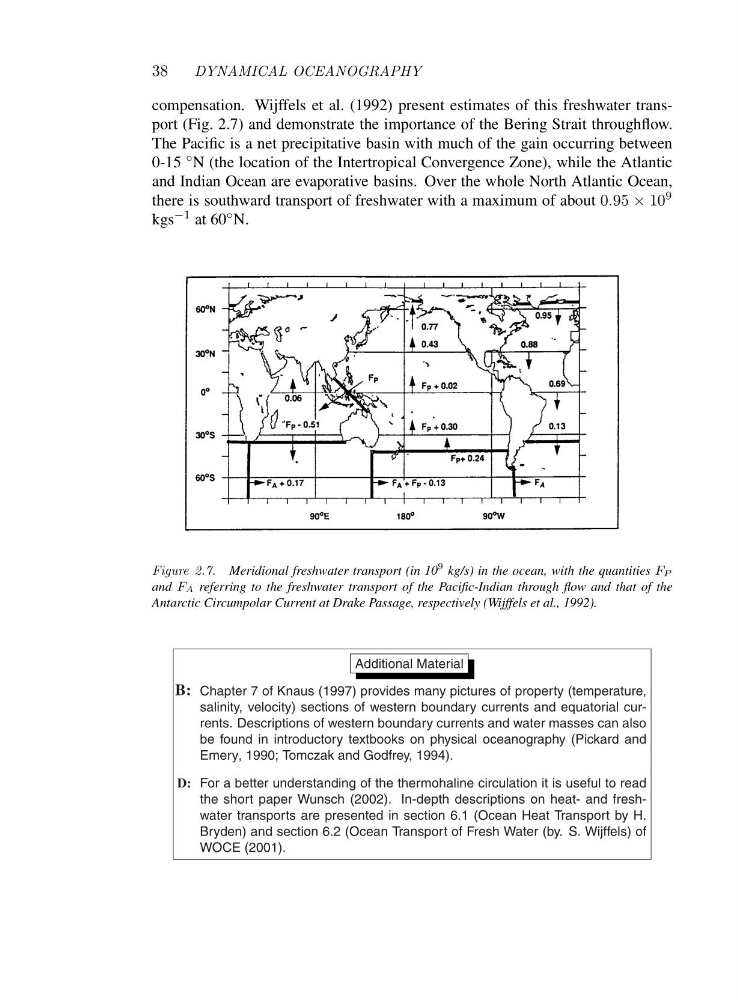
compensation. Wijffels et al. (1992) present estimates of this freshwater transport (Fig. 2.7) and demonstrate the importance of the Bering Strait throughflow.
The Pacific is a net precipitative basin with much of the gain occurring between
0-15 ◦ N (the location of the Intertropical Convergence Zone), while the Atlantic
and Indian Ocean are evaporative basins. Over the whole North Atlantic Ocean,
there is southward transport of freshwater with a maximum of about 0.95 × 10 9
kgs −1 at 60 ◦ N.
Figure 2.7. Meridional freshwater transport (in 10
9 kg/s) in the ocean, with the quantities FP
and FA referring to the freshwater transport of the Pacific-Indian through flow and that of the
Antarctic Circumpolar Current at Drake Passage, respectively (Wijffels et al., 1992).
Additional Material
B: Chapter 7 of Knaus (1997) provides many pictures of property (temperature,
salinity, velocity) sections of western boundary currents and equatorial currents. Descriptions of western boundary currents and water masses can also
be found in introductory textbooks on physical oceanography (Pickard and
Emery, 1990; Tomczak and Godfrey, 1994).
D: For a better understanding of the thermohaline circulation it is useful to read
the short paper Wunsch (2002). In-depth descriptions on heat- and freshwater transports are presented in section 6.1 (Ocean Heat Transport by H.
Bryden) and section 6.2 (Ocean Transport of Fresh Water (by. S. Wijffels) of
WOCE (2001).
DYNAMICAL OCEANOGRAPHY
compensation. Wijffels et al. (1992) present estimates of this freshwater transport (Fig. 2.7) and demonstrate the importance of the Bering Strait throughflow.
The Pacific is a net precipitative basin with much of the gain occurring between
0-15 ◦ N (the location of the Intertropical Convergence Zone), while the Atlantic
and Indian Ocean are evaporative basins. Over the whole North Atlantic Ocean,
there is southward transport of freshwater with a maximum of about 0.95 × 10 9
kgs −1 at 60 ◦ N.
Figure 2.7. Meridional freshwater transport (in 10
9 kg/s) in the ocean, with the quantities FP
and FA referring to the freshwater transport of the Pacific-Indian through flow and that of the
Antarctic Circumpolar Current at Drake Passage, respectively (Wijffels et al., 1992).
Additional Material
B: Chapter 7 of Knaus (1997) provides many pictures of property (temperature,
salinity, velocity) sections of western boundary currents and equatorial currents. Descriptions of western boundary currents and water masses can also
be found in introductory textbooks on physical oceanography (Pickard and
Emery, 1990; Tomczak and Godfrey, 1994).
D: For a better understanding of the thermohaline circulation it is useful to read
the short paper Wunsch (2002). In-depth descriptions on heat- and freshwater transports are presented in section 6.1 (Ocean Heat Transport by H.
Bryden) and section 6.2 (Ocean Transport of Fresh Water (by. S. Wijffels) of
WOCE (2001).