

388
DYNAMICAL OCEANOGRAPHY
16.5. Physical mechanisms
In this section, we will look at the two mechanisms which may cause multiple
equilibria in more detail: the salt-advection feedback and the convective feedback.
16.5.1. Advective feedback
A nonlinear feedback between the flow and the density structure, called the
(salt) advection feedback, is responsible for the non-uniqueness of equilibrium
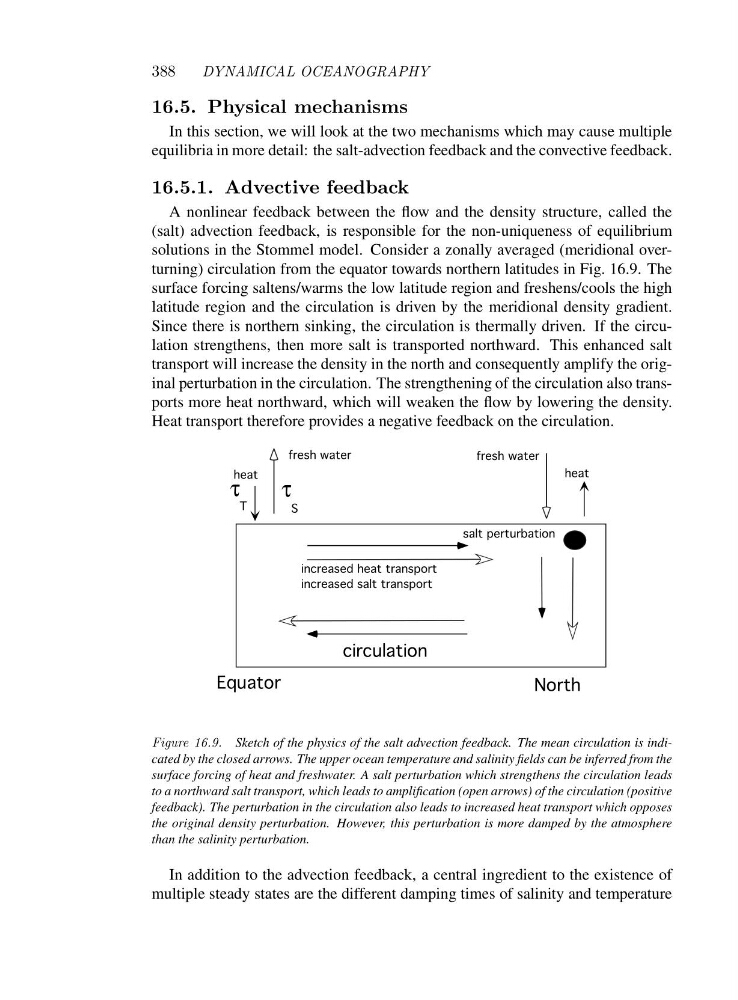
solutions in the Stommel model. Consider a zonally averaged (meridional overturning) circulation from the equator towards northern latitudes in Fig. 16.9. The
surface forcing saltens/warms the low latitude region and freshens/cools the high
latitude region and the circulation is driven by the meridional density gradient.
Since there is northern sinking, the circulation is thermally driven. If the circulation strengthens, then more salt is transported northward. This enhanced salt
transport will increase the density in the north and consequently amplify the original perturbation in the circulation. The strengthening of the circulation also transports more heat northward, which will weaken the flow by lowering the density.
Heat transport therefore provides a negative feedback on the circulation.
heat
heat
fresh water
fresh water
S
τ
T
τ
Equator
North
circulation
salt perturbation
increased heat transport
increased salt transport
Figure 16.9. Sketch of the physics of the salt advection feedback. The mean circulation is indicated by the closed arrows. The upper ocean temperature and salinity fields can be inferred from the
surface forcing of heat and freshwater. A salt perturbation which strengthens the circulation leads
to a northward salt transport, which leads to amplification (open arrows) of the circulation (positive
feedback). The perturbation in the circulation also leads to increased heat transport which opposes
the original density perturbation. However, this perturbation is more damped by the atmosphere
than the salinity perturbation.
In addition to the advection feedback, a central ingredient to the existence of
multiple steady states are the different damping times of salinity and temperature
DYNAMICAL OCEANOGRAPHY
16.5. Physical mechanisms
In this section, we will look at the two mechanisms which may cause multiple
equilibria in more detail: the salt-advection feedback and the convective feedback.
16.5.1. Advective feedback
A nonlinear feedback between the flow and the density structure, called the
(salt) advection feedback, is responsible for the non-uniqueness of equilibrium
solutions in the Stommel model. Consider a zonally averaged (meridional overturning) circulation from the equator towards northern latitudes in Fig. 16.9. The
surface forcing saltens/warms the low latitude region and freshens/cools the high
latitude region and the circulation is driven by the meridional density gradient.
Since there is northern sinking, the circulation is thermally driven. If the circulation strengthens, then more salt is transported northward. This enhanced salt
transport will increase the density in the north and consequently amplify the original perturbation in the circulation. The strengthening of the circulation also transports more heat northward, which will weaken the flow by lowering the density.
Heat transport therefore provides a negative feedback on the circulation.
heat
heat
fresh water
fresh water
S
τ
T
τ
Equator
North
circulation
salt perturbation
increased heat transport
increased salt transport
Figure 16.9. Sketch of the physics of the salt advection feedback. The mean circulation is indicated by the closed arrows. The upper ocean temperature and salinity fields can be inferred from the
surface forcing of heat and freshwater. A salt perturbation which strengthens the circulation leads
to a northward salt transport, which leads to amplification (open arrows) of the circulation (positive
feedback). The perturbation in the circulation also leads to increased heat transport which opposes
the original density perturbation. However, this perturbation is more damped by the atmosphere
than the salinity perturbation.
In addition to the advection feedback, a central ingredient to the existence of
multiple steady states are the different damping times of salinity and temperature