

Thermohaline circulation
387
where ˆ
x =( ˆ
T, ˆ
S) The matrix on the left hand side is called the Jacobian matrix
and will in most cases be indicated by J.
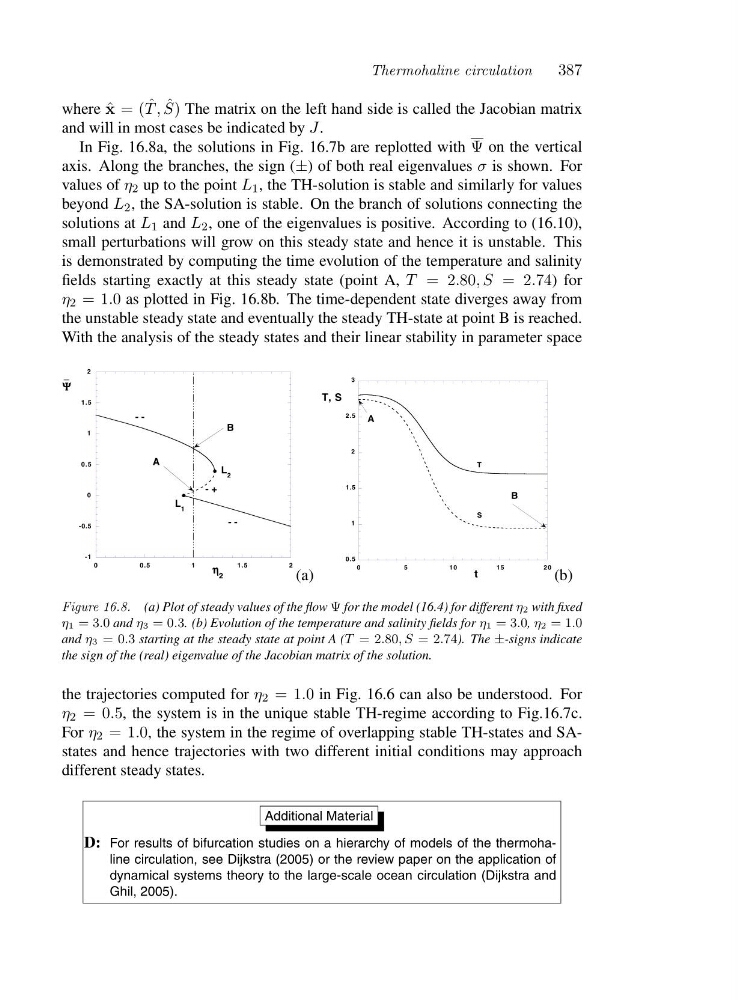
In Fig. 16.8a, the solutions in Fig. 16.7b are replotted with Ψ on the vertical
axis. Along the branches, the sign (±) of both real eigenvalues σ is shown. For
values of η 2 up to the point L 1 , the TH-solution is stable and similarly for values
beyond L 2 , the SA-solution is stable. On the branch of solutions connecting the
solutions at L 1 and L 2 , one of the eigenvalues is positive. According to (16.10),
small perturbations will grow on this steady state and hence it is unstable. This
is demonstrated by computing the time evolution of the temperature and salinity
fields starting exactly at this steady state (point A, T =2 .80,S =2 .74)f o r
η 2 =1 .0 as plotted in Fig. 16.8b. The time-dependent state diverges away from
the unstable steady state and eventually the steady TH-state at point B is reached.
With the analysis of the steady states and their linear stability in parameter space
-1
-0.5
0
0.5
1
1.5
2
0
0.5
1
1.5
2
η η η
η 2
Ψ Ψ
Ψ
Ψ
L 1
L 2
- -
- -
- +
A
B
_
(a)
0.5
1
1.5
2
2.5
3
0
5
10
15
20
t
T, S
T
S
A
B
(b)
Figure 16.8. (a) Plot of steady values of the flow Ψ for the model (16.4) for different η2 with fixed
η1 =3.0 and η3 =0.3. (b) Evolution of the temperature and salinity fields for η1 =3.0, η2 =1.0
and η3 =0 .3 starting at the steady state at point A (T =2 .80,S =2 .74). The ±-signs indicate
the sign of the (real) eigenvalue of the Jacobian matrix of the solution.
the trajectories computed for η 2 =1 .0 in Fig. 16.6 can also be understood. For
η 2 =0 .5, the system is in the unique stable TH-regime according to Fig.16.7c.
For η 2 =1 .0, the system in the regime of overlapping stable TH-states and SAstates and hence trajectories with two different initial conditions may approach
different steady states.
Additional Material
D: For results of bifurcation studies on a hierarchy of models of the thermohaline circulation, see Dijkstra (2005) or the review paper on the application of
dynamical systems theory to the large-scale ocean circulation (Dijkstra and
Ghil, 2005).
387
where ˆ
x =( ˆ
T, ˆ
S) The matrix on the left hand side is called the Jacobian matrix
and will in most cases be indicated by J.
In Fig. 16.8a, the solutions in Fig. 16.7b are replotted with Ψ on the vertical
axis. Along the branches, the sign (±) of both real eigenvalues σ is shown. For
values of η 2 up to the point L 1 , the TH-solution is stable and similarly for values
beyond L 2 , the SA-solution is stable. On the branch of solutions connecting the
solutions at L 1 and L 2 , one of the eigenvalues is positive. According to (16.10),
small perturbations will grow on this steady state and hence it is unstable. This
is demonstrated by computing the time evolution of the temperature and salinity
fields starting exactly at this steady state (point A, T =2 .80,S =2 .74)f o r
η 2 =1 .0 as plotted in Fig. 16.8b. The time-dependent state diverges away from
the unstable steady state and eventually the steady TH-state at point B is reached.
With the analysis of the steady states and their linear stability in parameter space
-1
-0.5
0
0.5
1
1.5
2
0
0.5
1
1.5
2
η η η
η 2
Ψ Ψ
Ψ
Ψ
L 1
L 2
- -
- -
- +
A
B
_
(a)
0.5
1
1.5
2
2.5
3
0
5
10
15
20
t
T, S
T
S
A
B
(b)
Figure 16.8. (a) Plot of steady values of the flow Ψ for the model (16.4) for different η2 with fixed
η1 =3.0 and η3 =0.3. (b) Evolution of the temperature and salinity fields for η1 =3.0, η2 =1.0
and η3 =0 .3 starting at the steady state at point A (T =2 .80,S =2 .74). The ±-signs indicate
the sign of the (real) eigenvalue of the Jacobian matrix of the solution.
the trajectories computed for η 2 =1 .0 in Fig. 16.6 can also be understood. For
η 2 =0 .5, the system is in the unique stable TH-regime according to Fig.16.7c.
For η 2 =1 .0, the system in the regime of overlapping stable TH-states and SAstates and hence trajectories with two different initial conditions may approach
different steady states.
Additional Material
D: For results of bifurcation studies on a hierarchy of models of the thermohaline circulation, see Dijkstra (2005) or the review paper on the application of
dynamical systems theory to the large-scale ocean circulation (Dijkstra and
Ghil, 2005).