

384
DYNAMICAL OCEANOGRAPHY
16.3. Equilibrium solutions
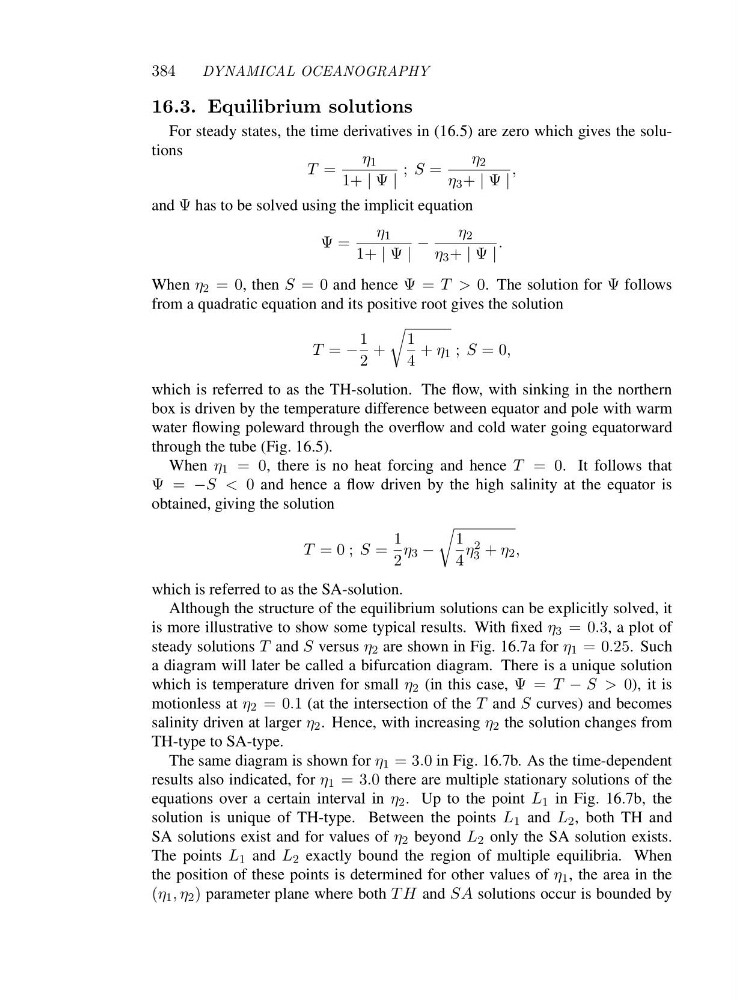
For steady states, the time derivatives in (16.5) are zero which gives the solutions
T =
η 1
1+ | Ψ |
; S =
η 2
η 3 + | Ψ |
,
and Ψ has to be solved using the implicit equation
Ψ=
η 1
1+ | Ψ |
−
η 2
η 3 + | Ψ |
.
When η 2 =0 ,t h e nS =0and hence Ψ=T>0. The solution for Ψ follows
from a quadratic equation and its positive root gives the solution
T = −
1
2
+
1
4
+ η 1 ; S =0,
which is referred to as the TH-solution. The flow, with sinking in the northern
box is driven by the temperature difference between equator and pole with warm
water flowing poleward through the overflow and cold water going equatorward
through the tube (Fig. 16.5).
When η 1 =0 , there is no heat forcing and hence T =0 . It follows that
Ψ=−S<0 and hence a flow driven by the high salinity at the equator is
obtained, giving the solution
T =0; S =
1
2
η 3 −
1
4
η 2
3 + η 2 ,
which is referred to as the SA-solution.
Although the structure of the equilibrium solutions can be explicitly solved, it
is more illustrative to show some typical results. With fixed η 3 =0 .3, a plot of
steady solutions T and S versus η 2 are shown in Fig. 16.7a for η 1 =0 .25.S u c h
a diagram will later be called a bifurcation diagram. There is a unique solution
which is temperature driven for small η 2 (in this case, Ψ=T − S>0), it is
motionless at η 2 =0 .1 (at the intersection of the T and S curves) and becomes
salinity driven at larger η 2 . Hence, with increasing η 2 the solution changes from
TH-type to SA-type.
Thesamediagramisshownforη 1 =3.0 in Fig. 16.7b. As the time-dependent
results also indicated, for η 1 =3 .0 there are multiple stationary solutions of the
equations over a certain interval in η 2 . Up to the point L 1 in Fig. 16.7b, the
solution is unique of TH-type. Between the points L 1 and L 2 , both TH and
SA solutions exist and for values of η 2 beyond L 2 only the SA solution exists.
The points L 1 and L 2 exactly bound the region of multiple equilibria. When
the position of these points is determined for other values of η 1 , the area in the
(η 1 ,η 2 ) parameter plane where both TH and SA solutions occur is bounded by
DYNAMICAL OCEANOGRAPHY
16.3. Equilibrium solutions
For steady states, the time derivatives in (16.5) are zero which gives the solutions
T =
η 1
1+ | Ψ |
; S =
η 2
η 3 + | Ψ |
,
and Ψ has to be solved using the implicit equation
Ψ=
η 1
1+ | Ψ |
−
η 2
η 3 + | Ψ |
.
When η 2 =0 ,t h e nS =0and hence Ψ=T>0. The solution for Ψ follows
from a quadratic equation and its positive root gives the solution
T = −
1
2
+
1
4
+ η 1 ; S =0,
which is referred to as the TH-solution. The flow, with sinking in the northern
box is driven by the temperature difference between equator and pole with warm
water flowing poleward through the overflow and cold water going equatorward
through the tube (Fig. 16.5).
When η 1 =0 , there is no heat forcing and hence T =0 . It follows that
Ψ=−S<0 and hence a flow driven by the high salinity at the equator is
obtained, giving the solution
T =0; S =
1
2
η 3 −
1
4
η 2
3 + η 2 ,
which is referred to as the SA-solution.
Although the structure of the equilibrium solutions can be explicitly solved, it
is more illustrative to show some typical results. With fixed η 3 =0 .3, a plot of
steady solutions T and S versus η 2 are shown in Fig. 16.7a for η 1 =0 .25.S u c h
a diagram will later be called a bifurcation diagram. There is a unique solution
which is temperature driven for small η 2 (in this case, Ψ=T − S>0), it is
motionless at η 2 =0 .1 (at the intersection of the T and S curves) and becomes
salinity driven at larger η 2 . Hence, with increasing η 2 the solution changes from
TH-type to SA-type.
Thesamediagramisshownforη 1 =3.0 in Fig. 16.7b. As the time-dependent
results also indicated, for η 1 =3 .0 there are multiple stationary solutions of the
equations over a certain interval in η 2 . Up to the point L 1 in Fig. 16.7b, the
solution is unique of TH-type. Between the points L 1 and L 2 , both TH and
SA solutions exist and for values of η 2 beyond L 2 only the SA solution exists.
The points L 1 and L 2 exactly bound the region of multiple equilibria. When
the position of these points is determined for other values of η 1 , the area in the
(η 1 ,η 2 ) parameter plane where both TH and SA solutions occur is bounded by