

286
DYNAMICAL OCEANOGRAPHY
where x P is a chosen fixed point within the area of wind response [x 1 ,x 2 ].
When the effect of the eastern boundary reflection is neglected (r E =0 ), then
(12.28b) and (12.28c) give
dT eE
dt
= −C TE T eE + μA 0 C hE
(T eE (t − 1+x P ) − θr W T eE (t − 1 − y
2
n x P )),
(12.29)
which shows that the average eastern basin temperature is influenced by local
damping and a remote signal due to propagation of Kelvin and Rossby waves.
The delay time 1 − x P is the effect due to the Kelvin wave and as this is relatively
fast, it can be neglected on long time scales. It provides the local amplification of
temperature perturbations by thermocline feedback through a forced Kelvin wave
response. The delay 1+y 2
n x P is the time taken for the Rossby wave to travel from
the center of wind patch near x P to the western boundary plus the time it takes
the reflected Kelvin wave to cross the basin. When returned in the eastern part of
the basin, it provides a delayed negative feedback to the temperature perturbation
(since r W > 0).
Additional Material
B: The articles Cane and Zebiak (1985), Battisti and Hirst (1989), Schopf and
Suarez (1988) provide an overview on the early modeling and understanding
of El Ni ˜
no .
D: The papers Jin (1997a) and Jin (1997b) provide a complete overview on the
different delayed oscillator models as the delayed oscillator equations are derived from shallow-water dynamics.
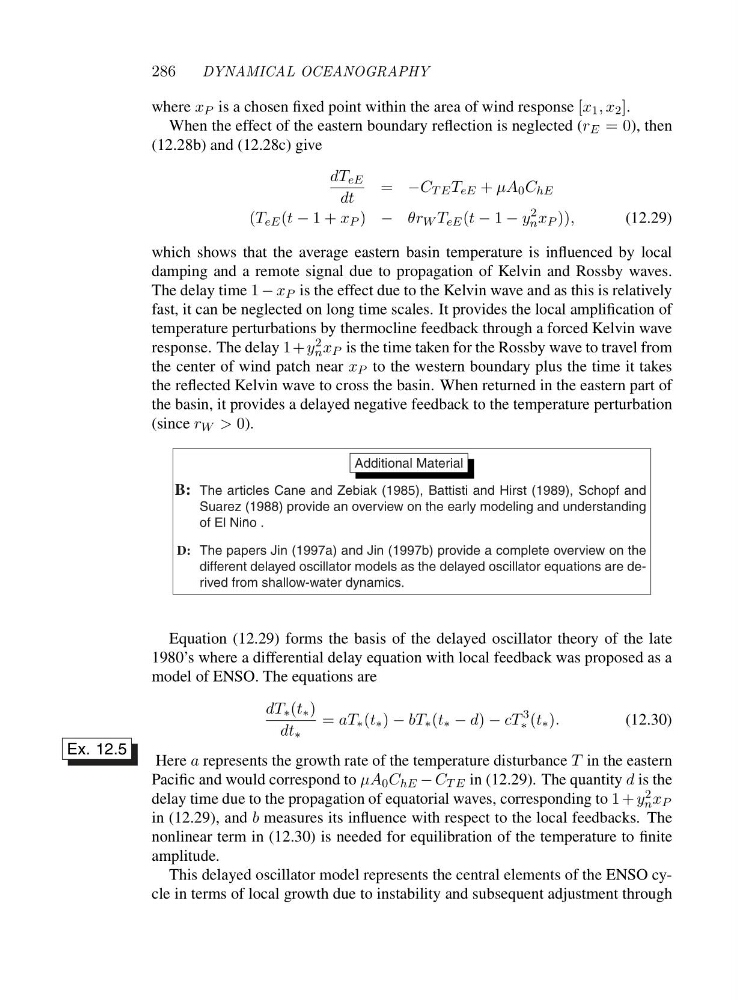
Equation (12.29) forms the basis of the delayed oscillator theory of the late
1980’s where a differential delay equation with local feedback was proposed as a
model of ENSO. The equations are
dT ∗ (t ∗ )
dt ∗
= aT ∗ (t ∗ ) − bT ∗ (t ∗ − d) − cT
3
∗ (t ∗ ).
(12.30)
Here a represents the growth rate of the temperature disturbance T in the eastern
Ex. 12.5
Pacific and would correspond to μA 0 C hE − C TE in (12.29). The quantity d is the
delay time due to the propagation of equatorial waves, corresponding to 1+y 2
n x P
in (12.29), and b measures its influence with respect to the local feedbacks. The
nonlinear term in (12.30) is needed for equilibration of the temperature to finite
amplitude.
This delayed oscillator model represents the central elements of the ENSO cycle in terms of local growth due to instability and subsequent adjustment through
DYNAMICAL OCEANOGRAPHY
where x P is a chosen fixed point within the area of wind response [x 1 ,x 2 ].
When the effect of the eastern boundary reflection is neglected (r E =0 ), then
(12.28b) and (12.28c) give
dT eE
dt
= −C TE T eE + μA 0 C hE
(T eE (t − 1+x P ) − θr W T eE (t − 1 − y
2
n x P )),
(12.29)
which shows that the average eastern basin temperature is influenced by local
damping and a remote signal due to propagation of Kelvin and Rossby waves.
The delay time 1 − x P is the effect due to the Kelvin wave and as this is relatively
fast, it can be neglected on long time scales. It provides the local amplification of
temperature perturbations by thermocline feedback through a forced Kelvin wave
response. The delay 1+y 2
n x P is the time taken for the Rossby wave to travel from
the center of wind patch near x P to the western boundary plus the time it takes
the reflected Kelvin wave to cross the basin. When returned in the eastern part of
the basin, it provides a delayed negative feedback to the temperature perturbation
(since r W > 0).
Additional Material
B: The articles Cane and Zebiak (1985), Battisti and Hirst (1989), Schopf and
Suarez (1988) provide an overview on the early modeling and understanding
of El Ni ˜
no .
D: The papers Jin (1997a) and Jin (1997b) provide a complete overview on the
different delayed oscillator models as the delayed oscillator equations are derived from shallow-water dynamics.
Equation (12.29) forms the basis of the delayed oscillator theory of the late
1980’s where a differential delay equation with local feedback was proposed as a
model of ENSO. The equations are
dT ∗ (t ∗ )
dt ∗
= aT ∗ (t ∗ ) − bT ∗ (t ∗ − d) − cT
3
∗ (t ∗ ).
(12.30)
Here a represents the growth rate of the temperature disturbance T in the eastern
Ex. 12.5
Pacific and would correspond to μA 0 C hE − C TE in (12.29). The quantity d is the
delay time due to the propagation of equatorial waves, corresponding to 1+y 2
n x P
in (12.29), and b measures its influence with respect to the local feedbacks. The
nonlinear term in (12.30) is needed for equilibration of the temperature to finite
amplitude.
This delayed oscillator model represents the central elements of the ENSO cycle in terms of local growth due to instability and subsequent adjustment through