

Dynamics of ENSO
287
(individual) Kelvin and Rossby waves. In the eastern part of the basin, strong
feedback takes place which leads to amplification of disturbances: positive SST
anomalies cause wind-stress anomalies, which weaken the background trade
winds, with maximum weakening west of the SST anomaly. This is turn creates a
different slope in the thermocline which leads through the thermocline feedback
to a larger SST anomaly.
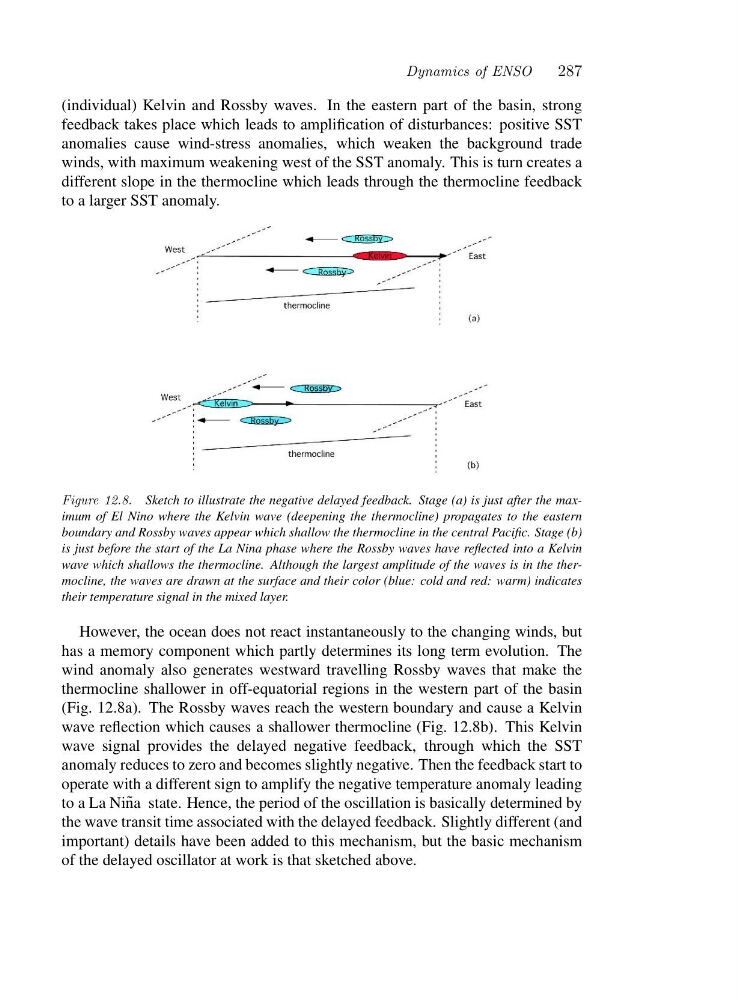
Figure 12.8. Sketch to illustrate the negative delayed feedback. Stage (a) is just after the maximum of El Nino where the Kelvin wave (deepening the thermocline) propagates to the eastern
boundary and Rossby waves appear which shallow the thermocline in the central Pacific. Stage (b)
is just before the start of the La Nina phase where the Rossby waves have reflected into a Kelvin
wave which shallows the thermocline. Although the largest amplitude of the waves is in the thermocline, the waves are drawn at the surface and their color (blue: cold and red: warm) indicates
their temperature signal in the mixed layer.
However, the ocean does not react instantaneously to the changing winds, but
has a memory component which partly determines its long term evolution. The
wind anomaly also generates westward travelling Rossby waves that make the
thermocline shallower in off-equatorial regions in the western part of the basin
(Fig. 12.8a). The Rossby waves reach the western boundary and cause a Kelvin
wave reflection which causes a shallower thermocline (Fig. 12.8b). This Kelvin
wave signal provides the delayed negative feedback, through which the SST
anomaly reduces to zero and becomes slightly negative. Then the feedback start to
operate with a different sign to amplify the negative temperature anomaly leading
toaLaNi˜ na state. Hence, the period of the oscillation is basically determined by
the wave transit time associated with the delayed feedback. Slightly different (and
important) details have been added to this mechanism, but the basic mechanism
of the delayed oscillator at work is that sketched above.
287
(individual) Kelvin and Rossby waves. In the eastern part of the basin, strong
feedback takes place which leads to amplification of disturbances: positive SST
anomalies cause wind-stress anomalies, which weaken the background trade
winds, with maximum weakening west of the SST anomaly. This is turn creates a
different slope in the thermocline which leads through the thermocline feedback
to a larger SST anomaly.
Figure 12.8. Sketch to illustrate the negative delayed feedback. Stage (a) is just after the maximum of El Nino where the Kelvin wave (deepening the thermocline) propagates to the eastern
boundary and Rossby waves appear which shallow the thermocline in the central Pacific. Stage (b)
is just before the start of the La Nina phase where the Rossby waves have reflected into a Kelvin
wave which shallows the thermocline. Although the largest amplitude of the waves is in the thermocline, the waves are drawn at the surface and their color (blue: cold and red: warm) indicates
their temperature signal in the mixed layer.
However, the ocean does not react instantaneously to the changing winds, but
has a memory component which partly determines its long term evolution. The
wind anomaly also generates westward travelling Rossby waves that make the
thermocline shallower in off-equatorial regions in the western part of the basin
(Fig. 12.8a). The Rossby waves reach the western boundary and cause a Kelvin
wave reflection which causes a shallower thermocline (Fig. 12.8b). This Kelvin
wave signal provides the delayed negative feedback, through which the SST
anomaly reduces to zero and becomes slightly negative. Then the feedback start to
operate with a different sign to amplify the negative temperature anomaly leading
toaLaNi˜ na state. Hence, the period of the oscillation is basically determined by
the wave transit time associated with the delayed feedback. Slightly different (and
important) details have been added to this mechanism, but the basic mechanism
of the delayed oscillator at work is that sketched above.