

Afi r s ti m p r e s s i o n
13
1.3.3. T - S diagrams and water masses
Salinity is a very important controlling agent of the density of ocean water
which increases with increasing salinity. Apart from the salinity, the temperature
T also exerts an influence on the density of ocean water. When pure water is
heated, the velocities of the water molecules increase which leads to thermal expansion. The supplied energy is also used for the formation of hydrogen bridges
which leads to thermal compression. The combination of both effects causes the
maximum density of pure water at 4 ◦ C, instead of at the freezing point.
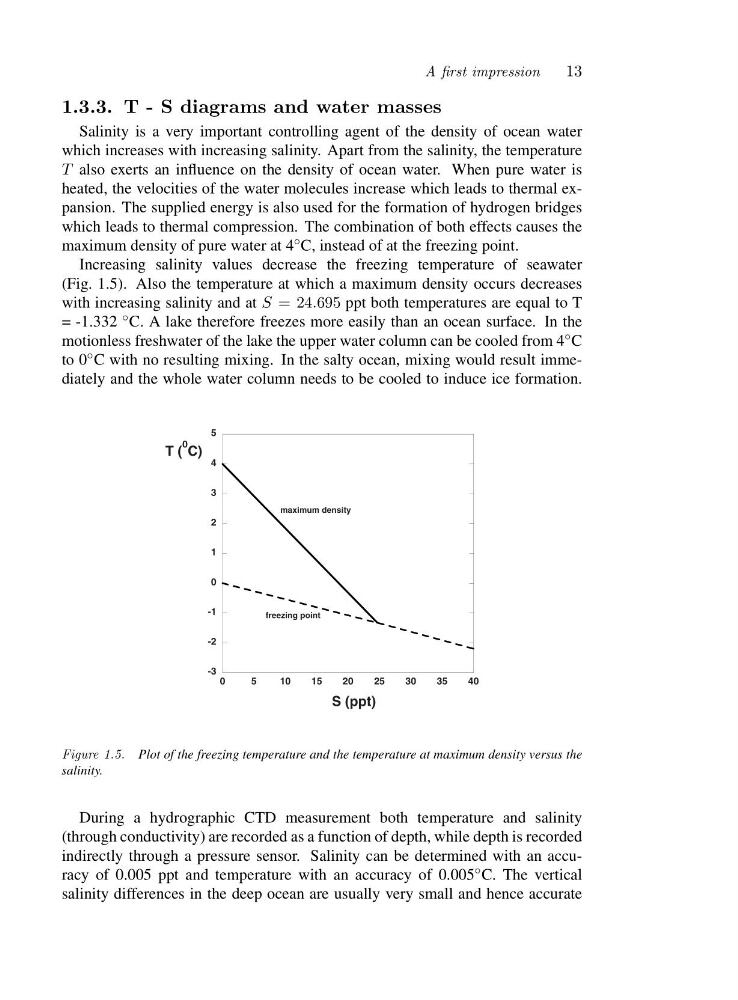
Increasing salinity values decrease the freezing temperature of seawater
(Fig. 1.5). Also the temperature at which a maximum density occurs decreases
with increasing salinity and at S =2 4 .695 ppt both temperatures are equal to T
= -1.332 ◦ C. A lake therefore freezes more easily than an ocean surface. In the
motionless freshwater of the lake the upper water column can be cooled from 4 ◦ C
to 0 ◦ C with no resulting mixing. In the salty ocean, mixing would result immediately and the whole water column needs to be cooled to induce ice formation.
-3
-2
-1
0
1
2
3
4
5
0
5
10
15
20
25
30
35
40
T (
0 C)
S (ppt)
maximum density
freezing point
Figure 1.5. Plot of the freezing temperature and the temperature at maximum density versus the
salinity.
During a hydrographic CTD measurement both temperature and salinity
(through conductivity) are recorded as a function of depth, while depth is recorded
indirectly through a pressure sensor. Salinity can be determined with an accuracy of 0.005 ppt and temperature with an accuracy of 0.005 ◦ C. The vertical
salinity differences in the deep ocean are usually very small and hence accurate
13
1.3.3. T - S diagrams and water masses
Salinity is a very important controlling agent of the density of ocean water
which increases with increasing salinity. Apart from the salinity, the temperature
T also exerts an influence on the density of ocean water. When pure water is
heated, the velocities of the water molecules increase which leads to thermal expansion. The supplied energy is also used for the formation of hydrogen bridges
which leads to thermal compression. The combination of both effects causes the
maximum density of pure water at 4 ◦ C, instead of at the freezing point.
Increasing salinity values decrease the freezing temperature of seawater
(Fig. 1.5). Also the temperature at which a maximum density occurs decreases
with increasing salinity and at S =2 4 .695 ppt both temperatures are equal to T
= -1.332 ◦ C. A lake therefore freezes more easily than an ocean surface. In the
motionless freshwater of the lake the upper water column can be cooled from 4 ◦ C
to 0 ◦ C with no resulting mixing. In the salty ocean, mixing would result immediately and the whole water column needs to be cooled to induce ice formation.
-3
-2
-1
0
1
2
3
4
5
0
5
10
15
20
25
30
35
40
T (
0 C)
S (ppt)
maximum density
freezing point
Figure 1.5. Plot of the freezing temperature and the temperature at maximum density versus the
salinity.
During a hydrographic CTD measurement both temperature and salinity
(through conductivity) are recorded as a function of depth, while depth is recorded
indirectly through a pressure sensor. Salinity can be determined with an accuracy of 0.005 ppt and temperature with an accuracy of 0.005 ◦ C. The vertical
salinity differences in the deep ocean are usually very small and hence accurate