

Stability of zonal flows
229
isopycnals
g
light
dense
X
X
U(z)
y
z
A
B
φ
α
P
ζ
η
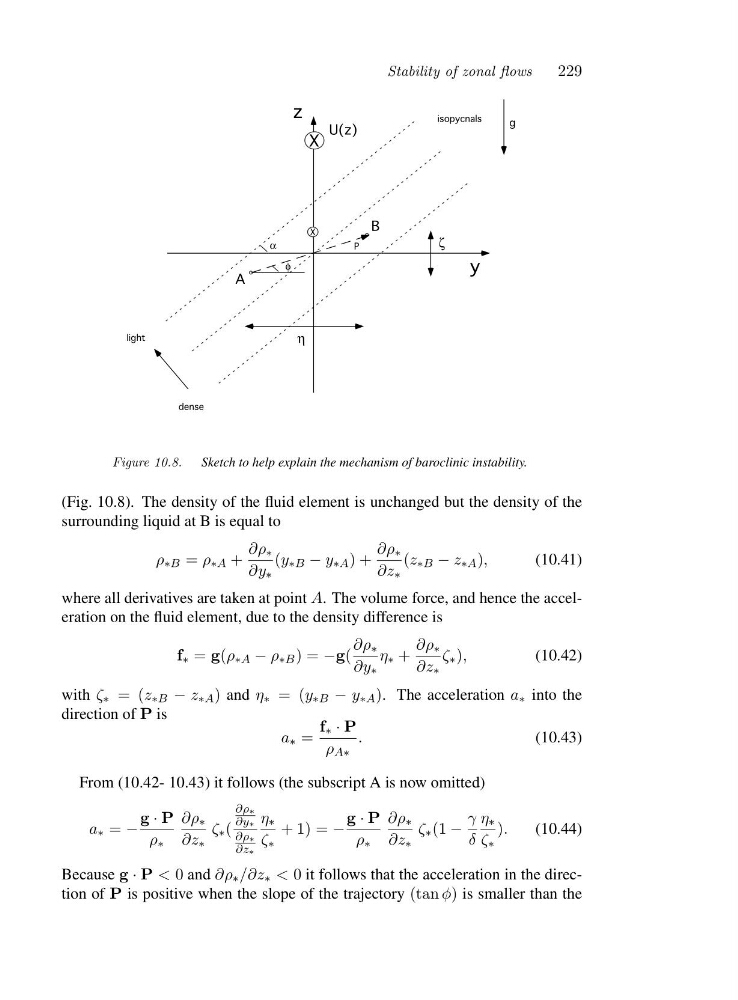
Figure 10.8. Sketch to help explain the mechanism of baroclinic instability.
(Fig. 10.8). The density of the fluid element is unchanged but the density of the
surrounding liquid at B is equal to
ρ ∗B = ρ ∗A +
∂ρ ∗
∂y ∗
(y ∗B − y ∗A )+
∂ρ ∗
∂z ∗
(z ∗B − z ∗A ),
(10.41)
where all derivatives are taken at point A. The volume force, and hence the acceleration on the fluid element, due to the density difference is
f ∗ = g(ρ ∗A − ρ ∗B )=−g(
∂ρ ∗
∂y ∗
η ∗ +
∂ρ ∗
∂z ∗
ζ ∗ ),
(10.42)
with ζ ∗ =( z ∗B − z ∗A ) and η ∗ =( y ∗B − y ∗A ). The acceleration a ∗ into the
direction of P is
a ∗ =
f ∗ · P
ρ A∗
.
(10.43)
From (10.42- 10.43) it follows (the subscript A is now omitted)
a ∗ = −
g · P
ρ ∗
∂ρ ∗
∂z ∗
ζ ∗ (
∂ρ∗
∂y∗
∂ρ∗
∂z∗
η ∗
ζ ∗
+1)=−
g · P
ρ ∗
∂ρ ∗
∂z ∗
ζ ∗ (1 −
γ
δ
η ∗
ζ ∗
).
(10.44)
Because g · P < 0 and ∂ρ ∗ /∂z ∗ < 0 it follows that the acceleration in the direction of P is positive when the slope of the trajectory (tan φ) is smaller than the
229
isopycnals
g
light
dense
X
X
U(z)
y
z
A
B
φ
α
P
ζ
η
Figure 10.8. Sketch to help explain the mechanism of baroclinic instability.
(Fig. 10.8). The density of the fluid element is unchanged but the density of the
surrounding liquid at B is equal to
ρ ∗B = ρ ∗A +
∂ρ ∗
∂y ∗
(y ∗B − y ∗A )+
∂ρ ∗
∂z ∗
(z ∗B − z ∗A ),
(10.41)
where all derivatives are taken at point A. The volume force, and hence the acceleration on the fluid element, due to the density difference is
f ∗ = g(ρ ∗A − ρ ∗B )=−g(
∂ρ ∗
∂y ∗
η ∗ +
∂ρ ∗
∂z ∗
ζ ∗ ),
(10.42)
with ζ ∗ =( z ∗B − z ∗A ) and η ∗ =( y ∗B − y ∗A ). The acceleration a ∗ into the
direction of P is
a ∗ =
f ∗ · P
ρ A∗
.
(10.43)
From (10.42- 10.43) it follows (the subscript A is now omitted)
a ∗ = −
g · P
ρ ∗
∂ρ ∗
∂z ∗
ζ ∗ (
∂ρ∗
∂y∗
∂ρ∗
∂z∗
η ∗
ζ ∗
+1)=−
g · P
ρ ∗
∂ρ ∗
∂z ∗
ζ ∗ (1 −
γ
δ
η ∗
ζ ∗
).
(10.44)
Because g · P < 0 and ∂ρ ∗ /∂z ∗ < 0 it follows that the acceleration in the direction of P is positive when the slope of the trajectory (tan φ) is smaller than the