

Stability of zonal flows
219
with boundary conditions (8.33- 8.34), i.e.,
(
∂
∂t
+ u
∂
∂x
+ v
∂
∂y
)(∇
2 ψ +
∂
∂z
(
1
S
∂ψ
∂z
)+βy)=0,
(10.1a)
z = −1:−
1
S
(
∂
∂t
+ u
∂
∂x
+ v
∂
∂y
)
∂ψ
∂z
= u.∇η b −
r
2
∇
2 ψ, (10.1b)
z =0:−
1
S
(
∂
∂t
+ u
∂
∂x
+ v
∂
∂y
)
∂ψ
∂z
=
αr
2
∇·(T ∧ e 3 ), (10.1c)
u = −
∂ψ
∂y
; v =
∂ψ
∂x
.
(10.1d)
If we consider a zonal channel bounded by lateral walls at y ± 1 then the boundary
conditions (the horizontal mixing of momentum is neglected) are
y = ±1:u · n =0,
(10.2)
where u =(u, v) T is the horizontal geostrophic velocity vector and n the outward
normal on each lateral wall.
Suppose there is a steady solution ¯
ψ(x, y, z) of the equations above. To investigate the stability of this solution, we look at small perturbations φ(x, y, z, t) on
the steady state. With
ψ(x, y, z, t)= ¯
ψ(x, y, z)+φ(x, y, z, t),
(10.3)
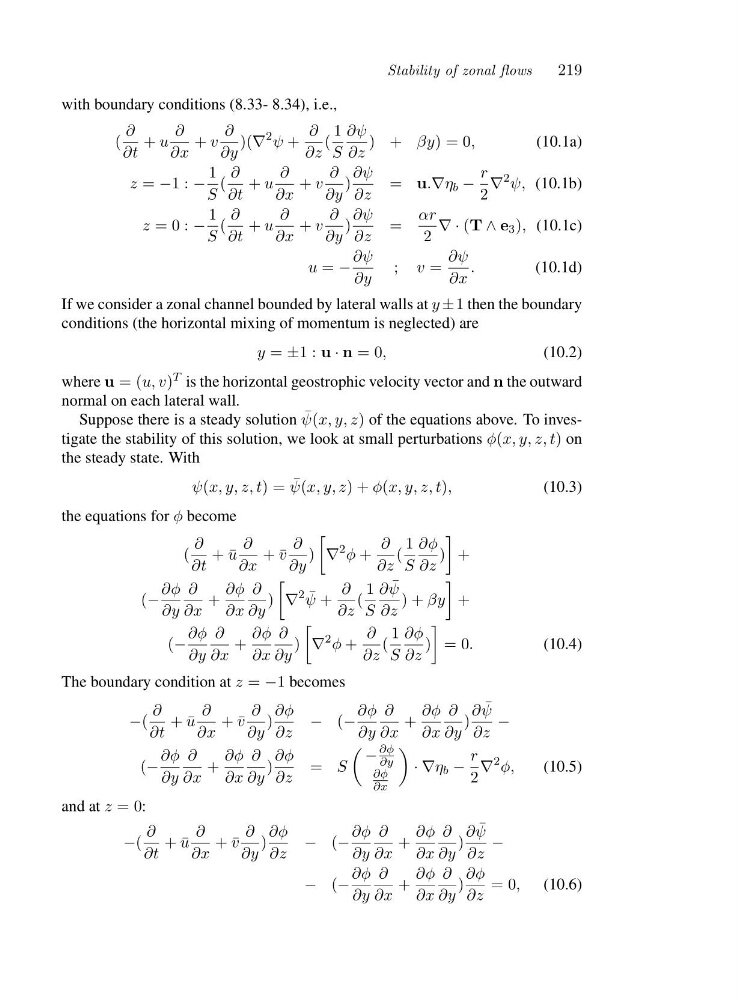
the equations for φ become
(
∂
∂t
+¯ u
∂
∂x
+¯ v
∂
∂y
)
∇
2 φ +
∂
∂z
(
1
S
∂φ
∂z
)
+
(−
∂φ
∂y
∂
∂x
+
∂φ
∂x
∂
∂y
)
∇
2 ¯
ψ +
∂
∂z
(
1
S
∂ ¯
ψ
∂z
)+βy
+
(−
∂φ
∂y
∂
∂x
+
∂φ
∂x
∂
∂y
)
∇
2 φ +
∂
∂z
(
1
S
∂φ
∂z
)
=0.
(10.4)
The boundary condition at z = −1 becomes
−(
∂
∂t
+¯ u
∂
∂x
+¯ v
∂
∂y
)
∂φ
∂z
− (−
∂φ
∂y
∂
∂x
+
∂φ
∂x
∂
∂y
)
∂ ¯
ψ
∂z
−
(−
∂φ
∂y
∂
∂x
+
∂φ
∂x
∂
∂y
)
∂φ
∂z
= S
−
∂φ
∂y
∂φ
∂x
·∇η b −
r
2
∇
2 φ,
(10.5)
and at z =0:
−(
∂
∂t
+¯ u
∂
∂x
+¯ v
∂
∂y
)
∂φ
∂z
− (−
∂φ
∂y
∂
∂x
+
∂φ
∂x
∂
∂y
)
∂ ¯
ψ
∂z
−
− (−
∂φ
∂y
∂
∂x
+
∂φ
∂x
∂
∂y
)
∂φ
∂z
=0, (10.6)
219
with boundary conditions (8.33- 8.34), i.e.,
(
∂
∂t
+ u
∂
∂x
+ v
∂
∂y
)(∇
2 ψ +
∂
∂z
(
1
S
∂ψ
∂z
)+βy)=0,
(10.1a)
z = −1:−
1
S
(
∂
∂t
+ u
∂
∂x
+ v
∂
∂y
)
∂ψ
∂z
= u.∇η b −
r
2
∇
2 ψ, (10.1b)
z =0:−
1
S
(
∂
∂t
+ u
∂
∂x
+ v
∂
∂y
)
∂ψ
∂z
=
αr
2
∇·(T ∧ e 3 ), (10.1c)
u = −
∂ψ
∂y
; v =
∂ψ
∂x
.
(10.1d)
If we consider a zonal channel bounded by lateral walls at y ± 1 then the boundary
conditions (the horizontal mixing of momentum is neglected) are
y = ±1:u · n =0,
(10.2)
where u =(u, v) T is the horizontal geostrophic velocity vector and n the outward
normal on each lateral wall.
Suppose there is a steady solution ¯
ψ(x, y, z) of the equations above. To investigate the stability of this solution, we look at small perturbations φ(x, y, z, t) on
the steady state. With
ψ(x, y, z, t)= ¯
ψ(x, y, z)+φ(x, y, z, t),
(10.3)
the equations for φ become
(
∂
∂t
+¯ u
∂
∂x
+¯ v
∂
∂y
)
∇
2 φ +
∂
∂z
(
1
S
∂φ
∂z
)
+
(−
∂φ
∂y
∂
∂x
+
∂φ
∂x
∂
∂y
)
∇
2 ¯
ψ +
∂
∂z
(
1
S
∂ ¯
ψ
∂z
)+βy
+
(−
∂φ
∂y
∂
∂x
+
∂φ
∂x
∂
∂y
)
∇
2 φ +
∂
∂z
(
1
S
∂φ
∂z
)
=0.
(10.4)
The boundary condition at z = −1 becomes
−(
∂
∂t
+¯ u
∂
∂x
+¯ v
∂
∂y
)
∂φ
∂z
− (−
∂φ
∂y
∂
∂x
+
∂φ
∂x
∂
∂y
)
∂ ¯
ψ
∂z
−
(−
∂φ
∂y
∂
∂x
+
∂φ
∂x
∂
∂y
)
∂φ
∂z
= S
−
∂φ
∂y
∂φ
∂x
·∇η b −
r
2
∇
2 φ,
(10.5)
and at z =0:
−(
∂
∂t
+¯ u
∂
∂x
+¯ v
∂
∂y
)
∂φ
∂z
− (−
∂φ
∂y
∂
∂x
+
∂φ
∂x
∂
∂y
)
∂ ¯
ψ
∂z
−
− (−
∂φ
∂y
∂
∂x
+
∂φ
∂x
∂
∂y
)
∂φ
∂z
=0, (10.6)