

218
DYNAMICAL OCEANOGRAPHY
In chapter 6, we used the Sverdrup-Stommel-Munk theory to explain the
existence of a strong western boundary current, such as the Gulf Stream.
From observations, it is clear that the Gulf Stream is a strong meandering
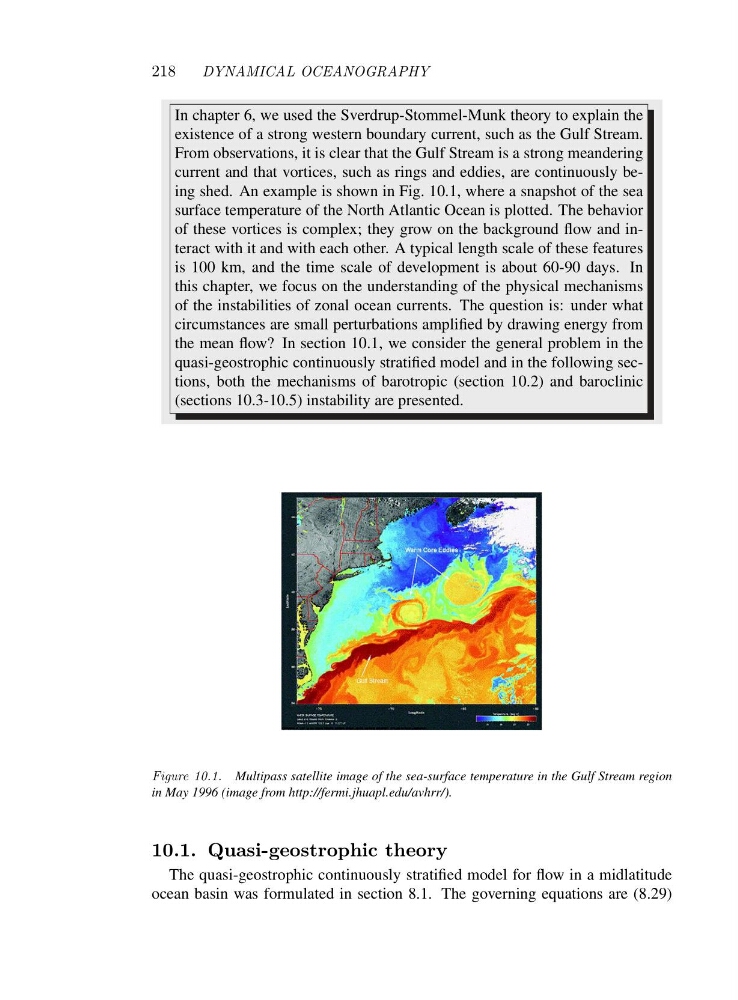
current and that vortices, such as rings and eddies, are continuously being shed. An example is shown in Fig. 10.1, where a snapshot of the sea
surface temperature of the North Atlantic Ocean is plotted. The behavior
of these vortices is complex; they grow on the background flow and interact with it and with each other. A typical length scale of these features
is 100 km, and the time scale of development is about 60-90 days. In
this chapter, we focus on the understanding of the physical mechanisms
of the instabilities of zonal ocean currents. The question is: under what
circumstances are small perturbations amplified by drawing energy from
the mean flow? In section 10.1, we consider the general problem in the
quasi-geostrophic continuously stratified model and in the following sections, both the mechanisms of barotropic (section 10.2) and baroclinic
(sections 10.3-10.5) instability are presented.
Figure 10.1. Multipass satellite image of the sea-surface temperature in the Gulf Stream region
in May 1996 (image from http://fermi.jhuapl.edu/avhrr/).
10.1. Quasi-geostrophic theory
The quasi-geostrophic continuously stratified model for flow in a midlatitude
ocean basin was formulated in section 8.1. The governing equations are (8.29)
DYNAMICAL OCEANOGRAPHY
In chapter 6, we used the Sverdrup-Stommel-Munk theory to explain the
existence of a strong western boundary current, such as the Gulf Stream.
From observations, it is clear that the Gulf Stream is a strong meandering
current and that vortices, such as rings and eddies, are continuously being shed. An example is shown in Fig. 10.1, where a snapshot of the sea
surface temperature of the North Atlantic Ocean is plotted. The behavior
of these vortices is complex; they grow on the background flow and interact with it and with each other. A typical length scale of these features
is 100 km, and the time scale of development is about 60-90 days. In
this chapter, we focus on the understanding of the physical mechanisms
of the instabilities of zonal ocean currents. The question is: under what
circumstances are small perturbations amplified by drawing energy from
the mean flow? In section 10.1, we consider the general problem in the
quasi-geostrophic continuously stratified model and in the following sections, both the mechanisms of barotropic (section 10.2) and baroclinic
(sections 10.3-10.5) instability are presented.
Figure 10.1. Multipass satellite image of the sea-surface temperature in the Gulf Stream region
in May 1996 (image from http://fermi.jhuapl.edu/avhrr/).
10.1. Quasi-geostrophic theory
The quasi-geostrophic continuously stratified model for flow in a midlatitude
ocean basin was formulated in section 8.1. The governing equations are (8.29)