

Free waves
163
The case k = f/C 0 can be considered as a special case of a Kelvin wave and
the amplitude of η is given by (for σ = f ):
η(x, y, t)=e
−ky cos(kx − ft).
(7.28)
(iii) Poincar´ e waves
The last solution of the dispersion relation is given by
α
2 L
2 = L
2 (
σ 2 − f 2
C 2
0
− k
2 )=n
2 π
2 ,n =1, 2, ... ⇒
σ = σ n = ±
f 2 + C 2
0 (k 2 +(
nπ
L
) 2 ),n =1, 2, ...
(7.29)
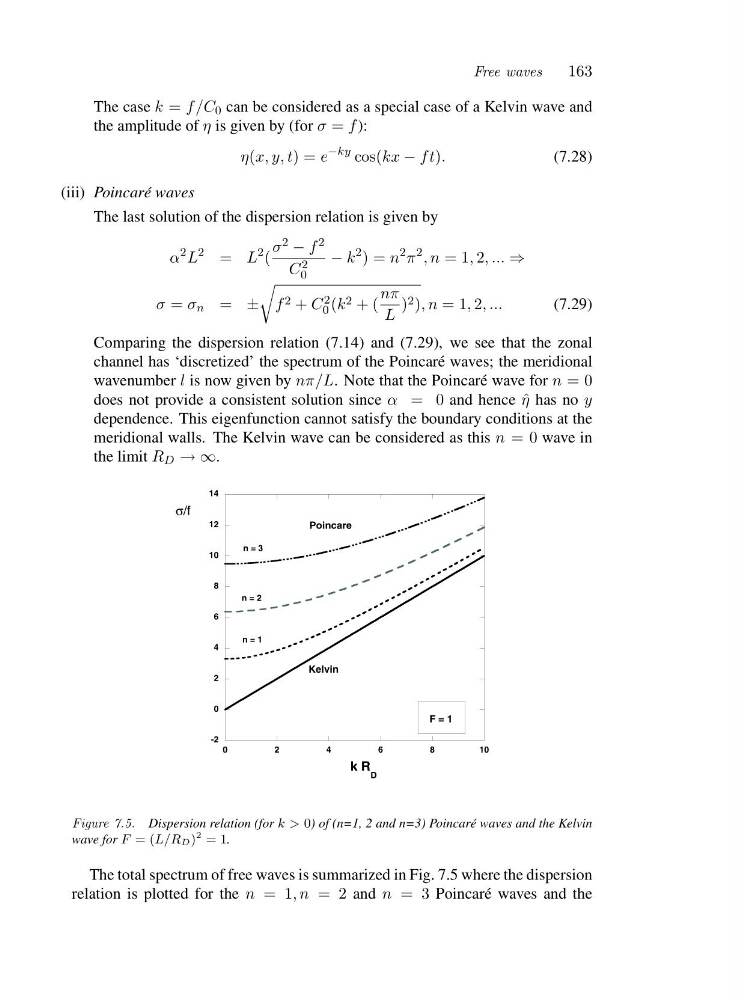
Comparing the dispersion relation (7.14) and (7.29), we see that the zonal
channel has ‘discretized’ the spectrum of the Poincar´ e waves; the meridional
wavenumber l is now given by nπ/L. Note that the Poincar´ ewaveforn =0
does not provide a consistent solution since α =0 and hence ˆ
η has no y
dependence. This eigenfunction cannot satisfy the boundary conditions at the
meridional walls. The Kelvin wave can be considered as this n =0wave in
the limit R D →∞.
-2
0
2
4
6
8
10
12
14
024681 0
n = 3
n = 2
n = 1
σ/f
k R
D
F = 1
Poincare
Kelvin
Figure 7.5. Dispersion relation (for k>0) of (n=1, 2 and n=3) Poincar´ e waves and the Kelvin
wave for F =(L/RD)
2 =1.
The total spectrum of free waves is summarized in Fig. 7.5 where the dispersion
relation is plotted for the n =1 ,n =2and n =3Poincar´ e waves and the
163
The case k = f/C 0 can be considered as a special case of a Kelvin wave and
the amplitude of η is given by (for σ = f ):
η(x, y, t)=e
−ky cos(kx − ft).
(7.28)
(iii) Poincar´ e waves
The last solution of the dispersion relation is given by
α
2 L
2 = L
2 (
σ 2 − f 2
C 2
0
− k
2 )=n
2 π
2 ,n =1, 2, ... ⇒
σ = σ n = ±
f 2 + C 2
0 (k 2 +(
nπ
L
) 2 ),n =1, 2, ...
(7.29)
Comparing the dispersion relation (7.14) and (7.29), we see that the zonal
channel has ‘discretized’ the spectrum of the Poincar´ e waves; the meridional
wavenumber l is now given by nπ/L. Note that the Poincar´ ewaveforn =0
does not provide a consistent solution since α =0 and hence ˆ
η has no y
dependence. This eigenfunction cannot satisfy the boundary conditions at the
meridional walls. The Kelvin wave can be considered as this n =0wave in
the limit R D →∞.
-2
0
2
4
6
8
10
12
14
024681 0
n = 3
n = 2
n = 1
σ/f
k R
D
F = 1
Poincare
Kelvin
Figure 7.5. Dispersion relation (for k>0) of (n=1, 2 and n=3) Poincar´ e waves and the Kelvin
wave for F =(L/RD)
2 =1.
The total spectrum of free waves is summarized in Fig. 7.5 where the dispersion
relation is plotted for the n =1 ,n =2and n =3Poincar´ e waves and the