

164
DYNAMICAL OCEANOGRAPHY
Kelvin wave. Note that the frequency approaches zero for the Kelvin wave but the
Poincar´ e waves keep finite frequencies.
7.3. Free waves: H 0 = H 0 (y)
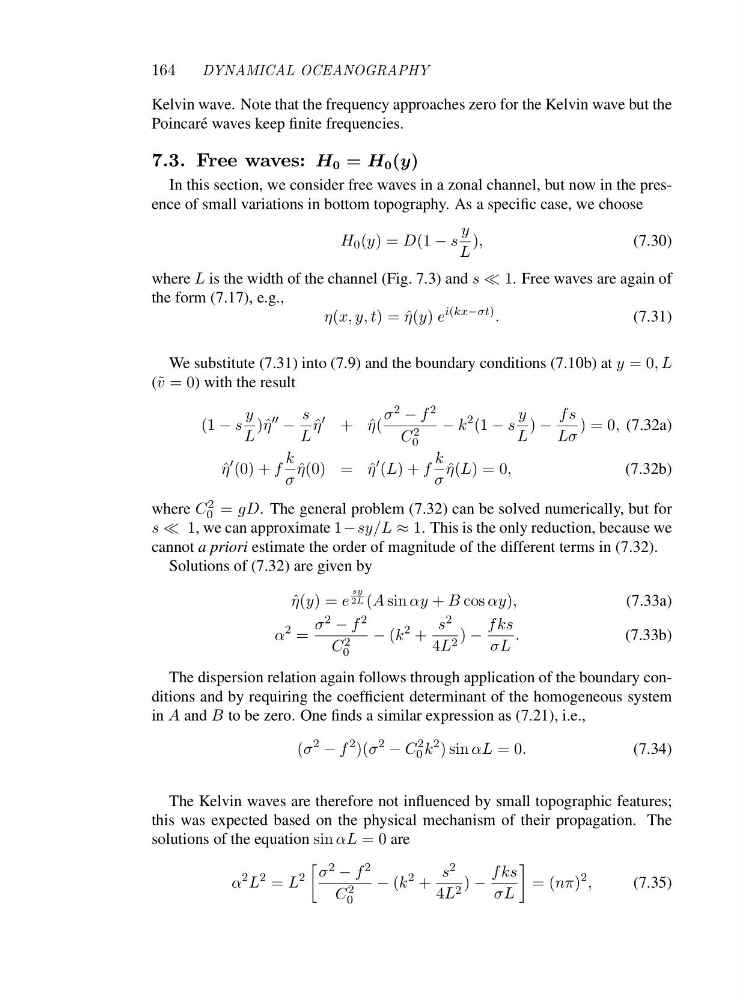
In this section, we consider free waves in a zonal channel, but now in the presence of small variations in bottom topography. As a specific case, we choose
H 0 (y)=D(1 − s
y
L
),
(7.30)
where L is the width of the channel (Fig. 7.3) and s ≪ 1. Free waves are again of
the form (7.17), e.g.,
η(x, y, t)=ˆ η(y) e
i(kx−σt) .
(7.31)
We substitute (7.31) into (7.9) and the boundary conditions (7.10b) at y =0,L
(˜ v =0) with the result
(1 − s
y
L
)ˆ η
′′ −
s
L
ˆ
η
′ +ˆ η(
σ 2 − f 2
C 2
0
− k
2 (1 − s
y
L
) −
fs
Lσ
)=0, (7.32a)
ˆ
η
′ (0) + f
k
σ
ˆ
η(0) = ˆ
η
′ (L)+f
k
σ
ˆ
η(L)=0,
(7.32b)
where C 2
0 = gD. The general problem (7.32) can be solved numerically, but for
s ≪ 1, we can approximate 1−sy/L ≈ 1. This is the only reduction, because we
cannot aprioriestimate the order of magnitude of the different terms in (7.32).
Solutions of (7.32) are given by
ˆ
η(y)=e
sy
2L (A sin αy + B cos αy),
(7.33a)
α
2 =
σ 2 − f 2
C 2
0
− (k
2 +
s 2
4L 2 ) −
fks
σL
.
(7.33b)
The dispersion relation again follows through application of the boundary conditions and by requiring the coefficient determinant of the homogeneous system
in A and B to be zero. One finds a similar expression as (7.21), i.e.,
(σ
2 − f
2 )(σ
2 − C
2
0 k
2 )sinαL =0.
(7.34)
The Kelvin waves are therefore not influenced by small topographic features;
this was expected based on the physical mechanism of their propagation. The
solutions of the equation sin αL =0are
α
2 L
2 = L
2
σ 2 − f 2
C 2
0
− (k
2 +
s 2
4L 2 ) −
fks
σL
=(nπ)
2 ,
(7.35)
DYNAMICAL OCEANOGRAPHY
Kelvin wave. Note that the frequency approaches zero for the Kelvin wave but the
Poincar´ e waves keep finite frequencies.
7.3. Free waves: H 0 = H 0 (y)
In this section, we consider free waves in a zonal channel, but now in the presence of small variations in bottom topography. As a specific case, we choose
H 0 (y)=D(1 − s
y
L
),
(7.30)
where L is the width of the channel (Fig. 7.3) and s ≪ 1. Free waves are again of
the form (7.17), e.g.,
η(x, y, t)=ˆ η(y) e
i(kx−σt) .
(7.31)
We substitute (7.31) into (7.9) and the boundary conditions (7.10b) at y =0,L
(˜ v =0) with the result
(1 − s
y
L
)ˆ η
′′ −
s
L
ˆ
η
′ +ˆ η(
σ 2 − f 2
C 2
0
− k
2 (1 − s
y
L
) −
fs
Lσ
)=0, (7.32a)
ˆ
η
′ (0) + f
k
σ
ˆ
η(0) = ˆ
η
′ (L)+f
k
σ
ˆ
η(L)=0,
(7.32b)
where C 2
0 = gD. The general problem (7.32) can be solved numerically, but for
s ≪ 1, we can approximate 1−sy/L ≈ 1. This is the only reduction, because we
cannot aprioriestimate the order of magnitude of the different terms in (7.32).
Solutions of (7.32) are given by
ˆ
η(y)=e
sy
2L (A sin αy + B cos αy),
(7.33a)
α
2 =
σ 2 − f 2
C 2
0
− (k
2 +
s 2
4L 2 ) −
fks
σL
.
(7.33b)
The dispersion relation again follows through application of the boundary conditions and by requiring the coefficient determinant of the homogeneous system
in A and B to be zero. One finds a similar expression as (7.21), i.e.,
(σ
2 − f
2 )(σ
2 − C
2
0 k
2 )sinαL =0.
(7.34)
The Kelvin waves are therefore not influenced by small topographic features;
this was expected based on the physical mechanism of their propagation. The
solutions of the equation sin αL =0are
α
2 L
2 = L
2
σ 2 − f 2
C 2
0
− (k
2 +
s 2
4L 2 ) −
fks
σL
=(nπ)
2 ,
(7.35)