

162
DYNAMICAL OCEANOGRAPHY
As the amplitude A is arbitrary, we just make the choice A = i such that (7.17)
provides a real function η. The result is
η(x, y, t)=e
−
yf
C 0 cos k(x − C 0 t).
(7.24)
Ex. 7.3
This is a ’normal’ plane wave that propagates in the positive x-direction with
a simple fixed y-profile. The characteristic meridional decay scale of η is the
external Rossby deformation radius (cf. section 3.1)
R D =
C 0
f
=
√ gH 0
f
.
(7.25)
The velocities ˜
u and ˜
v of the Kelvin wave follow from (7.10) as
˜
u =
g
C 0
e
−
yf
C 0 cos k(x − C 0 t)=−
g
f
∂η
∂y
,
(7.26a)
˜
v =0 ,
(7.26b)
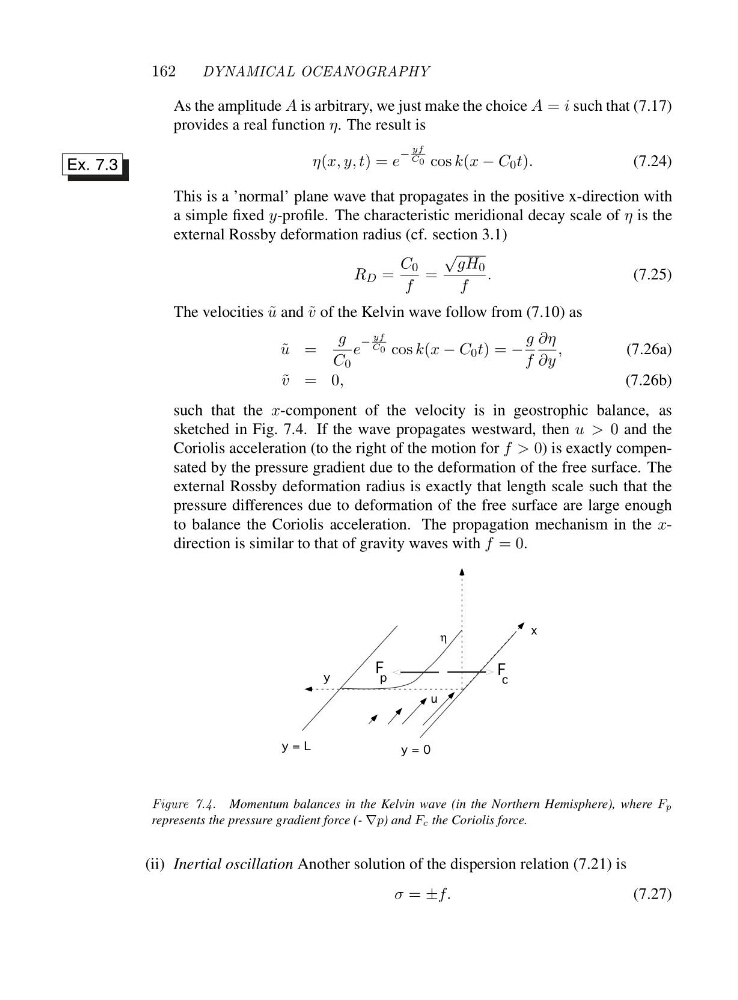
such that the x-component of the velocity is in geostrophic balance, as
sketched in Fig. 7.4. If the wave propagates westward, then u>0 and the
Coriolis acceleration (to the right of the motion for f>0) is exactly compensated by the pressure gradient due to the deformation of the free surface. The
external Rossby deformation radius is exactly that length scale such that the
pressure differences due to deformation of the free surface are large enough
to balance the Coriolis acceleration. The propagation mechanism in the xdirection is similar to that of gravity waves with f =0.
x
y
y = 0
y = L
η
u
F
c
F
p
Figure 7.4. Momentum balances in the Kelvin wave (in the Northern Hemisphere), where Fp
represents the pressure gradient force (- ∇p) and Fc the Coriolis force.
(ii) Inertial oscillation Another solution of the dispersion relation (7.21) is
σ = ±f.
(7.27)
DYNAMICAL OCEANOGRAPHY
As the amplitude A is arbitrary, we just make the choice A = i such that (7.17)
provides a real function η. The result is
η(x, y, t)=e
−
yf
C 0 cos k(x − C 0 t).
(7.24)
Ex. 7.3
This is a ’normal’ plane wave that propagates in the positive x-direction with
a simple fixed y-profile. The characteristic meridional decay scale of η is the
external Rossby deformation radius (cf. section 3.1)
R D =
C 0
f
=
√ gH 0
f
.
(7.25)
The velocities ˜
u and ˜
v of the Kelvin wave follow from (7.10) as
˜
u =
g
C 0
e
−
yf
C 0 cos k(x − C 0 t)=−
g
f
∂η
∂y
,
(7.26a)
˜
v =0 ,
(7.26b)
such that the x-component of the velocity is in geostrophic balance, as
sketched in Fig. 7.4. If the wave propagates westward, then u>0 and the
Coriolis acceleration (to the right of the motion for f>0) is exactly compensated by the pressure gradient due to the deformation of the free surface. The
external Rossby deformation radius is exactly that length scale such that the
pressure differences due to deformation of the free surface are large enough
to balance the Coriolis acceleration. The propagation mechanism in the xdirection is similar to that of gravity waves with f =0.
x
y
y = 0
y = L
η
u
F
c
F
p
Figure 7.4. Momentum balances in the Kelvin wave (in the Northern Hemisphere), where Fp
represents the pressure gradient force (- ∇p) and Fc the Coriolis force.
(ii) Inertial oscillation Another solution of the dispersion relation (7.21) is
σ = ±f.
(7.27)