

Free waves
159
of (7.12) into (7.11) gives
ση 0 (f
2 − σ
2 + C
2
0 (k
2 + l
2 )) = 0.
(7.13)
The interesting cases are when σ =0and from (7.13) we find the dispersion
relation
σ = ±
f 2 + C 2
0 (k 2 + l 2 ).
(7.14)
The dispersion relation shows that for every wavevector k =(k, l) T , there are two
free waves with a phase speed C = σ/|k| in the (positive and negative) direction
of the wavevector k, with
C =
σ
√
k 2 + l 2
= ±
C 2
0 +
f 2
(k 2 + l 2 )
.
(7.15)
For f =0 , the dispersion relation (7.14) reduces to that for ‘normal’ gravity
waves with phase speed C 0 =( gH 0 ) 1/2 .F o rf =0 , it follows from (7.14) that
the frequency of these so-called Poincar´ e waves is always larger than f , in other
words the period is always shorter than the inertial period f −1 .
Ex. 7.2
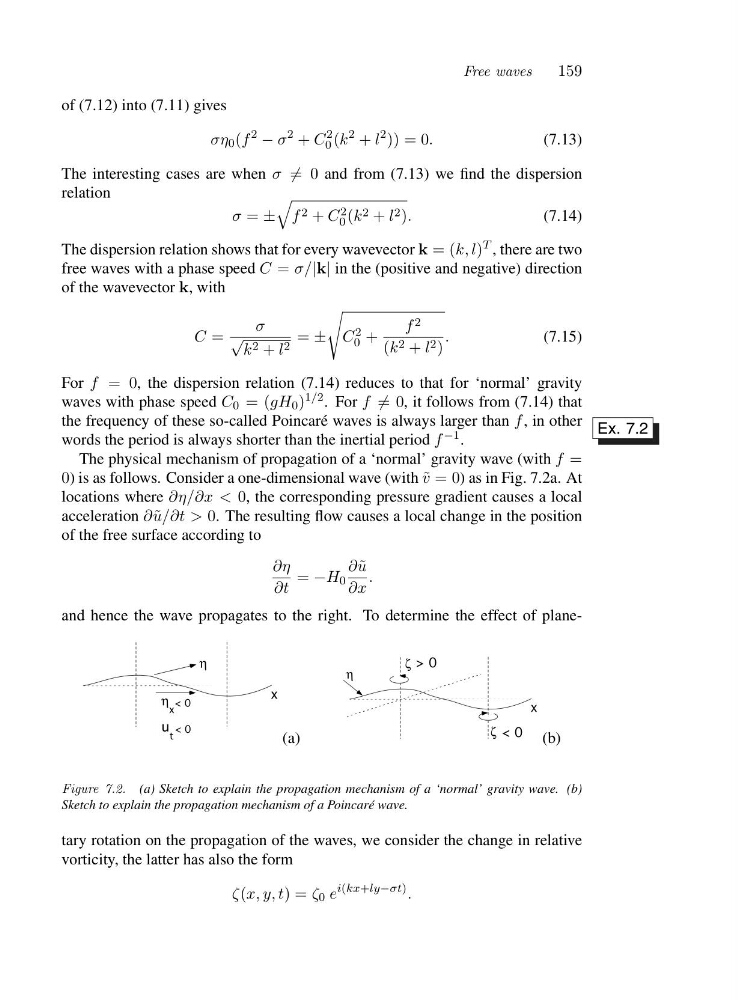
The physical mechanism of propagation of a ‘normal’ gravity wave (with f =
0) is as follows. Consider a one-dimensional wave (with ˜
v =0) as in Fig. 7.2a. At
locations where ∂η/∂x < 0, the corresponding pressure gradient causes a local
acceleration ∂ ˜
u/∂t > 0. The resulting flow causes a local change in the position
of the free surface according to
∂η
∂t
= −H 0
∂ ˜
u
∂x
.
and hence the wave propagates to the right. To determine the effect of planeη
η
x
< 0
u
t
< 0
x
(a)
η
x
ζ
ζ
> 0
< 0
(b)
Figure 7.2. (a) Sketch to explain the propagation mechanism of a ‘normal’ gravity wave. (b)
Sketch to explain the propagation mechanism of a Poincar´ ewave.
tary rotation on the propagation of the waves, we consider the change in relative
vorticity, the latter has also the form
ζ(x, y, t)=ζ 0 e
i(kx+ly−σt) .
159
of (7.12) into (7.11) gives
ση 0 (f
2 − σ
2 + C
2
0 (k
2 + l
2 )) = 0.
(7.13)
The interesting cases are when σ =0and from (7.13) we find the dispersion
relation
σ = ±
f 2 + C 2
0 (k 2 + l 2 ).
(7.14)
The dispersion relation shows that for every wavevector k =(k, l) T , there are two
free waves with a phase speed C = σ/|k| in the (positive and negative) direction
of the wavevector k, with
C =
σ
√
k 2 + l 2
= ±
C 2
0 +
f 2
(k 2 + l 2 )
.
(7.15)
For f =0 , the dispersion relation (7.14) reduces to that for ‘normal’ gravity
waves with phase speed C 0 =( gH 0 ) 1/2 .F o rf =0 , it follows from (7.14) that
the frequency of these so-called Poincar´ e waves is always larger than f , in other
words the period is always shorter than the inertial period f −1 .
Ex. 7.2
The physical mechanism of propagation of a ‘normal’ gravity wave (with f =
0) is as follows. Consider a one-dimensional wave (with ˜
v =0) as in Fig. 7.2a. At
locations where ∂η/∂x < 0, the corresponding pressure gradient causes a local
acceleration ∂ ˜
u/∂t > 0. The resulting flow causes a local change in the position
of the free surface according to
∂η
∂t
= −H 0
∂ ˜
u
∂x
.
and hence the wave propagates to the right. To determine the effect of planeη
η
x
< 0
u
t
< 0
x
(a)
η
x
ζ
ζ
> 0
< 0
(b)
Figure 7.2. (a) Sketch to explain the propagation mechanism of a ‘normal’ gravity wave. (b)
Sketch to explain the propagation mechanism of a Poincar´ ewave.
tary rotation on the propagation of the waves, we consider the change in relative
vorticity, the latter has also the form
ζ(x, y, t)=ζ 0 e
i(kx+ly−σt) .