

160
DYNAMICAL OCEANOGRAPHY
The amplitude ζ 0 follows through substitution (together with (7.12)) into (7.6) and
we find
σ
ζ 0 −
fη 0
H 0
=0,
which exactly represents the conservation of the linearized potential vorticity.
With the help of (7.14), we see that the relative vorticity is proportional to the
interface height through vortex stretching. If η 0 > 0 (η 0 < 0), then the change
in relative vorticity (in the northern hemisphere) is also positive (negative); this
is sketched in Fig. 7.2b. Because of the induced velocities through this vorticity
distribution, the wave now propagates faster than the corresponding wave with
f =0.
7.2.2. Zonal channel
y = 0
y = L
x
y
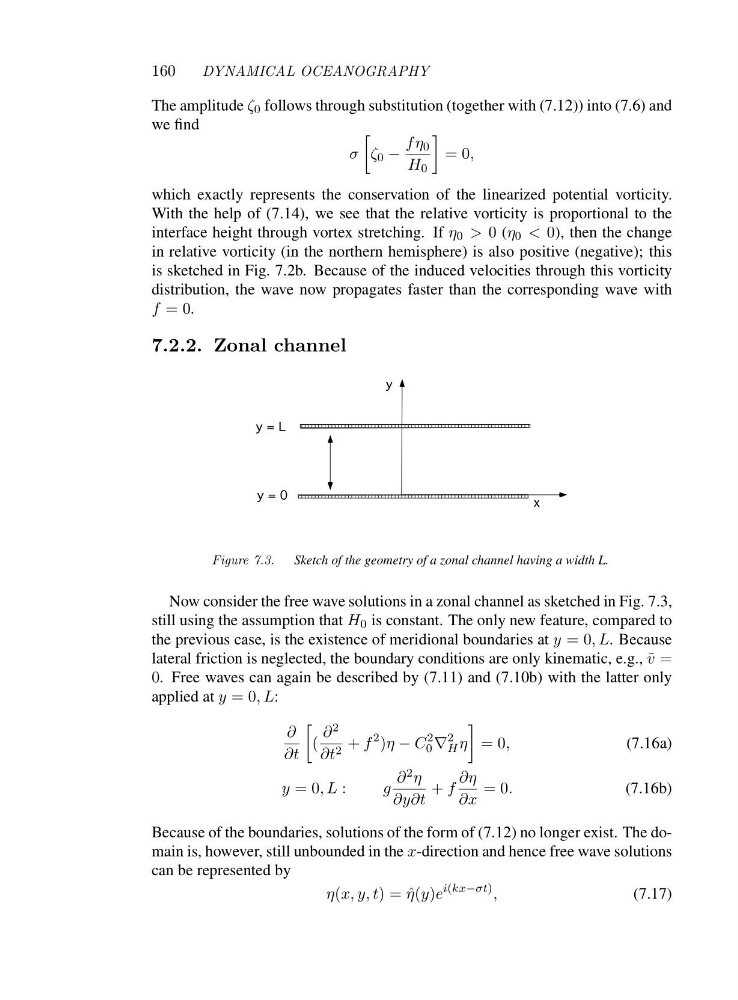
Figure 7.3. Sketch of the geometry of a zonal channel having a width L.
Now consider the free wave solutions in a zonal channel as sketched in Fig. 7.3,
still using the assumption that H 0 is constant. The only new feature, compared to
the previous case, is the existence of meridional boundaries at y =0,L. Because
lateral friction is neglected, the boundary conditions are only kinematic, e.g., ˜
v =
0. Free waves can again be described by (7.11) and (7.10b) with the latter only
applied at y =0,L:
∂
∂t
(
∂ 2
∂t 2 + f
2 )η − C
2
0 ∇
2
H η
=0,
(7.16a)
y =0,L :
g
∂ 2 η
∂y∂t
+ f
∂η
∂x
=0.
(7.16b)
Because of the boundaries, solutions of the form of (7.12) no longer exist. The domain is, however, still unbounded in the x-direction and hence free wave solutions
can be represented by
η(x, y, t)=ˆ η(y)e
i(kx−σt) ,
(7.17)
DYNAMICAL OCEANOGRAPHY
The amplitude ζ 0 follows through substitution (together with (7.12)) into (7.6) and
we find
σ
ζ 0 −
fη 0
H 0
=0,
which exactly represents the conservation of the linearized potential vorticity.
With the help of (7.14), we see that the relative vorticity is proportional to the
interface height through vortex stretching. If η 0 > 0 (η 0 < 0), then the change
in relative vorticity (in the northern hemisphere) is also positive (negative); this
is sketched in Fig. 7.2b. Because of the induced velocities through this vorticity
distribution, the wave now propagates faster than the corresponding wave with
f =0.
7.2.2. Zonal channel
y = 0
y = L
x
y
Figure 7.3. Sketch of the geometry of a zonal channel having a width L.
Now consider the free wave solutions in a zonal channel as sketched in Fig. 7.3,
still using the assumption that H 0 is constant. The only new feature, compared to
the previous case, is the existence of meridional boundaries at y =0,L. Because
lateral friction is neglected, the boundary conditions are only kinematic, e.g., ˜
v =
0. Free waves can again be described by (7.11) and (7.10b) with the latter only
applied at y =0,L:
∂
∂t
(
∂ 2
∂t 2 + f
2 )η − C
2
0 ∇
2
H η
=0,
(7.16a)
y =0,L :
g
∂ 2 η
∂y∂t
+ f
∂η
∂x
=0.
(7.16b)
Because of the boundaries, solutions of the form of (7.12) no longer exist. The domain is, however, still unbounded in the x-direction and hence free wave solutions
can be represented by
η(x, y, t)=ˆ η(y)e
i(kx−σt) ,
(7.17)