

146
DYNAMICAL OCEANOGRAPHY
boundary currents, such as the Gulf Stream as we have seen above. The nonlinear
theory is, however, far from complete. Although the strong effect of inertia on the
flows was already shown by Veronis (1963), the work to determine systematically
the solution structure of the barotropic vorticity equation (5.91) versus the lateral
friction parameter A H did not start until the mid 1990s (Cessi and Ierley, 1995;
Jiang et al., 1995).
-5
0
5
10
15
20
10
20
30
40
50
60
70
Re
ψ ψ
ψ
ψ R
P
1
P
2
L
A
2d
A
2u
A
1d
A
1u
S
1
S
2
S
3
(b)
(c)
(d)
(a)
(b)
(c)
(d)
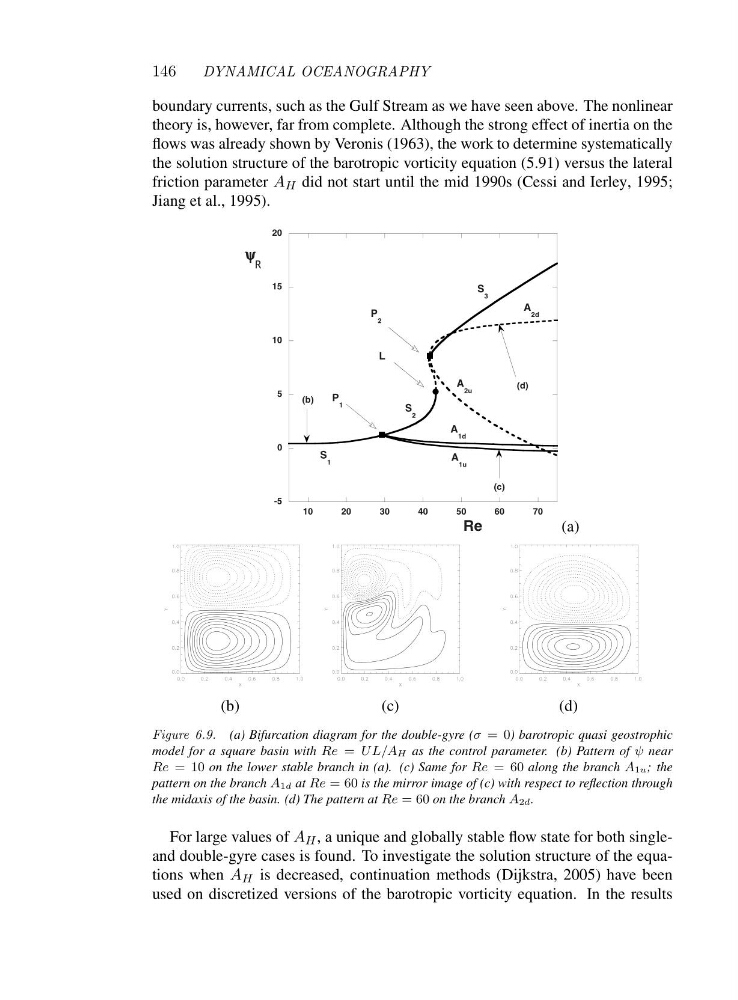
Figure 6.9. (a) Bifurcation diagram for the double-gyre (σ =0 ) barotropic quasi geostrophic
model for a square basin with Re = UL/AH as the control parameter. (b) Pattern of ψ near
Re =1 0on the lower stable branch in (a). (c) Same for Re =6 0along the branch A1u;t h e
pattern on the branch A1d at Re =6 0is the mirror image of (c) with respect to reflection through
the midaxis of the basin. (d) The pattern at Re =60on the branch A2d.
For large values of A H , a unique and globally stable flow state for both singleand double-gyre cases is found. To investigate the solution structure of the equations when A H is decreased, continuation methods (Dijkstra, 2005) have been
used on discretized versions of the barotropic vorticity equation. In the results
DYNAMICAL OCEANOGRAPHY
boundary currents, such as the Gulf Stream as we have seen above. The nonlinear
theory is, however, far from complete. Although the strong effect of inertia on the
flows was already shown by Veronis (1963), the work to determine systematically
the solution structure of the barotropic vorticity equation (5.91) versus the lateral
friction parameter A H did not start until the mid 1990s (Cessi and Ierley, 1995;
Jiang et al., 1995).
-5
0
5
10
15
20
10
20
30
40
50
60
70
Re
ψ ψ
ψ
ψ R
P
1
P
2
L
A
2d
A
2u
A
1d
A
1u
S
1
S
2
S
3
(b)
(c)
(d)
(a)
(b)
(c)
(d)
Figure 6.9. (a) Bifurcation diagram for the double-gyre (σ =0 ) barotropic quasi geostrophic
model for a square basin with Re = UL/AH as the control parameter. (b) Pattern of ψ near
Re =1 0on the lower stable branch in (a). (c) Same for Re =6 0along the branch A1u;t h e
pattern on the branch A1d at Re =6 0is the mirror image of (c) with respect to reflection through
the midaxis of the basin. (d) The pattern at Re =60on the branch A2d.
For large values of A H , a unique and globally stable flow state for both singleand double-gyre cases is found. To investigate the solution structure of the equations when A H is decreased, continuation methods (Dijkstra, 2005) have been
used on discretized versions of the barotropic vorticity equation. In the results