

Western intensification
145
where the dimensionless parameter σ controls the shape of the wind stress and
τ 0 is a typical amplitude. Since Veronis (1963), much attention has focussed
on the subtropical (single) gyre system as obtained above with the choice σ =
1. The single-gyre wind-stress forcing consists of easterlies (westerlies) at the
south (north) part of the basin. The so-called double-gyre case has more recently
received much attention and is obtained with σ =0in (6.81). In this case, both
the subtropical and subpolar gyres are forced and the wind stress is symmetric
with respect to the mid-axis of the basin (Fig. 6.7).
0
5
10
15
20
25
30
35
40
10
20
30
40
50
60
70
ψ ψ ψ
ψ R
Re
L
1
L
2
(b)
(c)
(d)
(a)
(b)
(c)
(d)
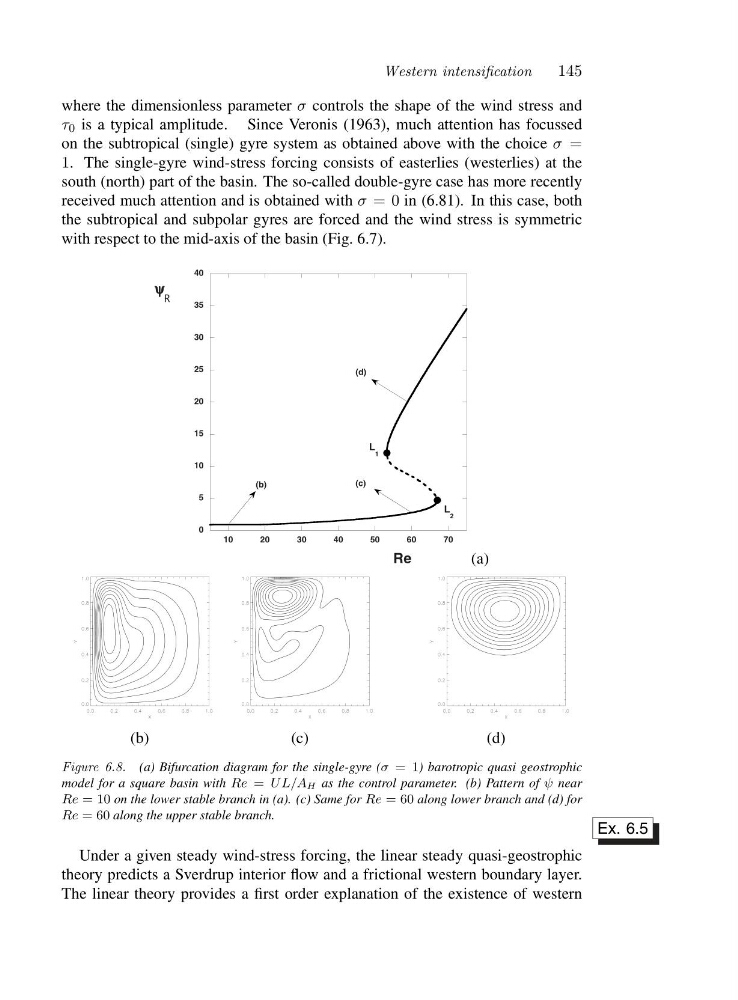
Figure 6.8. (a) Bifurcation diagram for the single-gyre (σ =1 ) barotropic quasi geostrophic
model for a square basin with Re = UL/AH as the control parameter. (b) Pattern of ψ near
Re =1 0on the lower stable branch in (a). (c) Same for Re =6 0along lower branch and (d) for
Re =60along the upper stable branch.
Ex. 6.5
Under a given steady wind-stress forcing, the linear steady quasi-geostrophic
theory predicts a Sverdrup interior flow and a frictional western boundary layer.
The linear theory provides a first order explanation of the existence of western
145
where the dimensionless parameter σ controls the shape of the wind stress and
τ 0 is a typical amplitude. Since Veronis (1963), much attention has focussed
on the subtropical (single) gyre system as obtained above with the choice σ =
1. The single-gyre wind-stress forcing consists of easterlies (westerlies) at the
south (north) part of the basin. The so-called double-gyre case has more recently
received much attention and is obtained with σ =0in (6.81). In this case, both
the subtropical and subpolar gyres are forced and the wind stress is symmetric
with respect to the mid-axis of the basin (Fig. 6.7).
0
5
10
15
20
25
30
35
40
10
20
30
40
50
60
70
ψ ψ ψ
ψ R
Re
L
1
L
2
(b)
(c)
(d)
(a)
(b)
(c)
(d)
Figure 6.8. (a) Bifurcation diagram for the single-gyre (σ =1 ) barotropic quasi geostrophic
model for a square basin with Re = UL/AH as the control parameter. (b) Pattern of ψ near
Re =1 0on the lower stable branch in (a). (c) Same for Re =6 0along lower branch and (d) for
Re =60along the upper stable branch.
Ex. 6.5
Under a given steady wind-stress forcing, the linear steady quasi-geostrophic
theory predicts a Sverdrup interior flow and a frictional western boundary layer.
The linear theory provides a first order explanation of the existence of western