

116
DYNAMICAL OCEANOGRAPHY
=
γyα
2
e
−χ (− sin χ +cosχ),
(5.81a)
v E (x, y, χ)=ˆ v
0 (x, y, χ) − v
0 (x, y)=
=
γyα
2
e
−χ (− cos χ +sinχ).
(5.81b)
At the surface χ =0,wehave
u E
v E
=
γyα
2
1
−1
,
(5.82)
while the total Ekman volume transport M E∗ per unit length is
M E∗ = γ
Uδ E α
2
0
−y
(5.83)
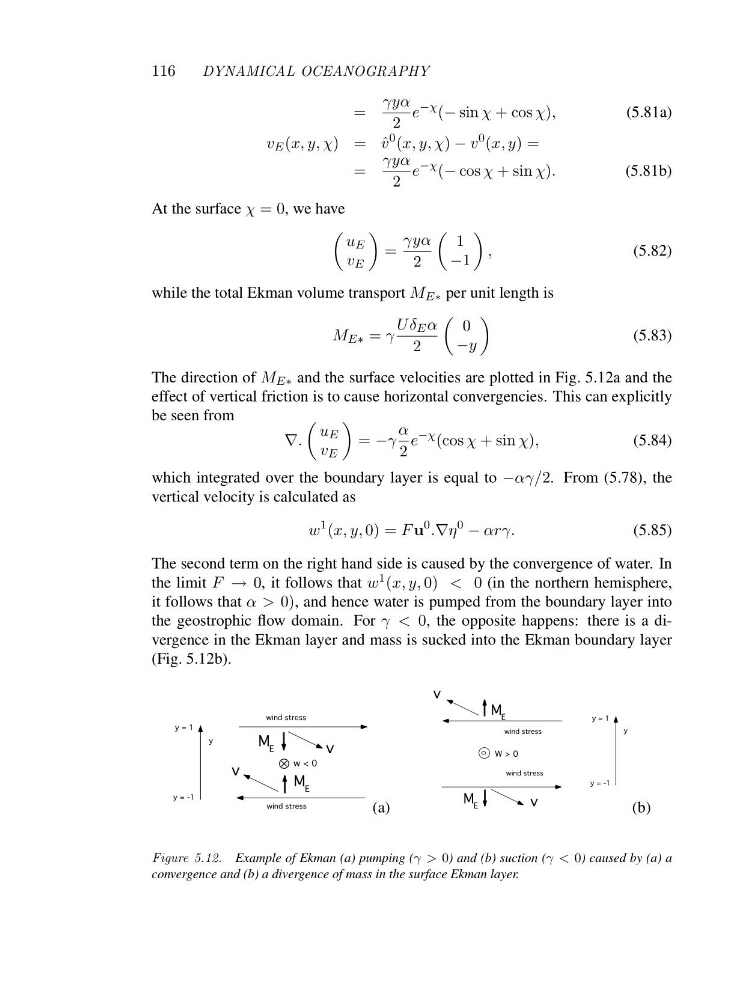
The direction of M E∗ and the surface velocities are plotted in Fig. 5.12a and the
effect of vertical friction is to cause horizontal convergencies. This can explicitly
be seen from
∇.
u E
v E
= −γ
α
2
e
−χ (cos χ +sinχ),
(5.84)
which integrated over the boundary layer is equal to −αγ/2. From (5.78), the
vertical velocity is calculated as
w
1 (x, y, 0) = F u
0 .∇η
0 − αrγ.
(5.85)
The second term on the right hand side is caused by the convergence of water. In
the limit F → 0, it follows that w 1 (x, y, 0) < 0 (in the northern hemisphere,
it follows that α>0), and hence water is pumped from the boundary layer into
the geostrophic flow domain. For γ<0, the opposite happens: there is a divergence in the Ekman layer and mass is sucked into the Ekman boundary layer
(Fig. 5.12b).
wind stress
wind stress
M E
M E
v
v
⊗ w < 0
y = 1
y = -1
y
(a)
wind stress
wind stress
M E
M E
v
v
W > 0
y = 1
y = -1
y
(b)
Figure 5.12. Example of Ekman (a) pumping (γ>0) and (b) suction (γ<0) caused by (a) a
convergence and (b) a divergence of mass in the surface Ekman layer.
DYNAMICAL OCEANOGRAPHY
=
γyα
2
e
−χ (− sin χ +cosχ),
(5.81a)
v E (x, y, χ)=ˆ v
0 (x, y, χ) − v
0 (x, y)=
=
γyα
2
e
−χ (− cos χ +sinχ).
(5.81b)
At the surface χ =0,wehave
u E
v E
=
γyα
2
1
−1
,
(5.82)
while the total Ekman volume transport M E∗ per unit length is
M E∗ = γ
Uδ E α
2
0
−y
(5.83)
The direction of M E∗ and the surface velocities are plotted in Fig. 5.12a and the
effect of vertical friction is to cause horizontal convergencies. This can explicitly
be seen from
∇.
u E
v E
= −γ
α
2
e
−χ (cos χ +sinχ),
(5.84)
which integrated over the boundary layer is equal to −αγ/2. From (5.78), the
vertical velocity is calculated as
w
1 (x, y, 0) = F u
0 .∇η
0 − αrγ.
(5.85)
The second term on the right hand side is caused by the convergence of water. In
the limit F → 0, it follows that w 1 (x, y, 0) < 0 (in the northern hemisphere,
it follows that α>0), and hence water is pumped from the boundary layer into
the geostrophic flow domain. For γ<0, the opposite happens: there is a divergence in the Ekman layer and mass is sucked into the Ekman boundary layer
(Fig. 5.12b).
wind stress
wind stress
M E
M E
v
v
⊗ w < 0
y = 1
y = -1
y
(a)
wind stress
wind stress
M E
M E
v
v
W > 0
y = 1
y = -1
y
(b)
Figure 5.12. Example of Ekman (a) pumping (γ>0) and (b) suction (γ<0) caused by (a) a
convergence and (b) a divergence of mass in the surface Ekman layer.