

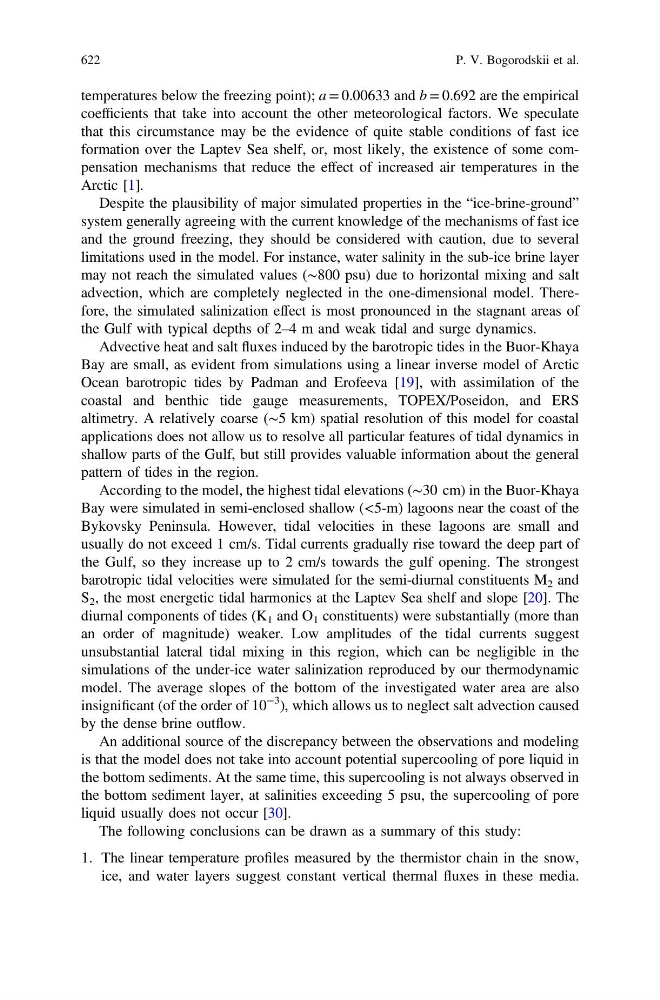
temperatures below the freezing point); a = 0.00633 and b = 0.692 are the empirical
coefficients that take into account the other meteorological factors. We speculate
that this circumstance may be the evidence of quite stable conditions of fast ice
formation over the Laptev Sea shelf, or, most likely, the existence of some compensation mechanisms that reduce the effect of increased air temperatures in the
Arctic [1].
Despite the plausibility of major simulated properties in the “ice-brine-ground”
system generally agreeing with the current knowledge of the mechanisms of fast ice
and the ground freezing, they should be considered with caution, due to several
limitations used in the model. For instance, water salinity in the sub-ice brine layer
may not reach the simulated values (∼800 psu) due to horizontal mixing and salt
advection, which are completely neglected in the one-dimensional model. Therefore, the simulated salinization effect is most pronounced in the stagnant areas of
the Gulf with typical depths of 2–4 m and weak tidal and surge dynamics.
Advective heat and salt fluxes induced by the barotropic tides in the Buor-Khaya
Bay are small, as evident from simulations using a linear inverse model of Arctic
Ocean barotropic tides by Padman and Erofeeva [19], with assimilation of the
coastal and benthic tide gauge measurements, TOPEX/Poseidon, and ERS
altimetry. A relatively coarse (∼5 km) spatial resolution of this model for coastal
applications does not allow us to resolve all particular features of tidal dynamics in
shallow parts of the Gulf, but still provides valuable information about the general
pattern of tides in the region.
According to the model, the highest tidal elevations (∼30 cm) in the Buor-Khaya
Bay were simulated in semi-enclosed shallow (<5-m) lagoons near the coast of the
Bykovsky Peninsula. However, tidal velocities in these lagoons are small and
usually do not exceed 1 cm/s. Tidal currents gradually rise toward the deep part of
the Gulf, so they increase up to 2 cm/s towards the gulf opening. The strongest
barotropic tidal velocities were simulated for the semi-diurnal constituents M 2 and
S 2 , the most energetic tidal harmonics at the Laptev Sea shelf and slope [20]. The
diurnal components of tides (K 1 and O 1 constituents) were substantially (more than
an order of magnitude) weaker. Low amplitudes of the tidal currents suggest
unsubstantial lateral tidal mixing in this region, which can be negligible in the
simulations of the under-ice water salinization reproduced by our thermodynamic
model. The average slopes of the bottom of the investigated water area are also
insignificant (of the order of 10
−3 ), which allows us to neglect salt advection caused
by the dense brine outflow.
An additional source of the discrepancy between the observations and modeling
is that the model does not take into account potential supercooling of pore liquid in
the bottom sediments. At the same time, this supercooling is not always observed in
the bottom sediment layer, at salinities exceeding 5 psu, the supercooling of pore
liquid usually does not occur [30].
The following conclusions can be drawn as a summary of this study:
1. The linear temperature profiles measured by the thermistor chain in the snow,
ice, and water layers suggest constant vertical thermal fluxes in these media.
622
P. V. Bogorodskii et al.