

time derivative, ρ is the density, P is the pressure, g is the gravitational acceleration,
f = 1.425 × 10
−4 1/s is the Coriolis parameter at a latitude of 78.5° and k
⇀
is the unit
vector along the z-direction.
The equations are transformed to the terrain-following coordinate system
(sigma-coordinates). Thus, it possible to increase the vertical resolution over the
shallow regions. The equations are solved over a domain bounded below by the
topography and a rigid lid above. The flow is forced by the semidiurnal barotropic
tidal inflow at the left boundary of the form V T sin(ω M2 t), where ω M2 is the M 2 tidal
frequency with period T = 12.4 h. At the right boundary an outflow condition is
used. The water column is initially at rest wit a horizontally uniform density ρ 0 (z).
The horizontal grid size is 90 m and the vertical sigma-coordinate resolution
consists of 80 grid points. The time step is tied to the Courant-Friedrichs-Levy
condition and varies from 2 to 5 s.
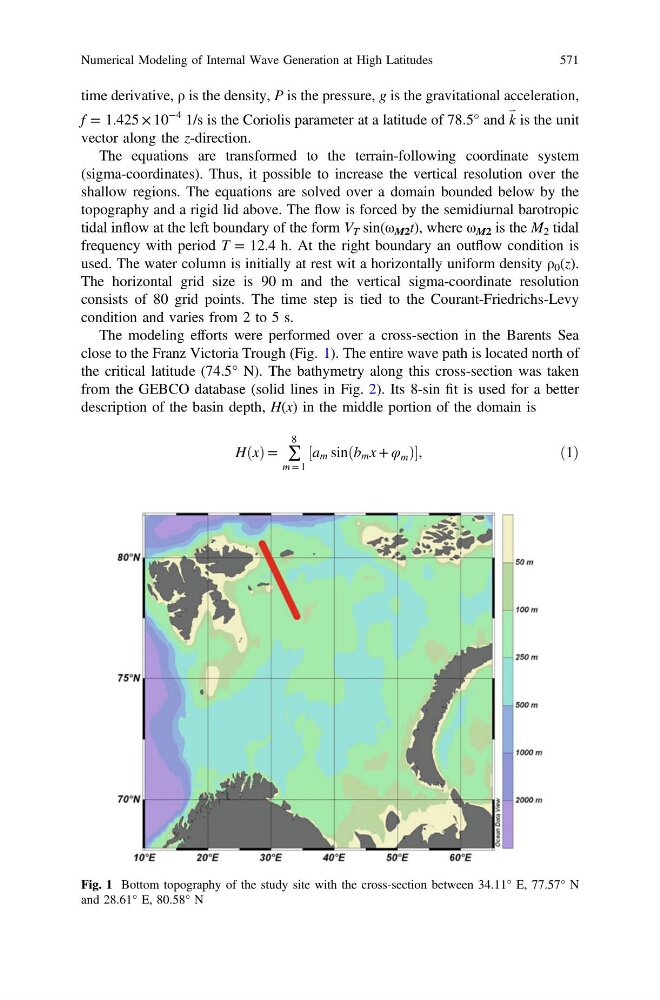
The modeling efforts were performed over a cross-section in the Barents Sea
close to the Franz Victoria Trough (Fig. 1). The entire wave path is located north of
the critical latitude (74.5° N). The bathymetry along this cross-section was taken
from the GEBCO database (solid lines in Fig. 2). Its 8-sin fit is used for a better
description of the basin depth, H(x) in the middle portion of the domain is
HðxÞ = ∑
8
m = 1
a m sinðb m x + φ m Þ
½
,
ð1Þ
Fig. 1 Bottom topography of the study site with the cross-section between 34.11° E, 77.57° N
and 28.61° E, 80.58° N
Numerical Modeling of Internal Wave Generation at High Latitudes
571