

in 1983 in the Saint Anna Trough and in 1986–1989 in the Franz Victoria Trough.
The latitude of the measurements was 80°–81° N and the depths were in the range
200–500 m. In addition to the other phenomena, very short and localized semidiurnal IWs were found. Their lengths were within 2–6 km. They propagated from the
slope of the trough and their amplitudes reached 40 m. When the measuring
instruments drifted from the slopes of the trough to a distance of 20–40 km toward
flat bottom regions, the amplitude of these waves significantly decreased. Under
certain stipulations, these semidiurnal waves were classified as internal tides.
The possibility of the generation of internal tidal waves by the topography north
of the critical latitude was demonstrated in [13] on the basis of a fully nonlinear
non-hydrostatic model. These waves are generated and trapped by the barotropic
tidal flow at the lee side of a sill. Such waves are called unsteady lee waves. Their
amplitudes depend on the amplitude of the tidal currents and the steepness of the
bottom topography. Dramatically high, up to 500 m, internal lee waves were
observed in the Luzon Strait and South China Sea [14]. Nonlinear generations of
IWs near the critical latitude and north of it were first modeled in the Barents Sea
conditions (near Bear Island) in [9, 15]. Propagation of short nonlinear IWs with
amplitudes of about 20 m was shown.
The goal of this study is to explain the nature of large-amplitude baroclinic
motions observed over the critical latitude in the Franz Victoria Trough, Barents
Sea in the framework of the fully nonlinear Euler equations for stratified water, and
to forecast dangerous underwater events in this region. Some preliminary results of
internal wave modeling in this region were reported in [16]. The numerical model
based on 2D Euler equations is described in section “Numerical Model”. The
results of numerical simulations are presented in section “Numerical Modelling”.
The results are summarized in section “Summary”.
Numerical Model
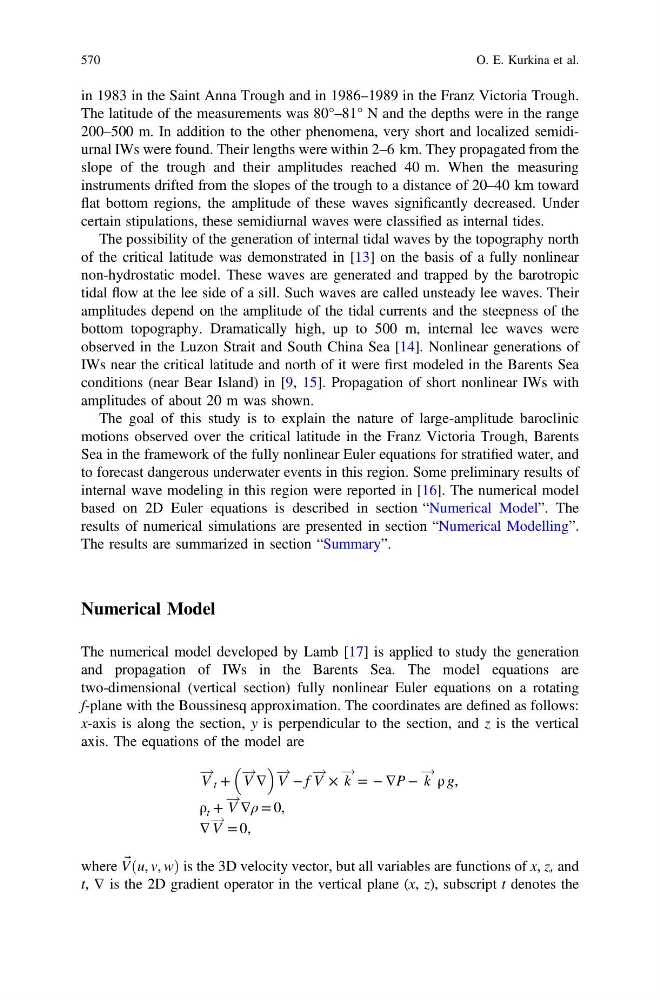
The numerical model developed by Lamb [17] is applied to study the generation
and propagation of IWs in the Barents Sea. The model equations are
two-dimensional (vertical section) fully nonlinear Euler equations on a rotating
f-plane with the Boussinesq approximation. The coordinates are defined as follows:
x-axis is along the section, y is perpendicular to the section, and z is the vertical
axis. The equations of the model are
V
!
t + V
!
∇
V
! − f V
! × k
! = − ∇P − k
! ρ g,
ρ t + V
!
∇ρ = 0,
∇ V
! = 0,
where V ⃗ u, v, w
ð
Þis the 3D velocity vector, but all variables are functions of x, z, and
t, ∇ is the 2D gradient operator in the vertical plane (x, z), subscript t denotes the
570
O. E. Kurkina et al.