

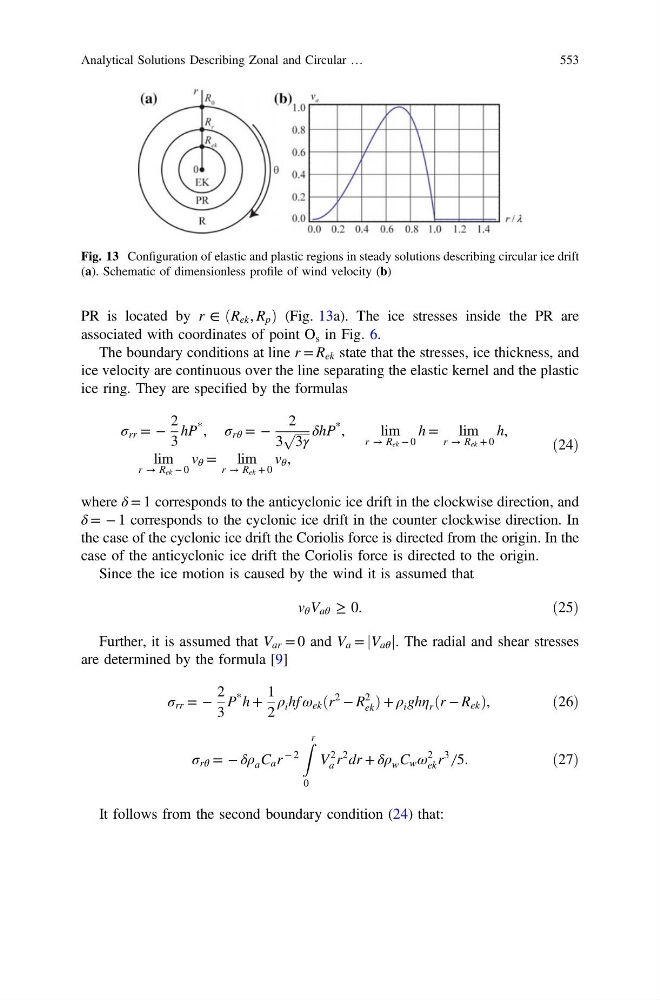
PR is located by r ∈ ðR ek , R p Þ (Fig. 13a). The ice stresses inside the PR are
associated with coordinates of point O s in Fig. 6.
The boundary conditions at line r = R ek state that the stresses, ice thickness, and
ice velocity are continuous over the line separating the elastic kernel and the plastic
ice ring. They are specified by the formulas
σ rr = −
2
3
hP
* , σ rθ = −
2
3
ffiffiffiffiffi
3γ
p δhP
* ,
lim
r → R ek − 0
h = lim
r → R ek + 0
h,
lim
r → R ek − 0
v θ = lim
r → R ek + 0
v θ ,
ð24Þ
where δ = 1 corresponds to the anticyclonic ice drift in the clockwise direction, and
δ = − 1 corresponds to the cyclonic ice drift in the counter clockwise direction. In
the case of the cyclonic ice drift the Coriolis force is directed from the origin. In the
case of the anticyclonic ice drift the Coriolis force is directed to the origin.
Since the ice motion is caused by the wind it is assumed that
v θ V aθ ≥ 0.
ð25Þ
Further, it is assumed that V ar = 0 and V a = jV aθ j. The radial and shear stresses
are determined by the formula [9]
σ rr = −
2
3
P
* h +
1
2
ρ i hf ω ek ðr
2
− R
2
ek Þ + ρ i ghη r ðr − R ek Þ,
ð26Þ
σ rθ = − δρ a C a r
− 2
Z r
0
V
2
a r
2 dr + δρ w C w ω
2
ek r
3
̸ 5.
ð27Þ
It follows from the second boundary condition (24) that:
Fig. 13 Configuration of elastic and plastic regions in steady solutions describing circular ice drift
(a). Schematic of dimensionless profile of wind velocity (b)
Analytical Solutions Describing Zonal and Circular …
553
associated with coordinates of point O s in Fig. 6.
The boundary conditions at line r = R ek state that the stresses, ice thickness, and
ice velocity are continuous over the line separating the elastic kernel and the plastic
ice ring. They are specified by the formulas
σ rr = −
2
3
hP
* , σ rθ = −
2
3
ffiffiffiffiffi
3γ
p δhP
* ,
lim
r → R ek − 0
h = lim
r → R ek + 0
h,
lim
r → R ek − 0
v θ = lim
r → R ek + 0
v θ ,
ð24Þ
where δ = 1 corresponds to the anticyclonic ice drift in the clockwise direction, and
δ = − 1 corresponds to the cyclonic ice drift in the counter clockwise direction. In
the case of the cyclonic ice drift the Coriolis force is directed from the origin. In the
case of the anticyclonic ice drift the Coriolis force is directed to the origin.
Since the ice motion is caused by the wind it is assumed that
v θ V aθ ≥ 0.
ð25Þ
Further, it is assumed that V ar = 0 and V a = jV aθ j. The radial and shear stresses
are determined by the formula [9]
σ rr = −
2
3
P
* h +
1
2
ρ i hf ω ek ðr
2
− R
2
ek Þ + ρ i ghη r ðr − R ek Þ,
ð26Þ
σ rθ = − δρ a C a r
− 2
Z r
0
V
2
a r
2 dr + δρ w C w ω
2
ek r
3
̸ 5.
ð27Þ
It follows from the second boundary condition (24) that:
Fig. 13 Configuration of elastic and plastic regions in steady solutions describing circular ice drift
(a). Schematic of dimensionless profile of wind velocity (b)
Analytical Solutions Describing Zonal and Circular …
553