

The ES speed v y depends only on the rheological constant γ and doesn’t depend
on P
* . The ES width Δx depends on both rheological constants. The ES speed v y
and width Δx are shown respectively in Fig. 10 and Fig. 11 versus sea surface tilt.
They are calculated with different values of the onshore wind speed and wind
direction. The ES speed v y decreases with the decrease of the wind speed and sea
surface tilt. The ice thickness increase influences the decrease of the ice ES speed.
The ES width increases with the increase of the sea surface tilt and ice thickness and
decreases with the increase of the wind speed. The maximum values of the ES
speed and width are reached when the wind is parallel to the ice edge.
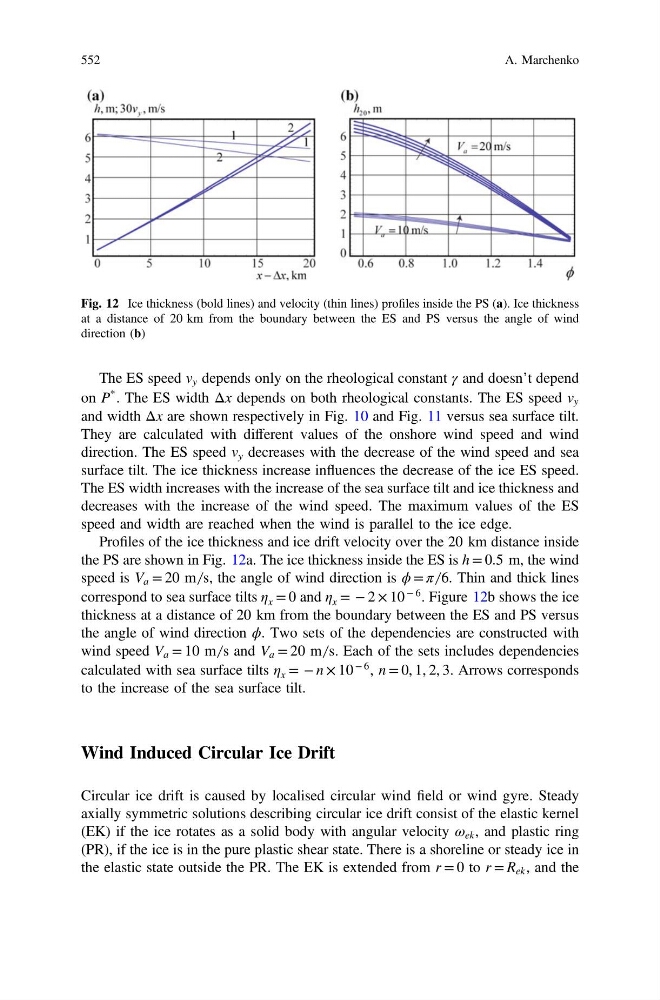
Profiles of the ice thickness and ice drift velocity over the 20 km distance inside
the PS are shown in Fig. 12a. The ice thickness inside the ES is h = 0.5 m, the wind
speed is V a = 20 m ̸ s, the angle of wind direction is ϕ = π ̸ 6. Thin and thick lines
correspond to sea surface tilts η x = 0 and η x = − 2 × 10
− 6 . Figure 12b shows the ice
thickness at a distance of 20 km from the boundary between the ES and PS versus
the angle of wind direction ϕ. Two sets of the dependencies are constructed with
wind speed V a = 10 m ̸ s and V a = 20 m ̸ s. Each of the sets includes dependencies
calculated with sea surface tilts η x = − n × 10
− 6 , n = 0, 1, 2, 3. Arrows corresponds
to the increase of the sea surface tilt.
Wind Induced Circular Ice Drift
Circular ice drift is caused by localised circular wind field or wind gyre. Steady
axially symmetric solutions describing circular ice drift consist of the elastic kernel
(EK) if the ice rotates as a solid body with angular velocity ω ek , and plastic ring
(PR), if the ice is in the pure plastic shear state. There is a shoreline or steady ice in
the elastic state outside the PR. The EK is extended from r = 0 to r = R ek , and the
Fig. 12 Ice thickness (bold lines) and velocity (thin lines) profiles inside the PS (a). Ice thickness
at a distance of 20 km from the boundary between the ES and PS versus the angle of wind
direction (b)
552
A. Marchenko
on P
* . The ES width Δx depends on both rheological constants. The ES speed v y
and width Δx are shown respectively in Fig. 10 and Fig. 11 versus sea surface tilt.
They are calculated with different values of the onshore wind speed and wind
direction. The ES speed v y decreases with the decrease of the wind speed and sea
surface tilt. The ice thickness increase influences the decrease of the ice ES speed.
The ES width increases with the increase of the sea surface tilt and ice thickness and
decreases with the increase of the wind speed. The maximum values of the ES
speed and width are reached when the wind is parallel to the ice edge.
Profiles of the ice thickness and ice drift velocity over the 20 km distance inside
the PS are shown in Fig. 12a. The ice thickness inside the ES is h = 0.5 m, the wind
speed is V a = 20 m ̸ s, the angle of wind direction is ϕ = π ̸ 6. Thin and thick lines
correspond to sea surface tilts η x = 0 and η x = − 2 × 10
− 6 . Figure 12b shows the ice
thickness at a distance of 20 km from the boundary between the ES and PS versus
the angle of wind direction ϕ. Two sets of the dependencies are constructed with
wind speed V a = 10 m ̸ s and V a = 20 m ̸ s. Each of the sets includes dependencies
calculated with sea surface tilts η x = − n × 10
− 6 , n = 0, 1, 2, 3. Arrows corresponds
to the increase of the sea surface tilt.
Wind Induced Circular Ice Drift
Circular ice drift is caused by localised circular wind field or wind gyre. Steady
axially symmetric solutions describing circular ice drift consist of the elastic kernel
(EK) if the ice rotates as a solid body with angular velocity ω ek , and plastic ring
(PR), if the ice is in the pure plastic shear state. There is a shoreline or steady ice in
the elastic state outside the PR. The EK is extended from r = 0 to r = R ek , and the
Fig. 12 Ice thickness (bold lines) and velocity (thin lines) profiles inside the PS (a). Ice thickness
at a distance of 20 km from the boundary between the ES and PS versus the angle of wind
direction (b)
552
A. Marchenko