

indicate that these anomalies were caused by strong southeasterly winds over the
EBS shelf, which raise the sea level along the Alaskan coast and enhance transport
of the warm and fresh waters through the Spanberg Strait.
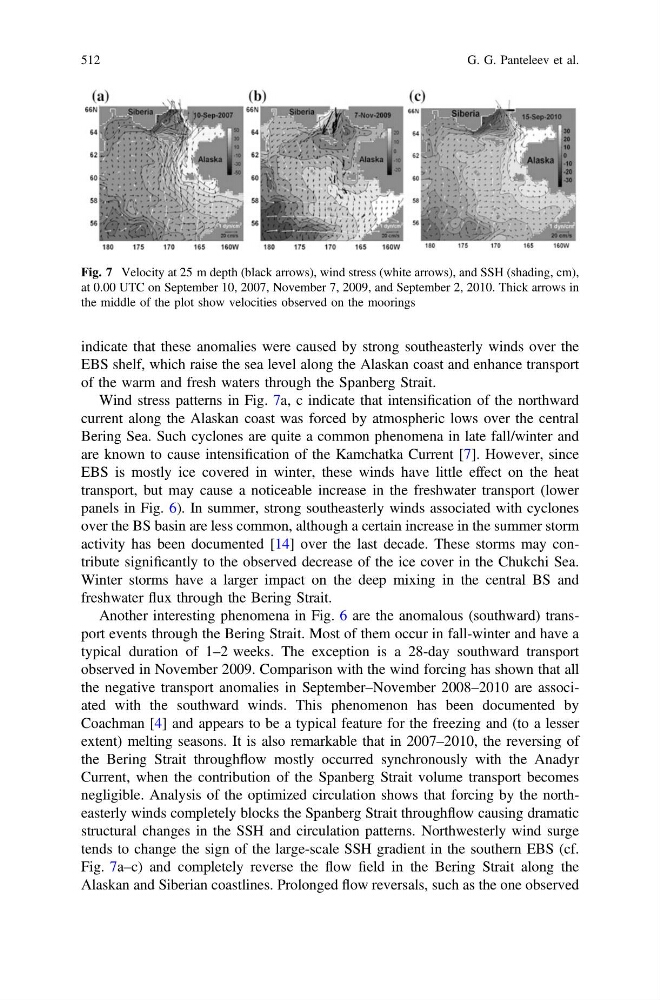
Wind stress patterns in Fig. 7a, c indicate that intensification of the northward
current along the Alaskan coast was forced by atmospheric lows over the central
Bering Sea. Such cyclones are quite a common phenomena in late fall/winter and
are known to cause intensification of the Kamchatka Current [7]. However, since
EBS is mostly ice covered in winter, these winds have little effect on the heat
transport, but may cause a noticeable increase in the freshwater transport (lower
panels in Fig. 6). In summer, strong southeasterly winds associated with cyclones
over the BS basin are less common, although a certain increase in the summer storm
activity has been documented [14] over the last decade. These storms may contribute significantly to the observed decrease of the ice cover in the Chukchi Sea.
Winter storms have a larger impact on the deep mixing in the central BS and
freshwater flux through the Bering Strait.
Another interesting phenomena in Fig. 6 are the anomalous (southward) transport events through the Bering Strait. Most of them occur in fall-winter and have a
typical duration of 1–2 weeks. The exception is a 28-day southward transport
observed in November 2009. Comparison with the wind forcing has shown that all
the negative transport anomalies in September–November 2008–2010 are associated with the southward winds. This phenomenon has been documented by
Coachman [4] and appears to be a typical feature for the freezing and (to a lesser
extent) melting seasons. It is also remarkable that in 2007–2010, the reversing of
the Bering Strait throughflow mostly occurred synchronously with the Anadyr
Current, when the contribution of the Spanberg Strait volume transport becomes
negligible. Analysis of the optimized circulation shows that forcing by the northeasterly winds completely blocks the Spanberg Strait throughflow causing dramatic
structural changes in the SSH and circulation patterns. Northwesterly wind surge
tends to change the sign of the large-scale SSH gradient in the southern EBS (cf.
Fig. 7a–c) and completely reverse the flow field in the Bering Strait along the
Alaskan and Siberian coastlines. Prolonged flow reversals, such as the one observed
Fig. 7 Velocity at 25 m depth (black arrows), wind stress (white arrows), and SSH (shading, cm),
at 0.00 UTC on September 10, 2007, November 7, 2009, and September 2, 2010. Thick arrows in
the middle of the plot show velocities observed on the moorings
512
G. G. Panteleev et al.
EBS shelf, which raise the sea level along the Alaskan coast and enhance transport
of the warm and fresh waters through the Spanberg Strait.
Wind stress patterns in Fig. 7a, c indicate that intensification of the northward
current along the Alaskan coast was forced by atmospheric lows over the central
Bering Sea. Such cyclones are quite a common phenomena in late fall/winter and
are known to cause intensification of the Kamchatka Current [7]. However, since
EBS is mostly ice covered in winter, these winds have little effect on the heat
transport, but may cause a noticeable increase in the freshwater transport (lower
panels in Fig. 6). In summer, strong southeasterly winds associated with cyclones
over the BS basin are less common, although a certain increase in the summer storm
activity has been documented [14] over the last decade. These storms may contribute significantly to the observed decrease of the ice cover in the Chukchi Sea.
Winter storms have a larger impact on the deep mixing in the central BS and
freshwater flux through the Bering Strait.
Another interesting phenomena in Fig. 6 are the anomalous (southward) transport events through the Bering Strait. Most of them occur in fall-winter and have a
typical duration of 1–2 weeks. The exception is a 28-day southward transport
observed in November 2009. Comparison with the wind forcing has shown that all
the negative transport anomalies in September–November 2008–2010 are associated with the southward winds. This phenomenon has been documented by
Coachman [4] and appears to be a typical feature for the freezing and (to a lesser
extent) melting seasons. It is also remarkable that in 2007–2010, the reversing of
the Bering Strait throughflow mostly occurred synchronously with the Anadyr
Current, when the contribution of the Spanberg Strait volume transport becomes
negligible. Analysis of the optimized circulation shows that forcing by the northeasterly winds completely blocks the Spanberg Strait throughflow causing dramatic
structural changes in the SSH and circulation patterns. Northwesterly wind surge
tends to change the sign of the large-scale SSH gradient in the southern EBS (cf.
Fig. 7a–c) and completely reverse the flow field in the Bering Strait along the
Alaskan and Siberian coastlines. Prolonged flow reversals, such as the one observed
Fig. 7 Velocity at 25 m depth (black arrows), wind stress (white arrows), and SSH (shading, cm),
at 0.00 UTC on September 10, 2007, November 7, 2009, and September 2, 2010. Thick arrows in
the middle of the plot show velocities observed on the moorings
512
G. G. Panteleev et al.