

in November 2009, may have a significant impact on the EBS ecosystem by
affecting the residence times and displacing the cold pool (e.g. [3]) boundary which
is advected by the general southward flow clearly seen in Fig. 7b on a larger scale.
Water pathways and residence times. Analysis of trajectories of the Lagrangian
particles is a convenient approach to study the regional ecosystems (e.g. [2, 19]). It
could be also useful in the analysis of water mass pathways and their transformation
rates (e.g. [22]). In the analysis described below, we focus on two important subregions: the Unimak Strait (the easternmost passage from the open Pacific into the
EBS) and the BSC source region properly located north of Unalaska Island.
Lagrangian particles were released in each region once a week during 3.5 years.
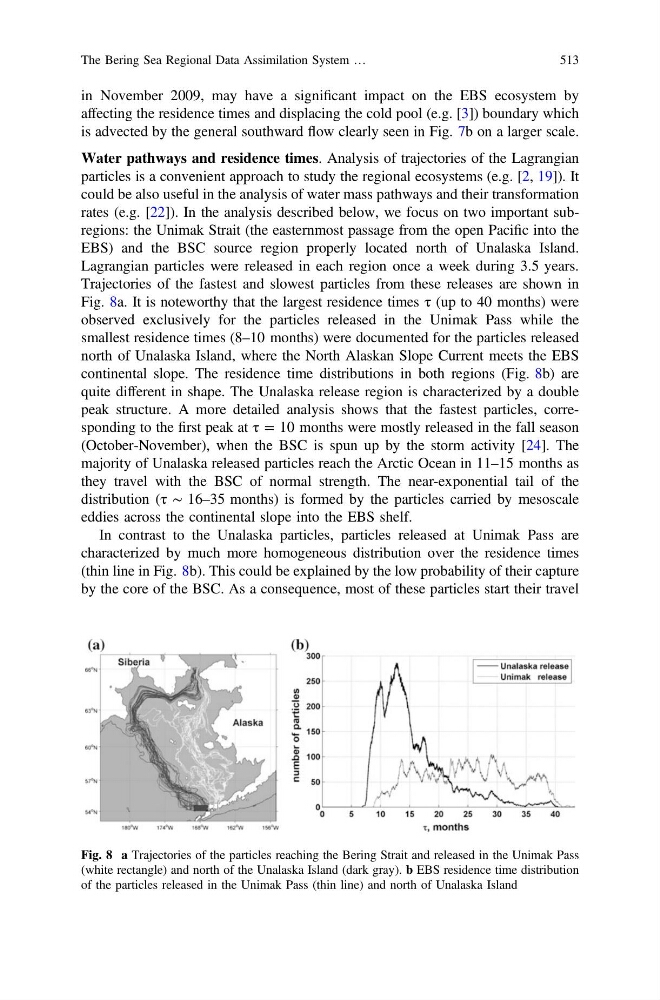
Trajectories of the fastest and slowest particles from these releases are shown in
Fig. 8a. It is noteworthy that the largest residence times τ (up to 40 months) were
observed exclusively for the particles released in the Unimak Pass while the
smallest residence times (8–10 months) were documented for the particles released
north of Unalaska Island, where the North Alaskan Slope Current meets the EBS
continental slope. The residence time distributions in both regions (Fig. 8b) are
quite different in shape. The Unalaska release region is characterized by a double
peak structure. A more detailed analysis shows that the fastest particles, corresponding to the first peak at τ = 10 months were mostly released in the fall season
(October-November), when the BSC is spun up by the storm activity [24]. The
majority of Unalaska released particles reach the Arctic Ocean in 11–15 months as
they travel with the BSC of normal strength. The near-exponential tail of the
distribution (τ ∼ 16–35 months) is formed by the particles carried by mesoscale
eddies across the continental slope into the EBS shelf.
In contrast to the Unalaska particles, particles released at Unimak Pass are
characterized by much more homogeneous distribution over the residence times
(thin line in Fig. 8b). This could be explained by the low probability of their capture
by the core of the BSC. As a consequence, most of these particles start their travel
Fig. 8 a Trajectories of the particles reaching the Bering Strait and released in the Unimak Pass
(white rectangle) and north of the Unalaska Island (dark gray). b EBS residence time distribution
of the particles released in the Unimak Pass (thin line) and north of Unalaska Island
The Bering Sea Regional Data Assimilation System …
513
affecting the residence times and displacing the cold pool (e.g. [3]) boundary which
is advected by the general southward flow clearly seen in Fig. 7b on a larger scale.
Water pathways and residence times. Analysis of trajectories of the Lagrangian
particles is a convenient approach to study the regional ecosystems (e.g. [2, 19]). It
could be also useful in the analysis of water mass pathways and their transformation
rates (e.g. [22]). In the analysis described below, we focus on two important subregions: the Unimak Strait (the easternmost passage from the open Pacific into the
EBS) and the BSC source region properly located north of Unalaska Island.
Lagrangian particles were released in each region once a week during 3.5 years.
Trajectories of the fastest and slowest particles from these releases are shown in
Fig. 8a. It is noteworthy that the largest residence times τ (up to 40 months) were
observed exclusively for the particles released in the Unimak Pass while the
smallest residence times (8–10 months) were documented for the particles released
north of Unalaska Island, where the North Alaskan Slope Current meets the EBS
continental slope. The residence time distributions in both regions (Fig. 8b) are
quite different in shape. The Unalaska release region is characterized by a double
peak structure. A more detailed analysis shows that the fastest particles, corresponding to the first peak at τ = 10 months were mostly released in the fall season
(October-November), when the BSC is spun up by the storm activity [24]. The
majority of Unalaska released particles reach the Arctic Ocean in 11–15 months as
they travel with the BSC of normal strength. The near-exponential tail of the
distribution (τ ∼ 16–35 months) is formed by the particles carried by mesoscale
eddies across the continental slope into the EBS shelf.
In contrast to the Unalaska particles, particles released at Unimak Pass are
characterized by much more homogeneous distribution over the residence times
(thin line in Fig. 8b). This could be explained by the low probability of their capture
by the core of the BSC. As a consequence, most of these particles start their travel
Fig. 8 a Trajectories of the particles reaching the Bering Strait and released in the Unimak Pass
(white rectangle) and north of the Unalaska Island (dark gray). b EBS residence time distribution
of the particles released in the Unimak Pass (thin line) and north of Unalaska Island
The Bering Sea Regional Data Assimilation System …
513