

Calculating FRAM’s Dead Water
45
Table 2 Speed U of FRAM, Reynolds number Re = Ul 0 ∕í µí¼, frictional resistance coefficient C F
obtained by the I.T.T.C. and A.T.T.C. lines
U
Re
C F (I.T.T.C.)
C F (A.T.T.C.)
5 knots
4.2 × 10 7
0.237 × 10 −2
0.236 × 10 −2
1 knots
0.84 × 10 7
0.309 × 10 −2
0.302 × 10 −2
convention. The balance (3) is obtained since the engine of FRAM was working at
full speed, without and with the dead water. The dead water resistance coefficient
may be obtained by
C dw = (U 1 ∕U 2 )
3 C F 1 − C F 2 ,
(4)
expressing C dw by C F 1 times the inverse speed reduction ratio cubed minus C F 2 .
The frictional resistance coefficients C F 1,2 are obtained from the I.T.T.C. (International Towing Tank Conference) and A.T.T.C. (American Towing Tank Conference)
empirical curves [14, Fig. 2.12]. The I.T.T.C. line is given by C F = 0.075∕(log 10 Re−
2)
2 and the A.T.T.C. line by 0.242∕
√
C F = log 10 (Re × C F ). Both curves depend on
the Reynolds number Re = Ul 0 ∕í µí¼, where U is the ship speed, l 0 = 30 m the ship
length of FRAM and í µí¼ = 1.79 ⋅ 10 −6 m 2 s −1 the kinematic viscosity of the water at
0
◦ C. Values of Re and C F for the actual ship speeds are given in Table 2 where the
average values of the I.T.T.C. and A.T.T.C. lines are used in the calculations.
0.5
0.52
0.54
0.56
0.58
0.6
0
0.05
0.1
0.15
0.2
C dw
(b 0 /h 0 ) 2
U 2 /c 0 = F r
U1 = 5 knots
U1 = 4.5 knots
b0
h0
=
5
4
b0
h0
= 1
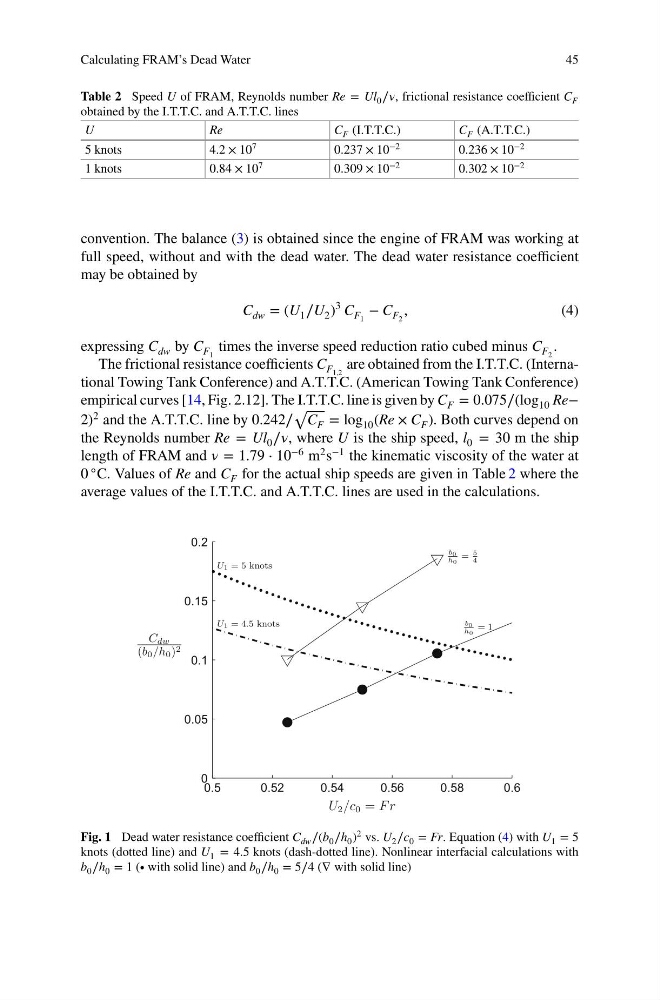
Fig. 1 Dead water resistance coefficient C dw ∕(b 0 ∕h 0 ) 2 vs. U 2 ∕c 0 = Fr. Equation (4) with U 1 = 5
knots (dotted line) and U 1 = 4.5 knots (dash-dotted line). Nonlinear interfacial calculations with
b 0 ∕h 0 = 1 (∙ with solid line) and b 0 ∕h 0 = 5∕4 (∇ with solid line)
45
Table 2 Speed U of FRAM, Reynolds number Re = Ul 0 ∕í µí¼, frictional resistance coefficient C F
obtained by the I.T.T.C. and A.T.T.C. lines
U
Re
C F (I.T.T.C.)
C F (A.T.T.C.)
5 knots
4.2 × 10 7
0.237 × 10 −2
0.236 × 10 −2
1 knots
0.84 × 10 7
0.309 × 10 −2
0.302 × 10 −2
convention. The balance (3) is obtained since the engine of FRAM was working at
full speed, without and with the dead water. The dead water resistance coefficient
may be obtained by
C dw = (U 1 ∕U 2 )
3 C F 1 − C F 2 ,
(4)
expressing C dw by C F 1 times the inverse speed reduction ratio cubed minus C F 2 .
The frictional resistance coefficients C F 1,2 are obtained from the I.T.T.C. (International Towing Tank Conference) and A.T.T.C. (American Towing Tank Conference)
empirical curves [14, Fig. 2.12]. The I.T.T.C. line is given by C F = 0.075∕(log 10 Re−
2)
2 and the A.T.T.C. line by 0.242∕
√
C F = log 10 (Re × C F ). Both curves depend on
the Reynolds number Re = Ul 0 ∕í µí¼, where U is the ship speed, l 0 = 30 m the ship
length of FRAM and í µí¼ = 1.79 ⋅ 10 −6 m 2 s −1 the kinematic viscosity of the water at
0
◦ C. Values of Re and C F for the actual ship speeds are given in Table 2 where the
average values of the I.T.T.C. and A.T.T.C. lines are used in the calculations.
0.5
0.52
0.54
0.56
0.58
0.6
0
0.05
0.1
0.15
0.2
C dw
(b 0 /h 0 ) 2
U 2 /c 0 = F r
U1 = 5 knots
U1 = 4.5 knots
b0
h0
=
5
4
b0
h0
= 1
Fig. 1 Dead water resistance coefficient C dw ∕(b 0 ∕h 0 ) 2 vs. U 2 ∕c 0 = Fr. Equation (4) with U 1 = 5
knots (dotted line) and U 1 = 4.5 knots (dash-dotted line). Nonlinear interfacial calculations with
b 0 ∕h 0 = 1 (∙ with solid line) and b 0 ∕h 0 = 5∕4 (∇ with solid line)