

44
J. Grue
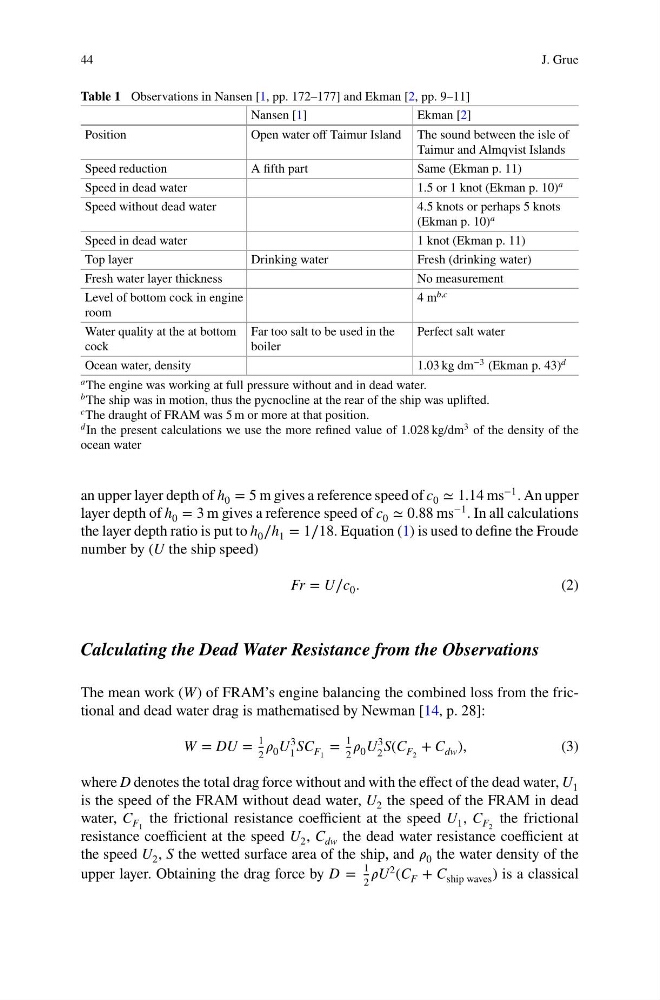
Table 1 Observations in Nansen [1, pp. 172–177] and Ekman [2, pp. 9–11]
Nansen [1]
Ekman [2]
Position
Open water off Taimur Island The sound between the isle of
Taimur and Almqvist Islands
Speed reduction
A fifth part
Same (Ekman p. 11)
Speed in dead water
1.5 or 1 knot (Ekman p. 10) a
Speed without dead water
4.5 knots or perhaps 5 knots
(Ekman p. 10)
a
Speed in dead water
1 knot (Ekman p. 11)
Top layer
Drinking water
Fresh (drinking water)
Fresh water layer thickness
No measurement
Level of bottom cock in engine
room
4 m b,c
Water quality at the at bottom
cock
Far too salt to be used in the
boiler
Perfect salt water
Ocean water, density
1.03 kg dm
−3 (Ekman p. 43)
d
a The engine was working at full pressure without and in dead water.
b The ship was in motion, thus the pycnocline at the rear of the ship was uplifted.
c The draught of FRAM was 5 m or more at that position.
d In the present calculations we use the more refined value of 1.028 kg/dm 3 of the density of the
ocean water
an upper layer depth of h 0 = 5 m gives a reference speed of c 0 ≃ 1.14 ms
−1 . An upper
layer depth of h 0 = 3 m gives a reference speed of c 0 ≃ 0.88 ms
−1 . In all calculations
the layer depth ratio is put to h 0 ∕h 1 = 1∕18. Equation (1) is used to define the Froude
number by (U the ship speed)
Fr = U∕c 0 .
(2)
Calculating the Dead Water Resistance from the Observations
The mean work (W) of FRAM’s engine balancing the combined loss from the frictional and dead water drag is mathematised by Newman [14, p. 28]:
W = DU =
1
2
í µí¼ 0 U
3
1
SC F 1 =
1
2
í µí¼ 0 U
3
2
S(C F 2 + C dw ),
(3)
where D denotes the total drag force without and with the effect of the dead water, U 1
is the speed of the FRAM without dead water, U 2 the speed of the FRAM in dead
water, C F 1 the frictional resistance coefficient at the speed U 1 , C F 2 the frictional
resistance coefficient at the speed U 2 , C dw the dead water resistance coefficient at
the speed U 2 , S the wetted surface area of the ship, and í µí¼ 0 the water density of the
upper layer. Obtaining the drag force by D =
1
2
í µí¼U
2
(C F + C ship waves ) is a classical
J. Grue
Table 1 Observations in Nansen [1, pp. 172–177] and Ekman [2, pp. 9–11]
Nansen [1]
Ekman [2]
Position
Open water off Taimur Island The sound between the isle of
Taimur and Almqvist Islands
Speed reduction
A fifth part
Same (Ekman p. 11)
Speed in dead water
1.5 or 1 knot (Ekman p. 10) a
Speed without dead water
4.5 knots or perhaps 5 knots
(Ekman p. 10)
a
Speed in dead water
1 knot (Ekman p. 11)
Top layer
Drinking water
Fresh (drinking water)
Fresh water layer thickness
No measurement
Level of bottom cock in engine
room
4 m b,c
Water quality at the at bottom
cock
Far too salt to be used in the
boiler
Perfect salt water
Ocean water, density
1.03 kg dm
−3 (Ekman p. 43)
d
a The engine was working at full pressure without and in dead water.
b The ship was in motion, thus the pycnocline at the rear of the ship was uplifted.
c The draught of FRAM was 5 m or more at that position.
d In the present calculations we use the more refined value of 1.028 kg/dm 3 of the density of the
ocean water
an upper layer depth of h 0 = 5 m gives a reference speed of c 0 ≃ 1.14 ms
−1 . An upper
layer depth of h 0 = 3 m gives a reference speed of c 0 ≃ 0.88 ms
−1 . In all calculations
the layer depth ratio is put to h 0 ∕h 1 = 1∕18. Equation (1) is used to define the Froude
number by (U the ship speed)
Fr = U∕c 0 .
(2)
Calculating the Dead Water Resistance from the Observations
The mean work (W) of FRAM’s engine balancing the combined loss from the frictional and dead water drag is mathematised by Newman [14, p. 28]:
W = DU =
1
2
í µí¼ 0 U
3
1
SC F 1 =
1
2
í µí¼ 0 U
3
2
S(C F 2 + C dw ),
(3)
where D denotes the total drag force without and with the effect of the dead water, U 1
is the speed of the FRAM without dead water, U 2 the speed of the FRAM in dead
water, C F 1 the frictional resistance coefficient at the speed U 1 , C F 2 the frictional
resistance coefficient at the speed U 2 , C dw the dead water resistance coefficient at
the speed U 2 , S the wetted surface area of the ship, and í µí¼ 0 the water density of the
upper layer. Obtaining the drag force by D =
1
2
í µí¼U
2
(C F + C ship waves ) is a classical